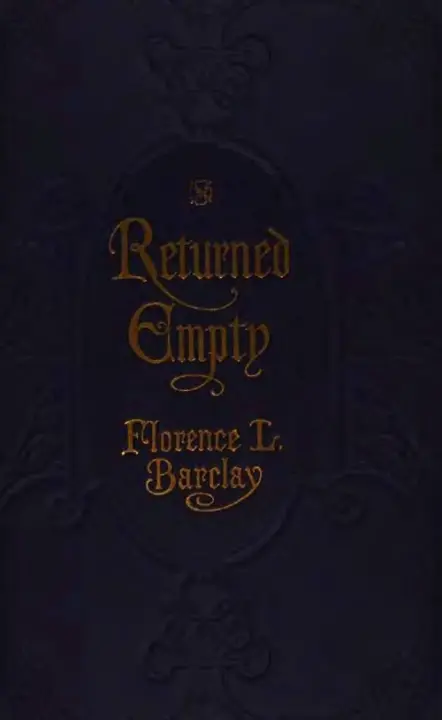
Returned Empty
Florence L. (Florence Louisa) Barclay
THE CLASSIC COLLECTION · 1912
"The Upas Tree: A Christmas Story for all the Year" by Florence L. Barclay is a fictional narrative written in the early 20th century. This work is centered around the lives of Ronald West and his wife Helen, exploring their relationship, ambitions, and the challenges they face as Ronald prepares to travel to Central Africa for his writing. The evocative title suggests themes of personal sacrifice, love, and the journey of self-discovery intertwined with Christmas sentimentality. The opening of the story sets the stage for the relationship dynamics between Ronald and Helen. It begins with Ronald contemplating how to discuss a significant matter with Helen, revealing that he wishes to travel to Africa to gather inspiration for a novel. Helen, who is depicted as supportive yet rational, expresses concerns about his decision and the potential separation it entails. As the couple navigates their feelings, the tension between personal aspirations and marital responsibilities unfolds, hinting at deeper themes of love and duty. The initial interaction establishes a strong emotional layer to their relationship, drawing readers into their world of longing, creativity, and impending separation.
Introduction adapted from the source catalogue; source summaries may be automatically generated.
Free to read · English · 43,301 words · No account needed
MAKE TIME FOR A GOOD BOOK
On by default. Untick to stop anonymous reading totals. Each page counts after 10 seconds in view. How this works.
Anonymous counting is on unless you have switched it off.
They each spoke at the same moment.
"It cannot be Ronnie," they said.
"It must be Ronnie," amended Helen. "There is no one else in the house."
"You go in," whispered Dick. "I will wait here. Call, if you want me. Don't startle him. Go in very softly. Be very--er--you know?"
Helen moved forward alone.
She laid her hand upon the handle of the studio door.
She wished the weird music within would cease for one moment, that she might feel more able to enter.
Cold shivers ran down her spine.
Try as she would, she could not connect that music with Ronnie.
Somebody else was also in the studio, of that she felt quite certain.
She nearly went back to Dick.
Then--rating herself for cowardice--she turned the handle of the door
and passed in.
Dick saw her disappear.
Almost at that moment the 'cello-playing ceased; there was a crash, a cry from Helen, a silence, and then--a wild shriek from Helen, a sound holding so much of fear and of horror, that Dick shouted in reply as he dashed forward.
He found himself in a low room, oak-panelled, lighted only by the uncertain flame a log-fire. The door by which Dick had centered was to the left of the fireplace. On the wall at the farther end of the room, opposite both door and fireplace, hung an immense mirror in a massive gilt frame.
On the floor in the centre of the room lay Ronnie, unconscious, on his back. The chair upon which he had been sitting and which had gone over backwards with him, lay broken beneath him. His 'cello rested on his chest. He gripped it there, with both his hands. They fell away from it, as Dick looked at him.
Ronnie's wife knelt on the floor beside him, but she was not looking at Ronnie. She was staring, with white face and starting eyes, into the mirror. Her left arm, stretched out before her, was rigid with horror, from the shoulder to the tip of the pointing finger.
"Look, Dick!" she shrieked. "Oh, heavens! Look!"
Dick flashed up the electric light; then looked into the mirror.
He saw himself loom large, dishevelled, grimy, travel-stained. Then he saw Ronnie and the Infant in a dark heap on the floor, and the white face of Ronnie's wife, kneeling beside him with outstretched arm and eyes upon the mirror. On the other side of Ronnie, in the very centre of the scene, stood a queer old chair of Italian workmanship, the heads of lions completing its curved arms, on its carved back the fleur-de-lis of Florence, its seat of padded leather, embossed in crimson and gold.
Your reading position is saved on this browser. Take it to another device with a library code. Reading pages adapt to text, rather than matching a printed edition.
Florence L. (Florence Louisa) Barclay

Florence L. (Florence Louisa) Barclay
Florence L. (Florence Louisa) Barclay
Florence L. (Florence Louisa) Barclay
BEHIND THE BOOK
This eBook is for the use of anyone anywhere in the United States and most other parts of the world at no cost and with almost no restrictions whatsoever. You may copy it, give it away or re-use it under the terms of the Project Gutenberg License included with this eBook or online at www.gutenberg.org. If you are not located in the United States, you will have to check the laws of the country where you are located before using this eBook. Read the source licence.
The original source file, including credits and licence, is retained by this library. Request an original-format copy at no charge. Please include the book title and Project Gutenberg identifier #16454.
KEEP YOUR CURIOSITY GOING
Coulson Kernahan

Maurice Baring
Frances Wright
Cécile Tormay

Frederic Jesup Stimson

W. H. P. (William Henry Pope) Jarvis