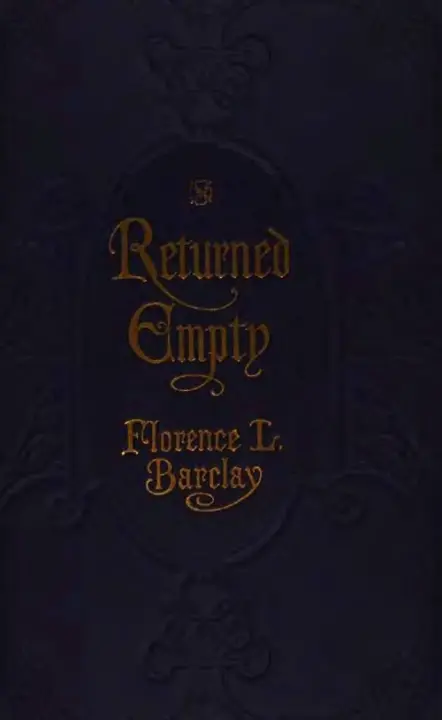
Returned Empty
Florence L. (Florence Louisa) Barclay
THE CLASSIC COLLECTION · 1912
"The Upas Tree: A Christmas Story for all the Year" by Florence L. Barclay is a fictional narrative written in the early 20th century. This work is centered around the lives of Ronald West and his wife Helen, exploring their relationship, ambitions, and the challenges they face as Ronald prepares to travel to Central Africa for his writing. The evocative title suggests themes of personal sacrifice, love, and the journey of self-discovery intertwined with Christmas sentimentality. The opening of the story sets the stage for the relationship dynamics between Ronald and Helen. It begins with Ronald contemplating how to discuss a significant matter with Helen, revealing that he wishes to travel to Africa to gather inspiration for a novel. Helen, who is depicted as supportive yet rational, expresses concerns about his decision and the potential separation it entails. As the couple navigates their feelings, the tension between personal aspirations and marital responsibilities unfolds, hinting at deeper themes of love and duty. The initial interaction establishes a strong emotional layer to their relationship, drawing readers into their world of longing, creativity, and impending separation.
Introduction adapted from the source catalogue; source summaries may be automatically generated.
Free to read · English · 43,301 words · No account needed
MAKE TIME FOR A GOOD BOOK
On by default. Untick to stop anonymous reading totals. Each page counts after 10 seconds in view. How this works.
Anonymous counting is on unless you have switched it off.
She waited for more.
It did not come. Ronnie was kissing her hair again.
"Were you glad when you had my letter, Ronnie?" she asked, very low.
"Which letter, sweet? I was always glad of every letter."
"Why, the last--the one to Leipzig."
"Ah, of course! Yes, I was very glad. I read it in your cousin's flat. I had just been showing him--oh, Helen! That reminds me--darling, I have something to show you! Such a jolly treasure--such a surprise! I left it in the hall. Would you like me to fetch it?"
He loosed his arms and she withdrew from them, looking up into his
glowing face.
"Yes, Ronnie," she said. "Why, certainly. Do fetch it."
He rushed off into the hall. He fumbled eagerly with the buckles of the canvas bag. It had never taken so long, to draw the precious Infant forth.
He held it up to the hall lights. He wanted to make sure that it was really as brown and as beautiful as it had always seemed to him.
Yes, it was as richly brown as the darkest horse-chestnut you ever saw
in a bursting bur!
He walked back into the sitting-room, carrying it proudly before him.
Helen had just lighted the spirit-lamp beneath the swinging kettle on the brass stand. Her face was rather white again.
"Here it is, Helen," he said. "The most beautiful 'cello you ever saw! It is one hundred and fifty years old. It was made at Prague. I paid a hundred and fifty pounds for it."
Helen looked.
"That was a good deal to pay for a 'cello," she said, yet conscious as she spoke that--even as Peter on the Mount--she had made the remark chiefly because she "wist not what to say."
"Not a bit!" said Ronnie. "A chap in the orchestra at the Hague, with a fine 'cello of his own, told me he had never in his life handled such a beauty. He considered it a wonderful bargain."
"It is a beauty," said Helen, pouring hot water from the urn into the teapot, with a hand which trembled.
Ronnie wheeled a third chair up to the low tea-table, opposite his own particular seat, leaned his 'cello up against it, sat down, put his elbows on his knees, and glowed at it with enthusiasm.
"I knew you would say so, darling. Ever since I bought it, after choosing your organ at Zimmermann's, I have been thinking of the moment when I should show it to you; though an even greater moment is coming for us soon, Helen."
"Yes, Ronnie."
"Look how the two silver strings shine in the firelight. I call it the
Infant of Prague."
Your reading position is saved on this browser. Take it to another device with a library code. Reading pages adapt to text, rather than matching a printed edition.
Florence L. (Florence Louisa) Barclay
Florence L. (Florence Louisa) Barclay
Florence L. (Florence Louisa) Barclay
Florence L. (Florence Louisa) Barclay
BEHIND THE BOOK
This eBook is for the use of anyone anywhere in the United States and most other parts of the world at no cost and with almost no restrictions whatsoever. You may copy it, give it away or re-use it under the terms of the Project Gutenberg License included with this eBook or online at www.gutenberg.org. If you are not located in the United States, you will have to check the laws of the country where you are located before using this eBook. Read the source licence.
The original source file, including credits and licence, is retained by this library. Request an original-format copy at no charge. Please include the book title and Project Gutenberg identifier #16454.
KEEP YOUR CURIOSITY GOING
Coulson Kernahan

Maurice Baring
Frances Wright
Cécile Tormay

Frederic Jesup Stimson

W. H. P. (William Henry Pope) Jarvis