THE CLASSIC COLLECTION✦The RetrospectCLASSIC FREE BOOKS
The Retrospect
Ada Cambridge
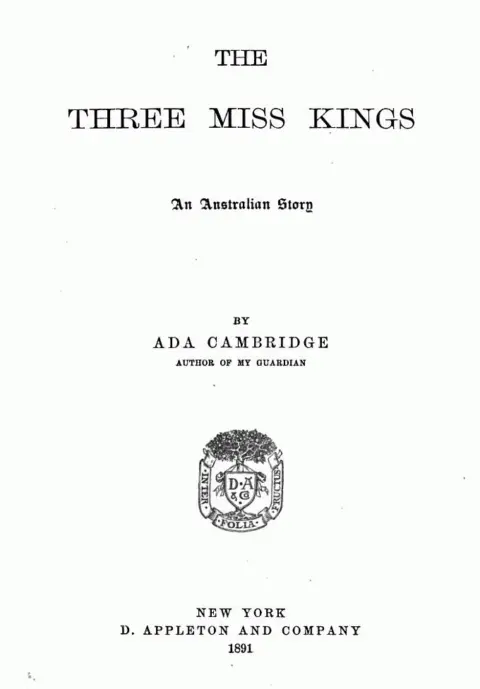
THE CLASSIC COLLECTION · 1891
"The Three Miss Kings: An Australian Story" by Ada Cambridge is a novel written in the late 19th century. It follows the lives of three orphaned sisters—Elizabeth, Patty, and Eleanor King—who find themselves alone in the world with limited financial means after the death of their parents. The story explores their struggles and aspirations as they decide to leave their isolated childhood home to start anew in Melbourne, seeking independence and a broader understanding of life. At the start of the narrative, the sisters reflect on their newfound independence and the choices that lie ahead. They debate potential plans, from traveling to Europe to simply settling in Melbourne, showcasing their varying personalities; Patty is impulsive and eager for adventure, while Elizabeth is more cautious and pragmatic. The depiction of their home environment, including the picturesque yet lonely setting by the Southern Ocean, emphasizes their sheltered upbringing. The challenges they face highlight their naiveté, but also their resilience as they prepare for the transition into a bustling urban life, ready to embrace the unknown that awaits them.
Introduction adapted from the source catalogue; source summaries may be automatically generated.
Free to read · English · 134,667 words · No account needed
MAKE TIME FOR A GOOD BOOK
On by default. Untick to stop anonymous reading totals. Each page counts after 10 seconds in view. How this works.
Anonymous counting is on unless you have switched it off.
It was a pity that Paul Brion, looking at Patty's charming figure in the gaslight, could not have looked into her heart. It is a pity, for us all, that there is no Palace of Truth amongst our sacred edifices, into which we could go--say, once a week--and show ourselves as we are to our neighbours and ourselves. If we could know our friends from our enemies, whom to trust and whom to shun--if we could vindicate ourselves from the false testimony of appearances in the eyes of those whom we love and by whom we desire to be loved--not to speak of larger privileges--what a different world it would be! But we can't, unfortunately. And so Paul carried away with him the impression that his Patty had become a fine lady--too fine to have any longer a thought for him--than which he had never conceived a baser calumny in his life.
Nor was he the only one who misread her superficial aspect that night. Mrs. Duff-Scott, the most discerning of women, had a fixed belief that her girls, all of them, thoroughly enjoyed their first ball. From the moment that they entered the room, a few minutes in advance of the Governor's party, received by a dozen or two of hosts drawn up in line on either side of the doorway, it was patent to her that they would do her every sort of credit; and this anticipation, at any rate, was abundantly realised. For the greater part of the evening she herself was enthroned under the gallery, which roofed a series of small drawing-rooms on this occasion, eminently adapted to matronly requirements; and from her arm-chair or sofa corner she looked out through curtains of æsthetic hues upon the pretty scene which had almost as fresh an interest for her to-night as it had for them. And no mother could have been more proud than she when one or other was taken from her side by the most eligible and satisfactory partners, or when for brief minutes they came back to her and gave her an opportunity to pull out a fold or a frill that had become disarranged, or when at intervals during their absence she caught sight of them amongst the throng, looking so distinguished in their expensively simple toilettes--those unpretending white muslins upon which she had not hesitated to spend the price of her own black velvet and Venetian point, whereof the costly richness was obvious to the least instructed observer--and evidently receiving as much homage and attention as they well knew what to do with. Now it was Eleanor going by on the arm of a naval foreigner, to whom she was chatting in that pure German (or equally pure French) that was one of her unaccountable accomplishments, or dancing as if she had danced from childhood with a more important somebody else. Now it was Patty, sitting bowered in azaleas on the steps under the great organ, while the Austrian band (bowered almost out of sight) discoursed Strauss waltzes over her head, and Mr. Smith sat in a significant attitude on the crimson carpet at her feet. And again it was Elizabeth, up in the gallery, which was a forest of fern trees to-night, sitting under the shade of the great green fronds with Mr. Yelverton, who had such an evident partiality for her society. Strange to say, Mrs. Duff-Scott, acute as she was in such matters, had never thought of Mr. Yelverton as a possible husband, and did not so think of him now--while noting his proceedings. She was taking so deep an interest in him as a philanthropist and social philosopher that she forgot he might have other and less exceptional characteristics; and she left off scheming for Elizabeth when Mr. Smith made choice of Patty, and was fully occupied in her manoeuvres and anxieties for the welfare of the younger sisters. That Patty should be the second Mrs. Smith she had quite made up her mind, and that Eleanor should be Mrs. Westmoreland was equally a settled thing. With these two affairs approaching a crisis together, she had quite enough to think of; and, with the prospect of losing two of her children so soon after becoming possessed of them, she was naturally in no hurry to deprive herself of the third. She was beginning to regard Elizabeth as destined to be her surviving comfort when the others were gone, and therefore abandoned all matrimonial projects on her behalf. Concerning Patty, the fairy godmother felt that her mind was at rest; half-a-dozen times in an hour and a half did she see the girl in some sort of association with Mr. Smith--who finally took her in to supper, and from supper to the cloak-room and carriage. For her she had reached the question of the trousseau and whom she would invite for bridesmaids. About Eleanor she was not so easy. It did not seem that Mr. Westmoreland lived up to his privileges; he did not dance with her at all, and was remarkably attentive to a plain heiress in a vulgar satin gown and diamonds. However, that was nothing. The bachelors of the club had all the roomful to entertain, and were obliged to lay aside their private preferences for the occasion. He had made his attentions to Eleanor so conspicuous that his proposal was only required as a matter of form; and Mrs. Duff-Scott felt that she would rather get the fuss of one engagement over before another came on. So, when the dissipations of the night were past, she retired from the field with a pleasant sense of almost unalloyed success, and fondly believed that her pretty protégées were as satisfied with the situation as she was.
Your reading position is saved on this browser. Take it to another device with a library code. Reading pages adapt to text, rather than matching a printed edition.
Ada Cambridge
Ada Cambridge
Ada Cambridge
Ada Cambridge
BEHIND THE BOOK
This eBook is for the use of anyone anywhere in the United States and most other parts of the world at no cost and with almost no restrictions whatsoever. You may copy it, give it away or re-use it under the terms of the Project Gutenberg License included with this eBook or online at www.gutenberg.org. If you are not located in the United States, you will have to check the laws of the country where you are located before using this eBook. Read the source licence.
The original source file, including credits and licence, is retained by this library. Request an original-format copy at no charge. Please include the book title and Project Gutenberg identifier #50476.
KEEP YOUR CURIOSITY GOING
Cécile Tormay

Moritz Busch
Coulson Kernahan
John L. Ransom

Maurice Baring
Frances Wright