THE CLASSIC COLLECTION✦The RetrospectCLASSIC FREE BOOKS
The Retrospect
Ada Cambridge
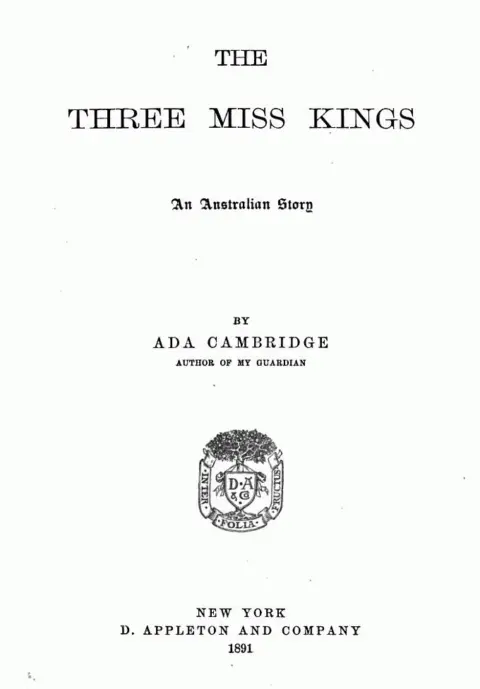
THE CLASSIC COLLECTION · 1891
"The Three Miss Kings: An Australian Story" by Ada Cambridge is a novel written in the late 19th century. It follows the lives of three orphaned sisters—Elizabeth, Patty, and Eleanor King—who find themselves alone in the world with limited financial means after the death of their parents. The story explores their struggles and aspirations as they decide to leave their isolated childhood home to start anew in Melbourne, seeking independence and a broader understanding of life. At the start of the narrative, the sisters reflect on their newfound independence and the choices that lie ahead. They debate potential plans, from traveling to Europe to simply settling in Melbourne, showcasing their varying personalities; Patty is impulsive and eager for adventure, while Elizabeth is more cautious and pragmatic. The depiction of their home environment, including the picturesque yet lonely setting by the Southern Ocean, emphasizes their sheltered upbringing. The challenges they face highlight their naiveté, but also their resilience as they prepare for the transition into a bustling urban life, ready to embrace the unknown that awaits them.
Introduction adapted from the source catalogue; source summaries may be automatically generated.
Free to read · English · 134,667 words · No account needed
MAKE TIME FOR A GOOD BOOK
On by default. Untick to stop anonymous reading totals. Each page counts after 10 seconds in view. How this works.
Anonymous counting is on unless you have switched it off.
Eleanor, like Patty, withstood the seductions of English life and miscellaneous English admirers, and lived to be Miss Yelverton in her turn, unappropriated and independent. And, like both her sisters, though more by accident than of deliberate intention, she remained true to her first love, and, after seeing the world and supping full of pleasure and luxury, returned to Melbourne and married Mr. Westmoreland. That is to say, Mr. Westmoreland followed her to England, and followed her all over Europe--dogging her from place to place with a steadfast persistence that certainly deserved reward--until the major and Mrs. Duff-Scott, returning home almost immediately after Patty's marriage and departure, brought their one ewe lamb, which the Yelvertons had not the conscience to immediately deprive them of, back to Australia with them; when her persevering suitor promptly took his passage in the same ship. All this time Mr. Westmoreland had been as much in love as his capacity for the tender passion--much larger than was generally supposed--permitted. Whether it was that she was the only woman who dared to bully him and trample on him, and thereby won his admiration and respect--or whether his passion required that the object of it should be difficult of attainment--or whether her grace and beauty were literally irresistible to him--or whether he was merely the sport of that unaccountable fate which seems to govern or misgovern these affairs, it is not necessary to conjecture. No one asks for reasons when a man or woman falls a victim to this sort of infatuation. Some said it was because she had become rich and grand, but that was not the case--except in so far as the change in her social circumstances had made her tyrannical and impudent, in which sense wealth and consequence had certainly enhanced her attractions in his eyes. Thirty thousand pounds, though a very respectable marriage portion in England, is not sufficient to make a fortune-hunter of an Australian suitor in his position; and let me do the Australian suitor of all ranks justice and here state that fortune hunting, through the medium of matrimony, is a weakness that his worst enemy cannot accuse him of--whatever his other faults may be. Mr. Westmoreland, being fond of money, as a constitutional and hereditary peculiarity--if you can call that a peculiarity--was tempted to marry it once, when that stout and swarthy person in the satin gown and diamonds exercised her fascinations on him at the club ball, and he could have married it at any time of his bachelor life, the above possessor of it being, like Barkis, "willin'", and even more than "willin'". Her fortune was such that Eleanor's thirty thousand was but a drop in the bucket compared with it, and yet even he did not value it in comparison with the favour of that capricious young lady. So he followed her about from day to day and from place to place, as if he had no other aim in life than to keep her within sight, making himself an insufferable nuisance to her friends very often, but apparently not offending her by his open and inveterate pursuit. She was not kind, but she was not cruel, and yet she was both in turn to a distracting degree. She made his life an ecstasy of miserable longing for her, keeping him by her side like a big dog on a chain, and feeding him with stones (in the prettiest manner) when he asked for bread. But she grew very partial to her big dog in the process of tormenting him and witnessing his touching patience under it. She was "used to him," she said; and when, from some untoward circumstance over which he had no control, he was for a little while absent from her, she felt the gap he left. She sensibly missed him. Moreover, though she trampled on him herself, it hurt her to see others do it; and when Mrs. Duff-Scott and Kingscote Yelverton respectively aired their opinions of his character and conduct, she instantly went over to his side, and protested in her heart, if not in words, against the injustice and opprobrium that he incurred for her sake. So, when Elizabeth became the much-occupied mother of a family, and when Patty was married and gone off into the world with her Paul, Eleanor, left alone in her independence, began to reckon up what it was worth. The spectacle of her sisters' wedded lives gave her pleasant notions of matrimony, and the state of single blessedness, as such, never had any particular charms for her. Was it worth while, she asked herself, to be cruel any more?--and might she not just as well have a house and home of her own as Elizabeth and Patty? Her lover was only a big dog upon a chain, but then why shouldn't he be? Husbands were not required to be all of the same pattern. She didn't want to be domineered over. And she didn't see anybody she liked better. She might go farther and fare worse. And--she was getting older every day.
Your reading position is saved on this browser. Take it to another device with a library code. Reading pages adapt to text, rather than matching a printed edition.
Ada Cambridge
Ada Cambridge
Ada Cambridge
Ada Cambridge
BEHIND THE BOOK
This eBook is for the use of anyone anywhere in the United States and most other parts of the world at no cost and with almost no restrictions whatsoever. You may copy it, give it away or re-use it under the terms of the Project Gutenberg License included with this eBook or online at www.gutenberg.org. If you are not located in the United States, you will have to check the laws of the country where you are located before using this eBook. Read the source licence.
The original source file, including credits and licence, is retained by this library. Request an original-format copy at no charge. Please include the book title and Project Gutenberg identifier #50476.
KEEP YOUR CURIOSITY GOING
Cécile Tormay

Moritz Busch
Coulson Kernahan
John L. Ransom

Maurice Baring
Frances Wright