THE CLASSIC COLLECTION✦The RetrospectCLASSIC FREE BOOKS
The Retrospect
Ada Cambridge
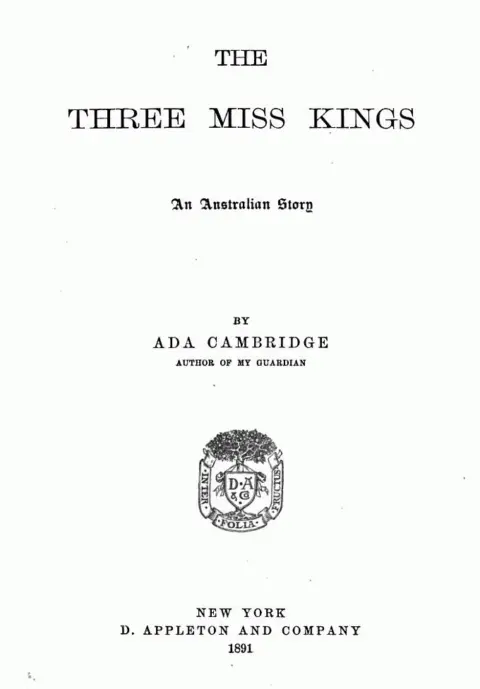
THE CLASSIC COLLECTION · 1891
"The Three Miss Kings: An Australian Story" by Ada Cambridge is a novel written in the late 19th century. It follows the lives of three orphaned sisters—Elizabeth, Patty, and Eleanor King—who find themselves alone in the world with limited financial means after the death of their parents. The story explores their struggles and aspirations as they decide to leave their isolated childhood home to start anew in Melbourne, seeking independence and a broader understanding of life. At the start of the narrative, the sisters reflect on their newfound independence and the choices that lie ahead. They debate potential plans, from traveling to Europe to simply settling in Melbourne, showcasing their varying personalities; Patty is impulsive and eager for adventure, while Elizabeth is more cautious and pragmatic. The depiction of their home environment, including the picturesque yet lonely setting by the Southern Ocean, emphasizes their sheltered upbringing. The challenges they face highlight their naiveté, but also their resilience as they prepare for the transition into a bustling urban life, ready to embrace the unknown that awaits them.
Introduction adapted from the source catalogue; source summaries may be automatically generated.
Free to read · English · 134,667 words · No account needed
MAKE TIME FOR A GOOD BOOK
On by default. Untick to stop anonymous reading totals. Each page counts after 10 seconds in view. How this works.
Anonymous counting is on unless you have switched it off.
But she was wrong. She was mistaken about them all--and most of all about Patty. When she first came into the room, and the fairy-land effect of the decorations burst upon her--when she passed up the lane of bachelor hosts, running the gauntlet of their respectful but admiring observation, like a young queen receiving homage--when the little major took her for a slow promenade round the hall and made her pause for a moment in front of one of the great mirrors that flanked the flowery orchestra, to show her herself in full length and in the most charming relief against her brilliant surroundings--the girl certainly did enjoy herself in a manner that bordered closely upon intoxication. She said very little, but her eyes were radiant and her whole face and figure rapturous, all her delicate soul spread out like a flower opened to the sunshine under the sensuous and artistic influences thus suddenly poured upon her. And then, after an interval of vague wonder as to what it was that was missing from the completeness of her pleasure--what it was that, being absent, spoiled the flavour of it all--there came an overpowering longing for her lover's presence and companionship, that lover without whom few balls are worth the trouble of dressing for, unless I am much mistaken. And after she found out that she wanted Paul Brion, who was not there, her gaiety became an excited restlessness, and her enjoyment of the pretty scene around her changed to passionate discontent. Why was he not there? She curled her lip in indignant scorn. Because he was poor, and a worker for his bread, and therefore was not accounted the equal of Mr. Westmoreland and Mr. Smith. She was too young and ardent to take into account the multitudes of other reasons which entirely removed it from the sphere of social grievances; like many another woman, she could see only one side of a subject at a time, and looked at that through a telescope. It seemed to her a despicably vulgar thing, and an indication of the utter rottenness of the whole fabric of society, that a high-born man of distinguished attainments should by common consent be neglected and despised simply because he was not rich. That was how she looked at it. And if Paul Brion had not been thought good enough for a select assembly, why had she been invited? Her answer to this question was a still more painful testimony to the generally improper state of things, and brought her to long for her own legitimate and humble environment, in which she could enjoy her independence and self-respect, and (which was the idea that tantalised her most just now) solace her lover with Beethoven sonatas when he was tired of writing, and wanted a rest. From the longing to see him in the ballroom, to have him with her as other girls had their natural counterparts, to share with her in the various delights of this great occasion, she fell to longing to go home to him--to belong to Myrtle Street and obscurity again, just as he did, and because he did. Why should she be listening to the Austrian band, eating ices and strawberries, rustling to and fro amongst the flowers and fine ladies, flaunting herself in this dazzling crowd of rich and idle people, while he plodded at his desk or smoked a lonely pipe on his balcony, out of it all, and with nothing to cheer him? Then the memory of their estrangement, and how it had come about, and how little chance there seemed now of any return to old relations and those blessed opportunities that she had so perversely thrown away, wrought upon her high-strung nerves, and inspired her with a kind of heroism of despair. Poor, thin-skinned Patty! She was sensitive to circumstances to a degree that almost merited the term "morbid," which is so convenient as a description of people of that sort. A ray of sunshine would light up the whole world, and show her her own pathway in it, shining into the farthest future with a divine effulgence of happiness and success; and the patter of rain upon the window on a dark day could beat down hope and discourage effort as effectually as if its natural mission were to bring misfortune. At one moment she would be inflated with a proud belief in herself and her own value and dignity, that gave her the strength of a giant to be and do and suffer; and then, at some little touch of failure, some discovery that she was mortal and a woman liable to blunder, as were other women, she would collapse into nothing and fling herself into the abysses of shame and self-condemnation as a worthless and useless thing. When this happened, her only chance of rescue and restoration in her own esteem was to do penance in some striking shape--to prove herself to herself as having some genuineness of moral substance in her, though it were only to own honestly how little it was. It was above all things necessary to her to have her own good opinion; what others thought of her was comparatively of no consequence.
Your reading position is saved on this browser. Take it to another device with a library code. Reading pages adapt to text, rather than matching a printed edition.
Ada Cambridge
Ada Cambridge
Ada Cambridge
Ada Cambridge
BEHIND THE BOOK
This eBook is for the use of anyone anywhere in the United States and most other parts of the world at no cost and with almost no restrictions whatsoever. You may copy it, give it away or re-use it under the terms of the Project Gutenberg License included with this eBook or online at www.gutenberg.org. If you are not located in the United States, you will have to check the laws of the country where you are located before using this eBook. Read the source licence.
The original source file, including credits and licence, is retained by this library. Request an original-format copy at no charge. Please include the book title and Project Gutenberg identifier #50476.
KEEP YOUR CURIOSITY GOING
Cécile Tormay

Moritz Busch
Coulson Kernahan
John L. Ransom

Maurice Baring
Frances Wright