THE CLASSIC COLLECTION✦The RetrospectCLASSIC FREE BOOKS
The Retrospect
Ada Cambridge
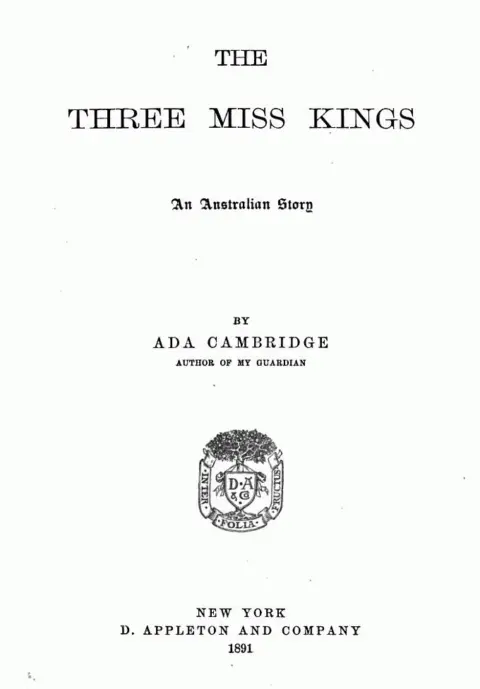
THE CLASSIC COLLECTION · 1891
"The Three Miss Kings: An Australian Story" by Ada Cambridge is a novel written in the late 19th century. It follows the lives of three orphaned sisters—Elizabeth, Patty, and Eleanor King—who find themselves alone in the world with limited financial means after the death of their parents. The story explores their struggles and aspirations as they decide to leave their isolated childhood home to start anew in Melbourne, seeking independence and a broader understanding of life. At the start of the narrative, the sisters reflect on their newfound independence and the choices that lie ahead. They debate potential plans, from traveling to Europe to simply settling in Melbourne, showcasing their varying personalities; Patty is impulsive and eager for adventure, while Elizabeth is more cautious and pragmatic. The depiction of their home environment, including the picturesque yet lonely setting by the Southern Ocean, emphasizes their sheltered upbringing. The challenges they face highlight their naiveté, but also their resilience as they prepare for the transition into a bustling urban life, ready to embrace the unknown that awaits them.
Introduction adapted from the source catalogue; source summaries may be automatically generated.
Free to read · English · 134,667 words · No account needed
MAKE TIME FOR A GOOD BOOK
On by default. Untick to stop anonymous reading totals. Each page counts after 10 seconds in view. How this works.
Anonymous counting is on unless you have switched it off.
When Paul Brion bade Mrs. Aarons good-night, he perceived that she was a little cold to him, and rather wondered at himself that he did not feel inclined either to resent or to grieve over that unprecedented circumstance.
"I am going to steal away," he said in an airy whisper, coming across her in the middle of the room as he made his way to the door. "I have a good couple of hours' work to get through to-night."
He was accustomed to speak to her in this familiar and confidential fashion, though she was but a recent acquaintance, and she had always responded in a highly gratifying way. But now she looked at him listlessly, with no change of face, and merely said, "Indeed."
"Yes," he repeated; "I have a lot to do before I can go to bed. It is delightful to be here; but I must not indulge myself any longer. Good-night."
"Good-night," she said, still unsmiling, as she gave him her hand. "I am sorry you must go so soon." But she did not look as if she were sorry; she looked as if she didn't care a straw whether he went or stayed. However, he pressed her hand with the wonted friendly pressure, and slipped out of the room, unabashed by her assumed indifference and real change of manner, which he was at no great trouble to interpret; and he took a cab to his office--now a humming hive of busy bees improving the shining hours of the gaslit night--and walked back from the city through the shadowy gardens to his lodgings, singing a tuneless air to himself, which, if devoid of music, was a pleasant expression of his frame of mind.
When he reached Myrtle Street the town clocks were striking twelve. He looked up at his neighbours' windows as he passed the gate of No. 6, and saw no light, and supposed they had returned from their revels and gone peaceably to bed. He opened his own door softly, as if afraid of waking them, and went upstairs to his sitting-room, where Mrs. M'Intyre, who loved to make him comfortable, had left him a bit of supper, and a speck of gas about the size of a pea in the burner at the head of his arm-chair; and he pulled off his dress coat, and kicked away his boots, and got his slippers and his dressing-gown, and his tobacco and his pipe, and took measures generally for making himself at home. But before he had quite settled himself the idea occurred to him that his neighbours might not have returned from Mrs. Aarons's, but might, indeed (for he knew their frugal and unconventional habits), be even then out in the streets, alone and unprotected, walking home by night as they walked home by day, unconscious of the perils and dangers that beset them. He had not presumed to offer his escort--he had not even spoken to them during the evening, lest he should seem to take those liberties that Miss Patty resented so much; but now he angrily reproached himself for not having stayed at Mrs. Aarons's until their departure, so that he could, at least, have followed and watched over them. He put down his pipe hastily, and, opening the window, stepped out on the balcony. It was a dark night, and a cold wind was blowing, and the quarter-hour after midnight was chiming from the tower of the Post Office. He was about to go in for his boots and his overcoat, when he was relieved to hear a cab approaching at a smart pace, and to see it draw up at the gate of No. 6. Standing still in the shadow of the partition that divided his enclosure from theirs, he watched the girls descend upon the footpath, one by one, fitfully illuminated from the interior of the vehicle. First Eleanor, then Elizabeth, then Patty--who entered the gate and tapped softly at her street door. He expected to see the driver dismissed, with probably double the fare to which he was entitled; but to his surprise, the cab lingered, and Elizabeth stood at the step and began to talk to someone inside. "Thank you so much for your kindness," she said, in her gentle but clear tones, which were perfectly audible on the balcony. A voice from the cab answered, "Don't mention it, my dear. I am very glad to see as much of you as possible, for I want to know you. May I come and have a little gossip to-morrow afternoon?" It was the voice of Mrs. Duff-Scott, who, after keeping them late at Mrs. Aarons's, talking to them, had frustrated their intention of making their own way home. That powerful woman had "taken them up," literally and figuratively, and she was not one to drop them again--as fine ladies commonly drop interesting impecunious protégées when the novelty of their acquaintance has worn off--save for causes in their own conduct and circumstances that were never likely to arise. Paul Brion, thoroughly realising that his little schemes had been crowned with the most gratifying success, stole back to his rooms, shut the window softly, and sat down to his pipe and his manuscripts. And he wrote such a maliciously bitter article that, when he took it to the office, his editor refused to print it without modifications, on the ground that it would land the paper in an action for libel.
Your reading position is saved on this browser. Take it to another device with a library code. Reading pages adapt to text, rather than matching a printed edition.
Ada Cambridge
Ada Cambridge
Ada Cambridge
Ada Cambridge
BEHIND THE BOOK
This eBook is for the use of anyone anywhere in the United States and most other parts of the world at no cost and with almost no restrictions whatsoever. You may copy it, give it away or re-use it under the terms of the Project Gutenberg License included with this eBook or online at www.gutenberg.org. If you are not located in the United States, you will have to check the laws of the country where you are located before using this eBook. Read the source licence.
The original source file, including credits and licence, is retained by this library. Request an original-format copy at no charge. Please include the book title and Project Gutenberg identifier #50476.
KEEP YOUR CURIOSITY GOING
Cécile Tormay

Moritz Busch
Coulson Kernahan
John L. Ransom

Maurice Baring
Frances Wright