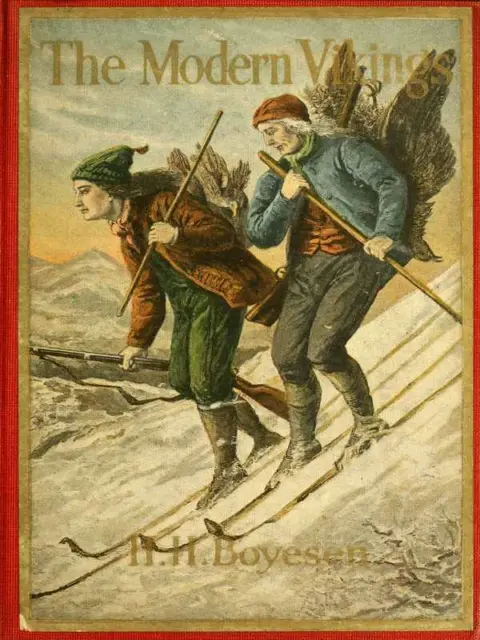
The Modern Vikings: Stories of Life and Sport in the Norseland
Hjalmar Hjorth Boyesen
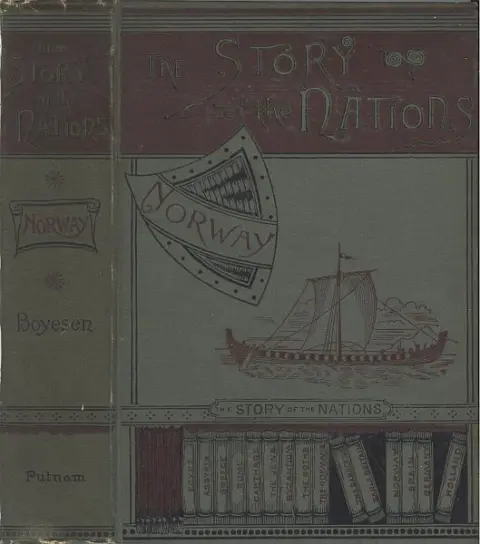
THE CLASSIC COLLECTION · 1888
"The Story of Norway" by Hjalmar Hjorth Boyesen is a historical account written in the late 19th century. The book aims to narrate the history of Norway from its early settlements through significant historical events and figures, while focusing on dramatic phases rather than institutional growth. The author particularly highlights the foundational role of the Norsemen, their migration patterns, and cultural history, which laid the groundwork for Norway's development as a nation. The opening of the book introduces readers to the Norsemen, detailing their origins as an Aryan race and their migration to Scandinavia. Boyesen explores the physical traits and societal structure of early Norse settlers, emphasizing their love for independence and innate aptitude for self-governance despite their violent tendencies. The author paints a vivid picture of the Norwegian landscape and the challenges faced by its inhabitants. He discusses the significance of their communal gatherings, or "thing", in maintaining order and governance among the tribes, and establishes the foundation for the complex history that will follow in later chapters. Overall, the beginning sets up a rich exploration of Norway's historical narrative while providing context for its cultural identity.
Introduction adapted from the source catalogue; source summaries may be automatically generated.
Free to read · English · 131,464 words · No account needed
MAKE TIME FOR A GOOD BOOK
On by default. Untick to stop anonymous reading totals. Each page counts after 10 seconds in view. How this works.
Anonymous counting is on unless you have switched it off.
In this desperate strait Sverre's true greatness revealed itself. He had been accustomed to fight against heavy odds, and the sense of danger served to bring all his energies into play. With undaunted resolution he set to work to repair his losses and to equip himself once more to meet his foes. His first task was to build a fleet instead of the one which the Baglers had destroyed; for without ships he would have been at their mercy. The Troenders whom he called upon for help assisted him faithfully; and by the beginning of spring (1199) he had eight large galleys ready to be launched. Besides these he expected a number of others which the peasants were building for him throughout Troendelag. The city of Nidaros he fortified with a large new block-house, and built hurling-machines which were used for throwing stones at the enemy. Early in June the Baglers appeared in the fjord with a large fleet, and the usual skirmishing commenced. All their efforts to capture the city were, however, unavailing, and in the battle at Strindsoe (June, 1199) their great fleet, which had formerly given them an advantage over the Birchlegs, fell into Sverre's hands. The battle was stubbornly contested, and both parties were wrought up to a warlike fury which refused to give or to take quarter. The king, whose gentleness and humane sentiments had made his stern resolution and courage the more admirable, put here a blot upon his fair name. He yielded to the importunities of his men, and allowed them to avenge the death of their kinsman upon the prisoners. It is but fair to ascribe this single act of cruelty to the momentary ferment of his blood and the hate that flared up uncontrollably against the authors of all his misfortunes.
After the battle of Strindsoe the Baglers fled southward with the few ships that were left to them, and were pursued by Sverre, who did not, however, succeed in overtaking them. They found, as usual, a refuge in Denmark, where they continued to plot mischief. They felt themselves, in point of strength and resources, so superior to Sverre that it seemed to them merely a question of time, when they should gain possession of the entire land. Even in Nidaros, where the king was yet able to hold his own, the rebels had many sympathizers among the clergy. After his victory at Strindsoe, Sverre sailed southward and went into winter-quarters in Oslo. The Baglers took advantage of his absence to visit Nidaros where they fought indecisively with an army of 1,800 peasants who undertook to defend the city. In the meanwhile a storm was drawing up over Sverre's head more menacing than any which he had hitherto weathered. The preaching of the disloyal clergy was beginning to show its effects. The peasants of Viken and the Oplands rose in rebellion, and poured in great torrents toward Oslo, for the purpose of destroying the excommunicated king. From three different directions their armies came marching, intending to effect a junction near the city, and by their greatly superior numbers overwhelm Sverre. The king had then only three thousand men, while the forces of the peasants, all told, must have numbered forty or fifty thousand. To fight against such odds would seem to be simple madness. Nevertheless he determined to sell his life dearly. Never did his genius shine more brightly than in the hour of danger. Calmly and confidently he addressed his men, assigning to each commander his task, and exhorting his Birchlegs to be brave, and to trust in God. Then, by a series of swift manoeuvres, he prevented the junction of the hostile armies, leaving his sons, Sigurd Lavard and Haakon, to guard his rear, while he engaged and defeated the two main divisions of the peasant army. The force under Sigurd and Haakon, which only numbered four hundred and eighty men, had in the meanwhile been routed by the third division, numbering twenty-four hundred, and the king would have had small chance of escape, if the peasants had had the wit to follow up their advantage. Instead of that they began carousing in the city, and even refrained from firing the royal fleet, which was in their power, because they regarded it already as their own. When, however, the sanguinary battle which was in progress out on the ice was at an end, the hilarious peasants discovered their mistake. Sverre came, not as vanquished, but as victor. Then there was hurly-burly of battle once more--fight, flight, and pursuit. The yeomen, sturdy fellows though they were, and not unaccustomed to war, lacked discipline, and above all they lacked a competent commander. Sverre chased them so hotly that they had to fling away their shields and trust for safety to their speed alone.
Your reading position is saved on this browser. Take it to another device with a library code. Reading pages adapt to text, rather than matching a printed edition.
Hjalmar Hjorth Boyesen
Hjalmar Hjorth Boyesen
Hjalmar Hjorth Boyesen
Hjalmar Hjorth Boyesen
BEHIND THE BOOK
This eBook is for the use of anyone anywhere in the United States and most other parts of the world at no cost and with almost no restrictions whatsoever. You may copy it, give it away or re-use it under the terms of the Project Gutenberg License included with this eBook or online at www.gutenberg.org. If you are not located in the United States, you will have to check the laws of the country where you are located before using this eBook. Read the source licence.
The original source file, including credits and licence, is retained by this library. Request an original-format copy at no charge. Please include the book title and Project Gutenberg identifier #34646.
KEEP YOUR CURIOSITY GOING
Cécile Tormay

Moritz Busch
John L. Ransom
Frances Wright
Cécile Tormay

Mabel Potter Daggett