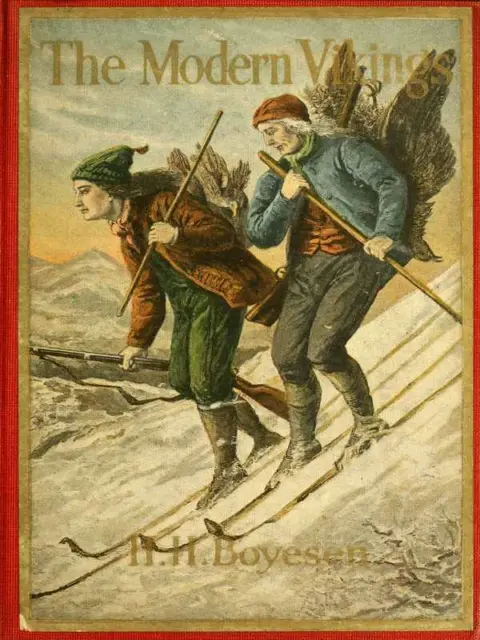
The Modern Vikings: Stories of Life and Sport in the Norseland
Hjalmar Hjorth Boyesen
THE CLASSIC COLLECTION · 1888
"The Story of Norway" by Hjalmar Hjorth Boyesen is a historical account written in the late 19th century. The book aims to narrate the history of Norway from its early settlements through significant historical events and figures, while focusing on dramatic phases rather than institutional growth. The author particularly highlights the foundational role of the Norsemen, their migration patterns, and cultural history, which laid the groundwork for Norway's development as a nation. The opening of the book introduces readers to the Norsemen, detailing their origins as an Aryan race and their migration to Scandinavia. Boyesen explores the physical traits and societal structure of early Norse settlers, emphasizing their love for independence and innate aptitude for self-governance despite their violent tendencies. The author paints a vivid picture of the Norwegian landscape and the challenges faced by its inhabitants. He discusses the significance of their communal gatherings, or "thing", in maintaining order and governance among the tribes, and establishes the foundation for the complex history that will follow in later chapters. Overall, the beginning sets up a rich exploration of Norway's historical narrative while providing context for its cultural identity.
Introduction adapted from the source catalogue; source summaries may be automatically generated.
Free to read · English · 131,464 words · No account needed
MAKE TIME FOR A GOOD BOOK
On by default. Untick to stop anonymous reading totals. Each page counts after 10 seconds in view. How this works.
Anonymous counting is on unless you have switched it off.
Duke Haakon, the second son of Magnus Law-Mender, succeeded his brother without opposition. He was then twenty-nine years old, tall and of stately appearance. He had not been long upon the throne, before he showed the haughty barons that he meant to have a reckoning with them. He first summoned Sir Audun Hugleiksson to meet him in Bergen, tried him for treason, and had him executed (1302). A woman from Luebeck had, two years before, appeared in Norway and created much excitement by claiming to be the Princess Margaret, "The Maid of Norway," who had died on the Orkneys. Her trial proved her to be an impostor, and she was burned at the stake. According to one conjecture, Sir Audun was in some way compromised by her trial, and it is not unlikely that he may have encouraged her pretensions. The legend, however, relates that Sir Audun suffered death for having insulted the king's bride, Countess Euphemia of Arnstein, whom, in 1295, he brought over from Germany.
It must have been an unpleasant surprise to the barons, who had had their own way so long, to find a stern and determined master in the new king, and it is the more to his credit that, in spite of their hostility, he induced them to consent to a change in the law of succession in favor of his daughter Ingeborg and her issue. As he was the only male descendant in the direct line of the old royal house, it was a source of uneasiness to him that he had no sons, and he foresaw that the only means of averting civil war, after his death, was to secure the succession to the prospective sons of his daughter, and in case she had none, to herself. Princess Ingeborg was, while a mere child, promised in marriage to the brilliant and ambitious Duke Erik, the second son of King Magnus Birgersson of Sweden. By this betrothal, King Haakon became involved in the quarrels of the dukes Erik and Valdemar with their brother, Birger Magnusson, whom they were endeavoring to dethrone. The dukes hated the king, and the king, who was jealous of Erik's popularity and eminence in chivalrous accomplishments, reciprocated their feelings. The long-smouldering hostility at last blazed forth, in 1306, when the dukes treacherously assaulted their brother and held him captive for about eighteen months. King Haakon was induced to take their part in the struggle, perhaps chiefly because his enemy, the king of Denmark, made common cause with King Birger. The good understanding between them did not, however, last long, for when it began to look as if Duke Erik aimed at the union of the three Scandinavian kingdoms under his own sceptre, Haakon, as an interested party, could scarcely remain inactive. He demanded the restoration of the fiefs which he had granted the duke during his exile. When this was refused, he opened negotiations with the king of Denmark, who was the brother-in-law of King Birger, and concluded a preliminary treaty at Copenhagen (1308) in accordance with which the Princess Ingeborg was to marry Magnus, the son of King Birger. Duke Erik then invaded Norway with an army, took Oslo and vainly besieged the fortress of Akershus. The province of Jemteland was also attacked by the Swedes, and the duke had in 1309 an indecisive fight with a portion of the Norwegian fleet in Kalfsund. Finally, after another fight, in which Erik gained the upper hand, negotiations were resumed, and by mutual concessions peace was reestablished (1310). Duke Erik had a powerful ally at the Norwegian court in Queen Euphemia, whose love for him was not of an entirely maternal character. He had thus little difficulty in conciliating King Haakon and getting again the promise of his daughter's hand. The wedding was finally celebrated with much splendor in Oslo in 1312. Duke Valdemar married the same day the king's niece, Ingeborg, the daughter of King Erik Priest-Hater. About four years later, when the hope had almost been abandoned, each of the duchesses bore a son. King Haakon's joy at this happy event was great, for it relieved him of his anxiety for the succession. But his joy was of short duration. There was one man in Sweden who was not rejoiced at the birth of the young princes, and that was King Birger. He feigned, however, delight, and invited his brothers to a great feast of reconciliation at the castle of Nykoeping. When the festivities were at an end, the dukes were thrown into prison and deprived of their lives. As there was no sign of violence on their bodies, the rumor went abroad that they had been starved to death. This was probably true. The tidings of this calamity gave King Haakon such a shock that he never recovered from it. He died, 1319, aged forty-nine years. With him the male line of the race of Harold the Fairhaired became extinct.
Your reading position is saved on this browser. Take it to another device with a library code. Reading pages adapt to text, rather than matching a printed edition.
Hjalmar Hjorth Boyesen
Hjalmar Hjorth Boyesen
Hjalmar Hjorth Boyesen
Hjalmar Hjorth Boyesen
BEHIND THE BOOK
This eBook is for the use of anyone anywhere in the United States and most other parts of the world at no cost and with almost no restrictions whatsoever. You may copy it, give it away or re-use it under the terms of the Project Gutenberg License included with this eBook or online at www.gutenberg.org. If you are not located in the United States, you will have to check the laws of the country where you are located before using this eBook. Read the source licence.
The original source file, including credits and licence, is retained by this library. Request an original-format copy at no charge. Please include the book title and Project Gutenberg identifier #34646.
KEEP YOUR CURIOSITY GOING
Cécile Tormay

Moritz Busch
John L. Ransom
Frances Wright
Cécile Tormay

Mabel Potter Daggett