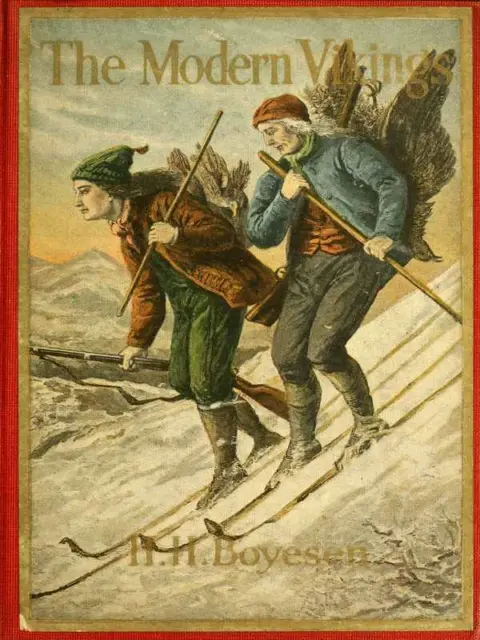
The Modern Vikings: Stories of Life and Sport in the Norseland
Hjalmar Hjorth Boyesen
THE CLASSIC COLLECTION · 1888
"The Story of Norway" by Hjalmar Hjorth Boyesen is a historical account written in the late 19th century. The book aims to narrate the history of Norway from its early settlements through significant historical events and figures, while focusing on dramatic phases rather than institutional growth. The author particularly highlights the foundational role of the Norsemen, their migration patterns, and cultural history, which laid the groundwork for Norway's development as a nation. The opening of the book introduces readers to the Norsemen, detailing their origins as an Aryan race and their migration to Scandinavia. Boyesen explores the physical traits and societal structure of early Norse settlers, emphasizing their love for independence and innate aptitude for self-governance despite their violent tendencies. The author paints a vivid picture of the Norwegian landscape and the challenges faced by its inhabitants. He discusses the significance of their communal gatherings, or "thing", in maintaining order and governance among the tribes, and establishes the foundation for the complex history that will follow in later chapters. Overall, the beginning sets up a rich exploration of Norway's historical narrative while providing context for its cultural identity.
Introduction adapted from the source catalogue; source summaries may be automatically generated.
Free to read · English · 131,464 words · No account needed
MAKE TIME FOR A GOOD BOOK
On by default. Untick to stop anonymous reading totals. Each page counts after 10 seconds in view. How this works.
Anonymous counting is on unless you have switched it off.
The Norsemen are a Germanic race, and belong, accordingly, to the great Aryan family. Their next of kin are the Swedes and Danes. Their original home was Asia, and probably that part of Asia which the ancients called Bactria, near the sources of the rivers Oxus and Jaxartes. Not only the Norsemen are supposed to have come from this region, but the ancestors of all the Aryan nations which now inhabit the greater portion of the civilized world. Among the first to leave this cradle of nations were the tribes which settled upon the eastern islands and peninsulas of the Mediterranean, and, under the name of Hellenes, developed, long before the Christian era, an art and a literature which are, in some respects, yet unrivalled. The early Italic tribes, from which sprung in time the world-empire of Rome, trace their descent from the same ancestry; as do also the Kelts, who in ancient times inhabited England, Ireland, and France; the Slavs who settled in the present Russia, Bohemia, and the northern Turkish provinces; and the Germans, who occupied the great central regions of the European continent. Among Asiatic nations, the Iranians inhabiting Persia, and the Hindoos in India, have Aryan blood.
It seems almost incredible that persons differing so widely in appearance, habits, and disposition, as, for instance, a Hindoo and an Englishman, should, if you go sufficiently far back, have the same ancestry. And yet there cannot be the slightest doubt that such is the case. The question, then, naturally arises: "If they were once alike, what can have made them so different?" And the answer is: "The climate, the soil, and the general character of the countries in which they settled."
The country from which the first Aryans emigrated was mountainous, with fertile valleys, and an even, temperate climate. There was no excessive heat to make men drowsy and indolent, nor excessive cold to stunt them in their growth and paralyze their energies. The earth did not, as in the tropics, produce a luxurious vegetation which would support the inhabitants without labor, but it offered sustenance to herds of cattle which, with the proper care, would supply the simple needs of primitive men. The race, thus situated, progressed physically as well as mentally, until it became superior to all the tribes inhabiting the neighboring regions. War followed, in which the weaker succumbed. The Aryans, increasing rapidly in numbers, took possession of the conquered territories, enslaved the indigenous population, or drove it back into localities where the conditions of life were less favorable. It is not positively known when the first migration on a large scale took place; but some scholars have supposed that the Hindoos separated from the parent race as early as 1500 B.C. The dates of the Greek, Italic, Keltic, and Slavic migrations are likewise uncertain, and the period which has been fixed upon for the Aryan occupation of Germany is also conjectural. The same uncertainty prevails regarding the earliest history of the Scandinavian tribes; although there is a strong probability that their invasion of the countries which they now inhabit must have taken place during the second century preceding the Christian era. It is not unlikely that they left their Asiatic home simultaneously with the Germans, with whom they were then almost, if not entirely, identical, and that their conquering hordes spread northward, subduing the Finns and Lapps, whom they found in possession of the land, partly exterminating them, partly forcing them up into the barren mountains of the extreme North. Among the tribes whose path of conquest was turned in this direction, the Goths (Gauter), the Swedes (Svear), and the Danes (Daner) were the most prominent, though several other names are mentioned, both by native and foreign authors. The name Norseman, or Northman, is not found among these, because it refers not to any of the Aryan tribes, but is solely derived from the country in which they settled. Their country soon became known as Norway (Noregr or Norvegr), i. e., the Northern Way. It is the long strip of territory extending north and south between the mountain chain Kjoelen, which separates it from Sweden and the Arctic and Atlantic oceans. It looks on the map like a big bag slung across the shoulders of Sweden.
Your reading position is saved on this browser. Take it to another device with a library code. Reading pages adapt to text, rather than matching a printed edition.
Hjalmar Hjorth Boyesen
Hjalmar Hjorth Boyesen
Hjalmar Hjorth Boyesen
Hjalmar Hjorth Boyesen
BEHIND THE BOOK
This eBook is for the use of anyone anywhere in the United States and most other parts of the world at no cost and with almost no restrictions whatsoever. You may copy it, give it away or re-use it under the terms of the Project Gutenberg License included with this eBook or online at www.gutenberg.org. If you are not located in the United States, you will have to check the laws of the country where you are located before using this eBook. Read the source licence.
The original source file, including credits and licence, is retained by this library. Request an original-format copy at no charge. Please include the book title and Project Gutenberg identifier #34646.
KEEP YOUR CURIOSITY GOING
Cécile Tormay

Moritz Busch
John L. Ransom
Frances Wright
Cécile Tormay

Mabel Potter Daggett