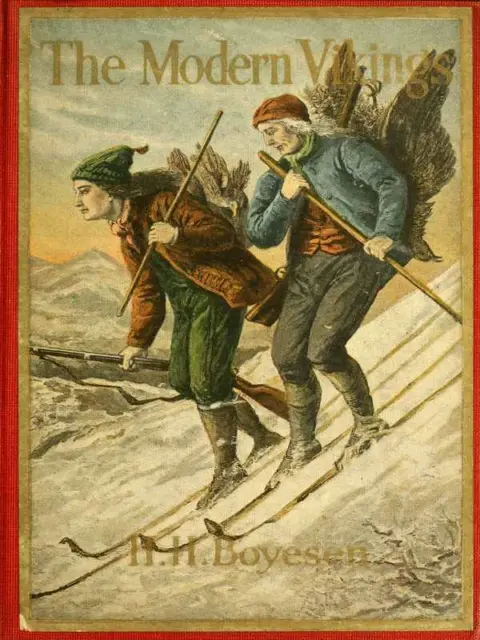
The Modern Vikings: Stories of Life and Sport in the Norseland
Hjalmar Hjorth Boyesen
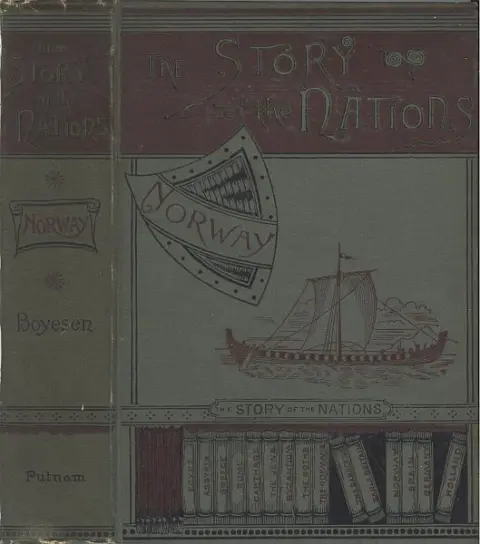
THE CLASSIC COLLECTION · 1888
"The Story of Norway" by Hjalmar Hjorth Boyesen is a historical account written in the late 19th century. The book aims to narrate the history of Norway from its early settlements through significant historical events and figures, while focusing on dramatic phases rather than institutional growth. The author particularly highlights the foundational role of the Norsemen, their migration patterns, and cultural history, which laid the groundwork for Norway's development as a nation. The opening of the book introduces readers to the Norsemen, detailing their origins as an Aryan race and their migration to Scandinavia. Boyesen explores the physical traits and societal structure of early Norse settlers, emphasizing their love for independence and innate aptitude for self-governance despite their violent tendencies. The author paints a vivid picture of the Norwegian landscape and the challenges faced by its inhabitants. He discusses the significance of their communal gatherings, or "thing", in maintaining order and governance among the tribes, and establishes the foundation for the complex history that will follow in later chapters. Overall, the beginning sets up a rich exploration of Norway's historical narrative while providing context for its cultural identity.
Introduction adapted from the source catalogue; source summaries may be automatically generated.
Free to read · English · 131,464 words · No account needed
MAKE TIME FOR A GOOD BOOK
On by default. Untick to stop anonymous reading totals. Each page counts after 10 seconds in view. How this works.
Anonymous counting is on unless you have switched it off.
The legitimate heir to the throne after Haakon's death was his nephew, Guttorm Sigurdsson, a son of his brother, Sigurd Lavard. In spite of his tender age, the Birchlegs made haste to elect him, with the understanding that Haakon Galen, with the title of earl, should conduct the government. There were, however, some of the Birchlegs who were dissatisfied with this arrangement, partly because they were jealous of Haakon Galen, partly because they felt that, in such troublous times, a king was needed, who should be something more than a name or a figure-head. The Baglers, too, strange to say, were ill at ease, because they feared that, Haakon Sverresson's restraining influence being removed, the Birchleg chiefs would give free rein to their passions of avarice and vengeance. Half in self-defence they, therefore, reorganized their troop under the leadership of an impostor, calling himself Erling Stonewall (Steinvegg), who pretended to be a son of King Magnus Erlingsson. A pretender of this name had, during the reign of Sverre, made some little stir, and had been imprisoned by King Knut of Sweden in a tower, whence he had escaped by means of a rope, made out of his bed-clothes. The rope proved, however, to be too short, and in letting himself drop to the ground, Erling broke his hip. He was overtaken, on his flight, by Sverre's men and in all probability slain. Nevertheless, it required audacity rather than proof of royal birth, in those days, to figure as a pretender; and the second Erling Stonewall, though probably few at first believed in him, soon had a considerable following. It was of no use that Bishop Nicholas opposed him, and urged his own nephew, Philip, a grandson of Harold Gille's queen, Ingerid, for the chieftainship. When Erling demanded the right to prove his birth by the ordeal of fire, the bishop told him bluntly that the result was in his hands. Under such circumstances, the pretender found it more to his advantage to make terms with the bishop and receive his assurance that the ordeal should turn out successfully. Erling, on his side, promised, when he became king, to make Philip his earl, and in other respects satisfied the prelate's demands. The latter had, in the meanwhile, by conferences with his peasants, ascertained that Philip's candidacy was regarded with great disfavor, because he neither had nor pretended to have a drop of royal blood. The peasants utterly refused to recognize him, and threatened to rebel, in case he was elected. It was therefore to the bishop's advantage to keep faith with Erling. The ordeal accordingly took place with great solemnity in the presence of the Danish king, Valdemar the Victorious, and proved successful. Erling was then proclaimed king, and received as a present from Valdemar a fleet of thirty fine ships. In return he recognized him as his feudal overlord and gave him hostages. The party of the magnates was thus faithful to its traditions, in sacrificing patriotism to private interests. With the aid of the powerful Danish king the party had, indeed, a good prospect of crushing the disheartened and disunited Birchlegs, who just at that time received a fresh blow in the death of their newly elected king. Christina, Haakon Galen's mistress, could not allow so slight an obstacle, as the life of a child, to stand between her and the goal of her wishes. If Guttorm were dead, her lover would have the best chance of succeeding him, being on his mother's side a grandson of Sigurd Mouth. It was, therefore, no mere accident that Guttorm died; and with all the symptoms of poisoning. He said that the "Swedish woman" had taken him upon her lap and stroked him caressingly over his whole body. Soon after he felt, as if needles were piercing his flesh, and before long he expired in great agony. Though Christina's guilt was obvious, her lover had yet sufficient influence to have the matter hushed up; and in order to give her the full benefit of his protection, he married her soon after. A meeting was now called in Nidaros to elect a new king. Earl Haakon, who was a favorite with the army, seemed to have every chance in his favor; and he would probably have been the choice of the Birchlegs, if Archbishop Erik had not opposed him, on account of his relation to Christina. The guilt thus defeated its own object. Several candidates were discussed, some of whom were related to Sverre only on his mother's side and thus had no consanguinity with the royal house. The most prominent among these was Peter Steyper, who had the additional advantage of having married a daughter of King Magnus Erlingsson. After long deliberations, the chiefs finally decided to leave the choice to the peasants, who would then be sure to stand by the king whom they themselves elected. The peasants were according summoned to Oere-thing where they conferred the royal dignity upon Inge Baardsson, a younger half-brother of Haakon Galen and like him, on the maternal side, a grandson of Sigurd Mouth. No sooner did the Baglers hear that the Birchlegs had chosen a new king than they started northward from Tunsberg, in order to test his mettle. The caution of Bishop Nicholas prevailed, however, over the counsel of the more warlike chiefs, and after some unimportant fights in and about Bergen, the rebels betook themselves to Denmark, where they had always a safe place of refuge. King Inge and Earl Haakon, therefore, found no opposition, when they visited Viken, and the peasants, though the great majority of them sympathized with the Baglers, had no scruple in swearing them allegiance. In fact, the long war was having a demoralizing influence upon the people, and its barbarizing effects began to be visible in many ways. To save their lives, the yeomen were obliged to feign friendship for every pretender who came along with his band, and swear him fidelity, or fly to the woods, leaving their farms a prey to the marauders. Even the ties of blood which had been exceptionally strong among the Norsemen, began to be disregarded, as members of the same family were impelled, by diverging interests, to join different parties. It was no rare occurence that brother fought against brother, and father against son. Thus it is told of a Bagler that during the attack upon Nidaros in 1206, he was hotly pursuing a Birchleg whom he finally killed. As he stooped over the dying man, in order to deprive him of his arms and garments, he discovered that it was his own brother. A great laxity in all moral obligations resulted from this state of things. Kings and chieftains broke their words; enemies who had surrendered on promise of pardon were ruthlessly slain; murder and rapine filled the land.
Your reading position is saved on this browser. Take it to another device with a library code. Reading pages adapt to text, rather than matching a printed edition.
Hjalmar Hjorth Boyesen
Hjalmar Hjorth Boyesen
Hjalmar Hjorth Boyesen
Hjalmar Hjorth Boyesen
BEHIND THE BOOK
This eBook is for the use of anyone anywhere in the United States and most other parts of the world at no cost and with almost no restrictions whatsoever. You may copy it, give it away or re-use it under the terms of the Project Gutenberg License included with this eBook or online at www.gutenberg.org. If you are not located in the United States, you will have to check the laws of the country where you are located before using this eBook. Read the source licence.
The original source file, including credits and licence, is retained by this library. Request an original-format copy at no charge. Please include the book title and Project Gutenberg identifier #34646.
KEEP YOUR CURIOSITY GOING
Cécile Tormay

Moritz Busch
John L. Ransom
Frances Wright
Cécile Tormay

Mabel Potter Daggett