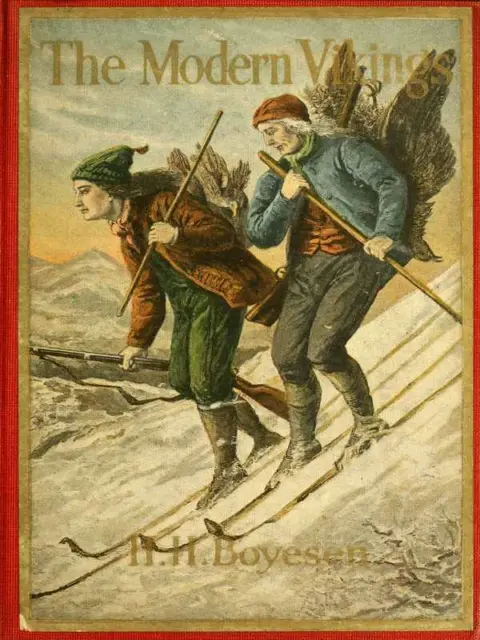
The Modern Vikings: Stories of Life and Sport in the Norseland
Hjalmar Hjorth Boyesen
THE CLASSIC COLLECTION · 1888
"The Story of Norway" by Hjalmar Hjorth Boyesen is a historical account written in the late 19th century. The book aims to narrate the history of Norway from its early settlements through significant historical events and figures, while focusing on dramatic phases rather than institutional growth. The author particularly highlights the foundational role of the Norsemen, their migration patterns, and cultural history, which laid the groundwork for Norway's development as a nation. The opening of the book introduces readers to the Norsemen, detailing their origins as an Aryan race and their migration to Scandinavia. Boyesen explores the physical traits and societal structure of early Norse settlers, emphasizing their love for independence and innate aptitude for self-governance despite their violent tendencies. The author paints a vivid picture of the Norwegian landscape and the challenges faced by its inhabitants. He discusses the significance of their communal gatherings, or "thing", in maintaining order and governance among the tribes, and establishes the foundation for the complex history that will follow in later chapters. Overall, the beginning sets up a rich exploration of Norway's historical narrative while providing context for its cultural identity.
Introduction adapted from the source catalogue; source summaries may be automatically generated.
Free to read · English · 131,464 words · No account needed
MAKE TIME FOR A GOOD BOOK
On by default. Untick to stop anonymous reading totals. Each page counts after 10 seconds in view. How this works.
Anonymous counting is on unless you have switched it off.
The summer passed, neither party gaining any decided advantage. Then Bishop Nicholas, despairing of destroying the Birchlegs as long as they had the town to fall back upon, determined to deprive them of this shelter. He accordingly set fire to the town and burned the greater part of it. The Birchlegs had enough to do in saving the block-house, and could give but little aid to the citizens in their efforts to limit the conflagration. It is doubtful, however, if the Baglers gained any thing by this unwarrantable destruction, for the citizens of Bergen, a large number of whom had been favorably inclined toward them, became from this day their enemies. Sverre was, indeed, compelled to abandon his position, leaving, however, a garrison in the block-house. But the Baglers scarcely profited by his departure, as the country round about had been denuded of provisions, and want compelled them to move. Bishop Nicholas then sailed northward to Nordmoere and Haalogaland, where he met with no opposition; and desertion from the ranks of the Birchlegs increased his army until its very magnitude caused him embarrassment. Oddly enough, at this very time, when the king's fortune was at its lowest ebb, the traitor, Thorstein Kugad, who had surrendered the block-house in Nidaros, returned to him. He flung himself at Sverre's feet, embraced his knees, and cried:
"Happy I am now, my lord, that I am so near you--that I can touch you. * * * Dear my lord, receive me, and let me never more part from you."
Though his former comrades demanded his death, Sverre gave him full pardon. The king's desperate position was indeed sufficient guaranty of the sincerity of Thorstein's repentance. The whole country, outside of Troendelag, was now in the hands of the rebels. The royal fleet was burned, and even many of the veteran Birchlegs had deserted. Then, as the final crushing blow, came the bull of Pope Innocent III., laying the country under interdict, prohibiting the celebration of public worship and the administration of the sacraments, in all those parts of the kingdom that yet remained faithful to Sverre. If the vicar of Christ had contented himself with hurling the thunderbolt of divine wrath against the king, he might perhaps have achieved his destruction. But the Pope, finding that the bull of his predecessor had been practically ineffective, aimed this time to affect the popular conscience, and he addressed to it certain arguments which showed how completely he had allowed himself to be deceived by Sverre's enemies. In his bull he described the king in a manner which must have appeared absurd to those who knew him; he attributed to him crimes which all knew that he had never committed; and exposed thereby--not Sverre's wickedness, but his own fallibility and partisanship. The king, instead of meekly submitting to an unfair sentence, felt, therefore, justified in coming forward in his own defence. He wrote or caused to be written, under his immediate supervision, a polemical brochure, in which he reviewed his relation to the Church and ably defended his conduct. The behavior of the clergy he subjected to a scathing criticism, showed the inconsistency of their position, as the partisans of Baglers, and exposed the true motive of their actions. The author's shrewdness, ability, and learning are manifest in every page, and the lucidity of expression and the plain common-sense arguments seem to reveal the well-known personality of Sverre. That it had the effect of preventing many from leaving him, who otherwise might have been frightened into desertion, is very probable. The disloyal clergy had, however, better facilities for reaching the people than the few who were yet faithful, and they improved their opportunity in inciting the peasants to an unreasoning, fanatical hostility to the excommunicated king. The Pope, in the meanwhile, was active in stirring up foreign enemies against him, and wrote the most urgent letters to the kings of Sweden and Denmark, exhorting them to merit the gratitude of God and his vicar, the Pope, by destroying the sacrilegious monster, Sverre. Happily, these exhortations had no effect; for King Knut of Denmark had his hands full at home, and King Sverke of Sweden was rather favorably inclined toward his neighbor.
Your reading position is saved on this browser. Take it to another device with a library code. Reading pages adapt to text, rather than matching a printed edition.
Hjalmar Hjorth Boyesen
Hjalmar Hjorth Boyesen
Hjalmar Hjorth Boyesen
Hjalmar Hjorth Boyesen
BEHIND THE BOOK
This eBook is for the use of anyone anywhere in the United States and most other parts of the world at no cost and with almost no restrictions whatsoever. You may copy it, give it away or re-use it under the terms of the Project Gutenberg License included with this eBook or online at www.gutenberg.org. If you are not located in the United States, you will have to check the laws of the country where you are located before using this eBook. Read the source licence.
The original source file, including credits and licence, is retained by this library. Request an original-format copy at no charge. Please include the book title and Project Gutenberg identifier #34646.
KEEP YOUR CURIOSITY GOING
Cécile Tormay

Moritz Busch
John L. Ransom
Frances Wright
Cécile Tormay

Mabel Potter Daggett