THE CLASSIC COLLECTION✦A Christmas greetingCLASSIC FREE BOOKS
A Christmas greeting
Marie Corelli
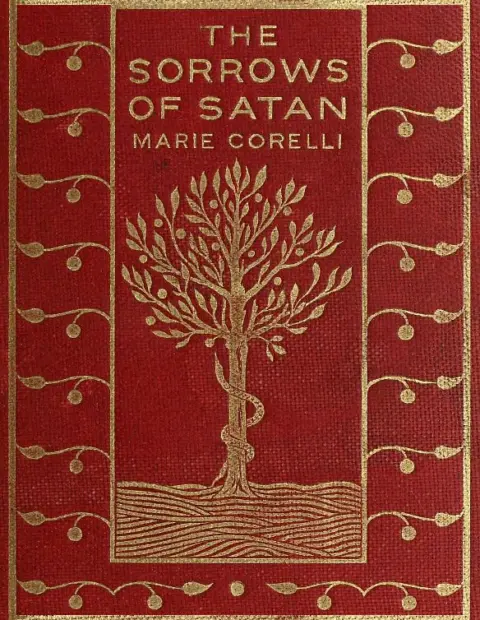
THE CLASSIC COLLECTION · 1895
"The Sorrows of Satan" by Marie Corelli is a Faustian novel published in 1895. Geoffrey Tempest, a starving author, suddenly inherits a fortune and befriends the charismatic aristocrat Lucio—who is actually the Devil in disguise. As Tempest's wealth brings only misery, the novel explores Satan's own yearning for salvation and redemption. This controversial bestseller critiques Victorian society's moral bankruptcy while mixing Christian themes with popular ideas like reincarnation and Theosophy. Despite savage criticism from literary circles, it became one of the world's first bestsellers.
Introduction adapted from the source catalogue; source summaries may be automatically generated.
Free to read · English · 162,977 words · No account needed
MAKE TIME FOR A GOOD BOOK
On by default. Untick to stop anonymous reading totals. Each page counts after 10 seconds in view. How this works.
Anonymous counting is on unless you have switched it off.
"I have made up my mind to die. Not out of passion or petulance,--but from deliberate choice, and as I think, necessity. My brain is tired of problems,--my body is tired of life; it is best to make an end. The idea of death,--which means annihilation,--is very sweet to me. I am glad to feel that by my own will and act I can silence this uneasy throbbing of my heart, this turmoil and heat of my blood,--this tortured aching of my nerves. Young as I am, I have no delight now in existence,--I see nothing but my love's luminous eyes, his god-like features, his enthralling smile,--and these are lost to me. For a brief while he has been my world, life and time,--he has gone,--and without him there is no universe. How could I endure the slow, wretched passing of hours, days, weeks, months and years alone?--though it is better to be alone than in the dull companionship of the self-satisfied, complacent and arrogant fool who is my husband. He has left me for ever, so he says in a letter the maid brought to me an hour ago. It is quite what I expected of him,--what man of his type could find pardon for a blow to his own amour propre! If he had studied my nature, entered into my emotions, or striven in the least to guide and sustain me,--if he had shown me any sign of a great, true love such as one sometimes dreams of and seldom finds,--I think I should be sorry for him now,--I should even ask his forgiveness for having married him. But he has treated me precisely as he might treat a paid mistress,--that is, he has fed me, clothed me, and provided me with money and jewels in return for making me the toy of his passions,--but he has not given me one touch of sympathy,--one proof of self-denial or humane forbearance. Therefore, I owe him nothing. And now he, and my love who will not be my lover, have gone away together; I am free to do as I will with this small pulse within me called life, which is after all, only a thread, easily broken. There is no one to say me nay, or to hold my hand back from giving myself the final quietus. It is well I have no friends; it is good for me that I have probed the hypocrisy and social sham of the world, and that I have mastered the following hard truths of life,--that there is no love without lust,--no friendship without self-interest,--no religion without avarice,--and no so-called virtue without its accompanying stronger vice. Who, knowing these things, would care to take part in them! On the verge of the grave I look back along the short vista of my years, and I see myself a child in this very place, this wooded Willowsmere; I can note how that life began to which I am about to put an end. Pampered, petted and spoilt, told that I must 'look pretty' and take pleasure in my clothes, I was even at the age of ten, capable of a certain amount of coquetry. Old roués, smelling of wine and tobacco, were eager to take me on their knees and pinch my soft flesh;--they would press my innocent lips with their withered ones,--withered and contaminated by the kisses of cocottes and 'soiled doves' of the town!--I have often wondered how it is these men can dare to touch a young child's mouth, knowing in themselves what beasts they are! I see my nurse,--a trained liar and time-server, giving herself more airs than a queen, and forbidding me to speak to this child or that child, because they were 'beneath' me;--then came my governess, full of a prurient prudery, as bad a woman in morals as ever lived, yet 'highly recommended' and with excellent references, and wearing an assumption of the strictest virtue, like many equally hypocritical clergymen's wives I have known. I soon found her out,--for even as a child I was painfully observant,--and the stories she and my mother's French maid used to tell, in lowered voices now and then broken by coarse laughter, were sufficient to enlighten me as to her true character. Yet, beyond having a supreme contempt for the woman who practised religious austerity outwardly, and was at heart a rake, I gave small consideration to the difficult problem such a nature suggested. I lived,--how strange it seems that I should be writing now of myself, as past and done with!--yes, I lived in a dreamy, more or less idyllic state of mind, thinking without being conscious of thought, full of fancies concerning the flowers, trees and birds,--wishing for things of which I knew nothing,--imagining myself a queen at times, and again, a peasant. I was an omnivorous reader,--and I was specially fond of poetry. I used to pore over the mystic verse of Shelley, and judged him then as a sort of demi-god;--and never, even when I knew all about his life, could I realize him as a man with a thin, shrieking falsetto voice and 'loose' notions concerning women. But I am quite sure it was good for his fame that he was drowned in early youth with so many melancholy and dramatic surroundings,--it saved him, I consider, from a possibly vicious and repulsive old age. I adored Keats till I knew he had wasted his passion on a Fanny Brawn,--and then the glamour of him vanished. I can offer no reason for this,--I merely set down the fact. I made a hero of Lord Byron,--in fact he has always formed for me the only heroical type of poet. Strong in himself and pitiless in his love for women, he treated them for the most part as they merited, considering the singular and unworthy specimens of the sex it was his misfortune to encounter. I used to wonder, when reading these men's amorous lines, whether love would ever come my way, and what beatific state of emotion I should then enjoy. Then came the rough awakening from all my dreams,--childhood melted into womanhood,--and at sixteen I was taken up to town with my parents to "know something of the ways and manners of society," before finally 'coming out.' Oh, those ways and manners! I learnt them to perfection! Astonished at first, then bewildered, and allowed no time to form any judgment on what I saw, I was hurried through a general vague 'impression' of things such as I had never imagined or dreamed of. While I was yet lost in wonderment, and kept constantly in companionship with young girls of my own rank and age, who nevertheless seemed much more advanced in knowledge of the world than I, my father suddenly informed me that Willowsmere was lost to us,--that he could not afford to keep it up,--and that we should return there no more. Ah, what tears I shed!--what a fury of grief consumed me!--I did not then comprehend the difficult entanglements of either wealth or poverty;--all I could realize was that the doors of my dear old home were closed upon me for ever. After that, I think I grew cold and hard in disposition; I had never loved my mother very dearly,--in fact I had seen very little of her, as she was always away visiting, if not entertaining visitors, and she seldom had me with her,--so that when she was suddenly struck down by a first shock of paralysis, it affected me but little. She had her doctors and nurses,--I had my governess still with me; and my mother's sister, Aunt Charlotte, came to keep house for us,--so I began to analyse society for myself, without giving any expression of my opinions on what I observed. I was not yet 'out,' but I went everywhere where girls of my age were invited, and perceived things without showing that I had any faculty of perception. I cultivated a passionless and cold exterior,--a listless, uninterested and frigid demeanor,--for I discovered that this was accepted by many people as dullness or stupidity, and that by assuming such a character, certain otherwise crafty persons would talk more readily before me, and betray themselves and their vices unawares. Thus my 'social education' began in grim earnest;--women of title and renown would ask me to their 'quiet teas,' because I was what they were pleased to call a 'harmless girl--' 'rather pretty, but dull,'--and allow me to assist them in entertaining the lovers who called upon them while their husbands were out. I remember that on one occasion, a great lady famous for two things, her diamonds and her intimacy with the Queen, kissed her 'cavaliere servente,' a noted sporting earl, with considerable abandon in my presence. He muttered something about me,--I heard it;--but his amorous mistress merely answered in a whisper--"Oh, it's only Sibyl Elton,--she understands nothing." Afterwards however, when he had gone, she turned to me with a grin and remarked--"You saw me kiss Bertie, didn't you? I often do; he's quite like my brother!" I made no reply,--I only smiled vaguely; and the next day she sent me a valuable diamond ring, which I at once returned to her with a prim little note, stating that I was much obliged, but that my father considered me too young as yet to wear diamonds. Why do I think of these trifles now I wonder!--now when I am about to take my leave of life and all its lies! ... There is a little bird singing outside my bedroom window,--such a pretty creature! I suppose it is happy?--it should be, as it is not human... The tears are in my eyes as I listen to its sweet warbling, and think that it will be living and singing still to-day at sunset when I am dead!
Your reading position is saved on this browser. Take it to another device with a library code. Reading pages adapt to text, rather than matching a printed edition.
Marie Corelli
Marie Corelli

Marie Corelli

Marie Corelli
BEHIND THE BOOK
This eBook is for the use of anyone anywhere in the United States and most other parts of the world at no cost and with almost no restrictions whatsoever. You may copy it, give it away or re-use it under the terms of the Project Gutenberg License included with this eBook or online at www.gutenberg.org. If you are not located in the United States, you will have to check the laws of the country where you are located before using this eBook. Read the source licence.
The original source file, including credits and licence, is retained by this library. Request an original-format copy at no charge. Please include the book title and Project Gutenberg identifier #42332.
KEEP YOUR CURIOSITY GOING
Coulson Kernahan

Maurice Baring
Frances Wright
Cécile Tormay

Frederic Jesup Stimson

W. H. P. (William Henry Pope) Jarvis