THE CLASSIC COLLECTION✦A Christmas greetingCLASSIC FREE BOOKS
A Christmas greeting
Marie Corelli
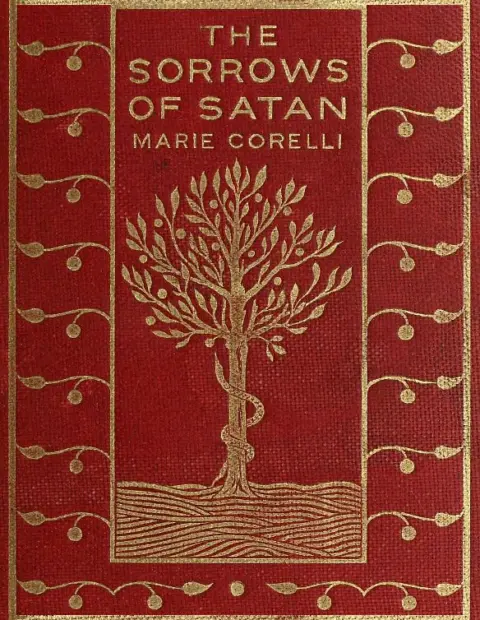
THE CLASSIC COLLECTION · 1895
"The Sorrows of Satan" by Marie Corelli is a Faustian novel published in 1895. Geoffrey Tempest, a starving author, suddenly inherits a fortune and befriends the charismatic aristocrat Lucio—who is actually the Devil in disguise. As Tempest's wealth brings only misery, the novel explores Satan's own yearning for salvation and redemption. This controversial bestseller critiques Victorian society's moral bankruptcy while mixing Christian themes with popular ideas like reincarnation and Theosophy. Despite savage criticism from literary circles, it became one of the world's first bestsellers.
Introduction adapted from the source catalogue; source summaries may be automatically generated.
Free to read · English · 162,977 words · No account needed
MAKE TIME FOR A GOOD BOOK
On by default. Untick to stop anonymous reading totals. Each page counts after 10 seconds in view. How this works.
Anonymous counting is on unless you have switched it off.
That last sentence was mere sentiment, for I am not sorry to die. If I felt the least regret about it I should not carry out my intention. I must resume my narrative,--for it is an analysis I am trying to make of myself, to find out if I can whether there are no excuses to be found for my particular disposition,--whether it is not after all, the education and training I have had that have made me what I am, or whether indeed I was born evil from the first. The circumstances that surrounded me, did not, at any rate, tend to soften or improve my character. I had just passed my seventeenth birthday, when one morning my father called me into his library and told me the true position of his affairs. I learned that he was crippled on all sides with debt,--that he lived on advances made to him by Jew usurers,--and that these advances were trusted to him solely on the speculation that I, his only daughter, would make a sufficiently rich marriage to enable him to repay all loans with heavy interest. He went on to say that he hoped I would act sensibly,--and that when any men showed indications of becoming suitors for my hand, I would, before encouraging them, inform him, in order that he might make strict enquiries as to their actual extent of fortune. I then understood, for the first time, that I was for sale. I listened in silence till he had finished,--then I asked him--'Love, I suppose, is not to be considered in the matter?' He laughed, and assured me it was much easier to love a rich man than a poor one, as I would find out after a little experience. He added, with some hesitation, that to help make both ends meet, as the expenses of town life were considerable, he had arranged to take a young American lady under his charge, a Miss Diana Chesney, who wished to be introduced into English society, and who would pay two thousand guineas a year to him for that privilege, and for Aunt Charlotte's services as chaperône. I do not remember now what I said to him when I heard this,--I know that my long suppressed feelings broke out in a storm of fury, and that for the moment he was completely taken aback by the force of my indignation. An American boarder in our house!--it seemed to me as outrageous and undignified as the conduct of a person I once heard of, who, favoured by the Queen's patronage with 'free' apartments in Kensington Palace, took from time to time on the sly, an American or Colonial 'paying-guest,' who adopted forthwith the address of Her Majesty's birthplace as her own, thus lowering the whole prestige of that historic habitation. My wrath however was useless;--the bargain was arranged,--my father, regardless of his proud lineage and the social dignity of his position, had degraded himself, in my opinion, to the level of a sort of superior lodging-house keeper,--and from that time I lost all my former respect for him. Of course it can be argued that I was wrong,--that I ought to have honoured him for turning his name to monetary account by loaning it out as a protective shield and panoply for an American woman without anything but the dollars of a vulgar 'railway-king' to back her up in society,--but I could not see it in that light. I retreated into myself more than ever,--and became more than pleasantly known for my coldness, reserve and hauteur. Miss Chesney came, and strove hard to be my friend,--but she soon found that impossible. She is a good-hearted creature I believe,--but she is badly bred and badly trained as all her compatriots are, more or less, despite their smattering of an European education; I disliked her from the first, and have spared no pains to show it. Yet I know she will be Countess of Elton as soon as it is decently possible,--say, after the year's ceremonious mourning for my mother has expired, and perhaps three months' hypocritical wearing of black for me,--my father believes himself to be still young and passably good-looking, and he is quite incapable of resisting the fortune she will bring him. When she took up her fixed abode in our house and Aunt Charlotte became her paid chaperône, I seldom went out to any social gatherings, for I could not endure the idea of being seen in her companionship. I kept to my own room a great deal, and thus secluded, read many books. All the fashionable fiction of the day passed through my hands, much to my gradual enlightenment, if not to my edification. One day,--a day that is stamped on my memory as a kind of turning-point in my life,--I read a novel by a woman which I did not at first entirely understand,--but on going over some of its passages a second time, all at once its horrible lasciviousness flashed upon me, and filled me with such genuine disgust that I flung it on the ground in a fit of loathing and contempt. Yet I had seen it praised in all the leading journals of the day; its obscenities were hinted at as 'daring,'--its vulgarities were quoted as 'brilliant wit,'--in fact so many laudatory columns were written about it in the press that I resolved to read it again. Encouraged by the 'literary censors' of the time, I did so, and little by little the insidious abomination of it filtered into my mind and stayed there. I began to think about it,--and by-and-by found pleasure in thinking about it. I sent for other books by the same tainted hand, and my appetite for that kind of prurient romance grew keener. At this particular juncture as chance or fate would have it, an acquaintance of mine, the daughter of a Marchioness, a girl with large black eyes, and those full protruding lips which remind one unconsciously of a swine's snout, brought me two or three odd volumes of the poems of Swinburne. Always devoted to poetry, and considering it to be the highest of the arts, and up to that period having been ignorant of this writer's work, I turned over the books with eagerness, expecting to enjoy the usual sublime emotions which it is the privilege and glory of the poet to inspire in mortals less divinely endowed than himself, and who turn to him
Your reading position is saved on this browser. Take it to another device with a library code. Reading pages adapt to text, rather than matching a printed edition.
Marie Corelli
Marie Corelli

Marie Corelli

Marie Corelli
BEHIND THE BOOK
This eBook is for the use of anyone anywhere in the United States and most other parts of the world at no cost and with almost no restrictions whatsoever. You may copy it, give it away or re-use it under the terms of the Project Gutenberg License included with this eBook or online at www.gutenberg.org. If you are not located in the United States, you will have to check the laws of the country where you are located before using this eBook. Read the source licence.
The original source file, including credits and licence, is retained by this library. Request an original-format copy at no charge. Please include the book title and Project Gutenberg identifier #42332.
KEEP YOUR CURIOSITY GOING
Coulson Kernahan

Maurice Baring
Frances Wright
Cécile Tormay

Frederic Jesup Stimson

W. H. P. (William Henry Pope) Jarvis