THE CLASSIC COLLECTION✦A Christmas greetingCLASSIC FREE BOOKS
A Christmas greeting
Marie Corelli
THE CLASSIC COLLECTION · 1895
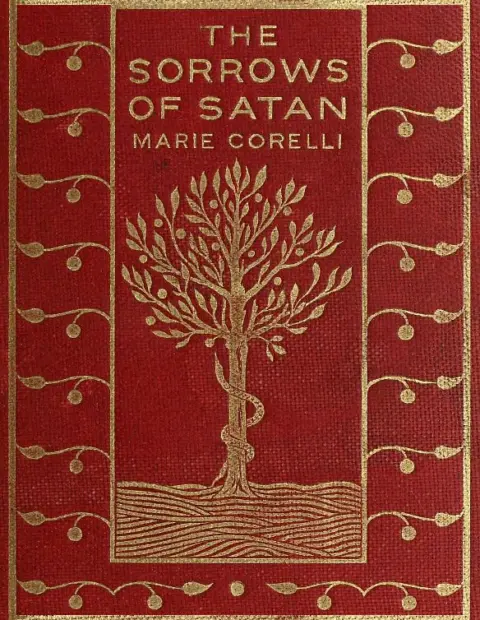
"The Sorrows of Satan" by Marie Corelli is a Faustian novel published in 1895. Geoffrey Tempest, a starving author, suddenly inherits a fortune and befriends the charismatic aristocrat Lucio—who is actually the Devil in disguise. As Tempest's wealth brings only misery, the novel explores Satan's own yearning for salvation and redemption. This controversial bestseller critiques Victorian society's moral bankruptcy while mixing Christian themes with popular ideas like reincarnation and Theosophy. Despite savage criticism from literary circles, it became one of the world's first bestsellers.
Introduction adapted from the source catalogue; source summaries may be automatically generated.
Free to read · English · 162,977 words · No account needed
MAKE TIME FOR A GOOD BOOK
On by default. Untick to stop anonymous reading totals. Each page counts after 10 seconds in view. How this works.
Anonymous counting is on unless you have switched it off.
The next three or four weeks flew by in a whirl of excitement, and by the time they were ended I found it hard to recognize myself in the indolent, listless, extravagant man of fashion I had so suddenly become. Sometimes at stray and solitary moments the past turned back upon me like a revolving picture in a glass with a flash of unwelcome recollection, and I saw myself worn and hungry, and shabbily clothed, bending over my writing in my dreary lodging, wretched, yet amid all my wretchedness receiving curious comfort from my own thoughts which created beauty out of penury, and love out of loneliness. This creative faculty was now dormant in me,--I did very little, and thought less. But I felt certain that this intellectual apathy was but a passing phase,--a mental holiday and desirable cessation from brain-work to which I was deservedly entitled after all my sufferings at the hands of poverty and disappointment. My book was nearly through the press,--and perhaps the chiefest pleasure of any I now enjoyed was the correction of the proofs as they passed under my supervision. Yet even this, the satisfaction of authorship, had its drawback,--and my particular grievance was somewhat singular. I read my own work with gratification of course, for I was not behind my contemporaries in thinking well of myself in all I did,--but my complacent literary egoism was mixed with a good deal of disagreeable astonishment and incredulity, because my work, written with enthusiasm and feeling, propounded sentiments and inculcated theories which I personally did not believe in. Now, how had this happened, I asked myself? Why had I thus invited the public to accept me at a false valuation? I paused to consider,--and I found the suggestion puzzling. How came I to write the book at all, seeing that it was utterly unlike me as I now knew myself? My pen, consciously or unconsciously, had written down things which my reasoning faculties entirely repudiated,--such as belief in a God,--trust in the eternal possibilities of man's diviner progress,--I credited neither of these doctrines. When I imagined such transcendental and foolish dreams I was poor,--starving,--and without a friend in the world;--remembering all this, I promptly set down my so-called 'inspiration' to the action of an ill-nourished brain. Yet there was something subtle in the teaching of the story, and one afternoon when I was revising some of the last proof sheets I caught myself thinking that the book was nobler than its writer. This idea smote me with a sudden pang,--I pushed my papers aside, and walking to the window, looked out. It was raining hard, and the streets were black with mud and slush,--the foot-passengers were drenched and miserable,--the whole prospect was dreary, and the fact that I was a rich man did not in the least lift from my mind the depression that had stolen on me unawares. I was quite alone, for I had my own suite of rooms now in the hotel, not far from those occupied by Prince Rimânez; I also had my own servant, a respectable, good sort of fellow whom I rather liked because he shared to the full the instinctive aversion I felt for the prince's man, Amiel. Then I had my own carriage and horses with attendant coachman and groom,--so that the prince and I, though the most intimate friends in the world, were able to avoid that 'familiarity which breeds contempt' by keeping up our own separate establishments. On this particular afternoon I was in a more miserable humour than ever my poverty had brought upon me, yet from a strictly reasonable point of view I had nothing to be miserable about. I was in full possession of my fortune,--I enjoyed excellent health, and I had everything I wanted, with the added consciousness that if my wants increased I could gratify them easily. The 'paragraph wheel' under Lucio's management had been worked with such good effect that I had seen myself mentioned in almost every paper in London and the provinces as the 'famous millionaire,'--and for the benefit of the public, who are sadly uninstructed on these matters, I may here state as a very plain unvarnished truth, that for forty pounds,[1] a well-known 'agency' will guarantee the insertion of any paragraph, provided it is not libellous, in no less than four hundred newspapers. The art of 'booming' is thus easily explained, and level-headed people will be able to comprehend why it is that a few names of authors are constantly mentioned in the press, while others, perhaps more deserving, remain ignored. Merit counts as nothing in such circumstances,--money wins the day. And the persistent paragraphing of my name, together with a description of my personal appearance and my 'marvellous literary gifts,' combined with a deferential and almost awe-struck allusion to the 'millions' which made me so interesting--(the paragraph was written out by Lucio and handed for circulation to the 'agency' aforesaid with 'money down')--all this I say brought upon me two inflictions,--first, any amount of invitations to social and artistic functions,--and secondly, a continuous stream of begging-letters. I was compelled to employ a secretary, who occupied a room near my suite, and who was kept hard at work all day. Needless to say I refused all appeals for money;--no one had helped me in my distress, with the exception of my old chum 'Boffles,'--no one save he had given me even so much as a word of sympathy,--I was resolved now to be as hard and as merciless as I had found my contemporaries. I had a certain grim pleasure in reading letters from two or three literary men, asking for work 'as secretary or companion,' or failing that, for the loan of a little cash to 'tide over present difficulties.' One of these applicants was a journalist on the staff of a well-known paper who had promised to find me work, and who instead of doing so, had, as I afterwards learned, strongly dissuaded his editor from giving me any employment. He never imagined that Tempest the millionaire, and Tempest the literary hack, were one and the same person,--so little do the majority think that wealth can ever fall to the lot of authors! I wrote to him myself however and told him what I deemed it well he should know, adding my sarcastic thanks for his friendly assistance to me in time of need,--and herein I tasted something of the sharp delight of vengeance. I never heard from him again, and I am pretty sure my letter gave him material not only for astonishment but meditation.
Your reading position is saved on this browser. Take it to another device with a library code. Reading pages adapt to text, rather than matching a printed edition.
Marie Corelli
Marie Corelli

Marie Corelli

Marie Corelli
BEHIND THE BOOK
This eBook is for the use of anyone anywhere in the United States and most other parts of the world at no cost and with almost no restrictions whatsoever. You may copy it, give it away or re-use it under the terms of the Project Gutenberg License included with this eBook or online at www.gutenberg.org. If you are not located in the United States, you will have to check the laws of the country where you are located before using this eBook. Read the source licence.
The original source file, including credits and licence, is retained by this library. Request an original-format copy at no charge. Please include the book title and Project Gutenberg identifier #42332.
KEEP YOUR CURIOSITY GOING
Coulson Kernahan

Maurice Baring
Frances Wright
Cécile Tormay

Frederic Jesup Stimson

W. H. P. (William Henry Pope) Jarvis