THE CLASSIC COLLECTION✦A Christmas greetingCLASSIC FREE BOOKS
A Christmas greeting
Marie Corelli
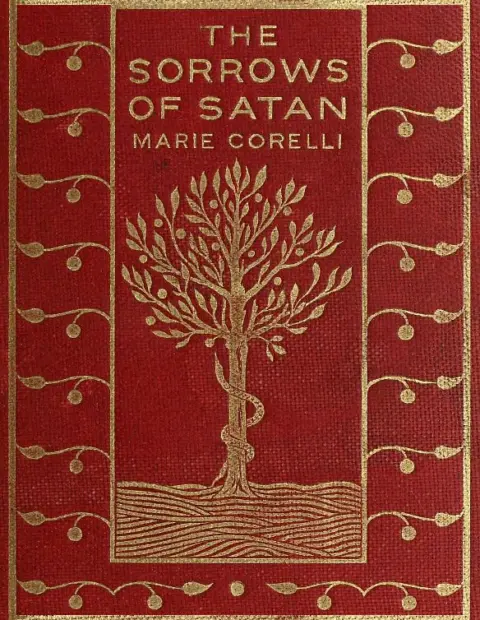
THE CLASSIC COLLECTION · 1895
"The Sorrows of Satan" by Marie Corelli is a Faustian novel published in 1895. Geoffrey Tempest, a starving author, suddenly inherits a fortune and befriends the charismatic aristocrat Lucio—who is actually the Devil in disguise. As Tempest's wealth brings only misery, the novel explores Satan's own yearning for salvation and redemption. This controversial bestseller critiques Victorian society's moral bankruptcy while mixing Christian themes with popular ideas like reincarnation and Theosophy. Despite savage criticism from literary circles, it became one of the world's first bestsellers.
Introduction adapted from the source catalogue; source summaries may be automatically generated.
Free to read · English · 162,977 words · No account needed
MAKE TIME FOR A GOOD BOOK
On by default. Untick to stop anonymous reading totals. Each page counts after 10 seconds in view. How this works.
Anonymous counting is on unless you have switched it off.
Two weeks later I stood on the deck of Lucio's yacht 'The Flame,'--a vessel whose complete magnificence filled me, as well as all other beholders, with bewildered wonderment and admiration. She was a miracle of speed, her motive power being electricity; and the electric engines with which she was fitted were so complex and remarkable as to baffle all would-be inquirers into the secret of their mechanism and potency. A large crowd of spectators gathered to see her as she lay off Southampton, attracted by the beauty of her shape and appearance,--some bolder spirits even came out in tugs and row-boats, hoping to be allowed to make a visit of inspection on board, but the sailors, powerfully-built men of a foreign and somewhat unpleasing type, soon intimated that the company of such inquisitive persons was undesirable and unwelcome. With white sails spread, and a crimson flag flying from her mast, she weighed anchor at sunset on the afternoon of the day her owner and I joined her, and moving through the waters with delicious noiselessness and incredible rapidity, soon left far behind her the English shore, looking like a white line in the mist, or the pale vision of a land that might once have been. I had done a few quixotic things before departing from my native country,--for example, I had made a free gift of his former home Willowsmere, to Lord Elton, taking a sort of sullen pleasure in thinking that he, the spendthrift nobleman, owed the restoration of his property to me,--to me who had never been either a successful linen-draper or furniture-man, but simply an author, one of 'those sort of people' whom my lord and my lady imagine they can 'patronize' and neglect again at pleasure without danger to themselves. The arrogant fools invariably forget what lasting vengeance can be taken for an unmerited slight by the owner of a brilliant pen! I was glad too, in a way, to realize that the daughter of the American railway-king would be brought to the grand old house to air her 'countess-ship,' and look at her prettily pert little physiognomy in the very mirror where Sibyl had watched herself die. I do not know why this idea pleased me, for I bore no grudge against Diana Chesney,--she was vulgar but harmless, and would probably make a much more popular châtelaine at Willowsmere Court than my wife had ever been. Among other things, I dismissed my man Morris, and made him miserable,--with the gift of a thousand pounds, to marry and start a business on. He was miserable because he could not make up his mind what business to adopt, his anxiety being to choose the calling that would 'pay' best,--and also, because though he 'had his eye' upon several young women, he could not tell which among them would be likely to be least extravagant, and the most serviceable as a cook and housekeeper. The love of money and the pains of taking care of it, embittered his days as it embitters the days of most men, and my unexpected munificence towards him burdened him with such a weight of trouble as robbed him of natural sleep and appetite. I cared nothing for his perplexities however, and gave him no advice, good or bad. My other servants I dismissed, each with a considerable gift of money, not that I particularly wished to benefit them, but simply because I desired them to speak well of me. And in this world it is very evident that the only way to get a good opinion is to pay for it! I gave orders to a famous Italian sculptor for Sibyl's monument, English sculptors having no conception of sculpture,--it was to be of exquisite design, wrought in purest white marble, the chief adornment being the centre-figure of an angel ready for flight, with the face of Sibyl faithfully copied from her picture. Because, however devilish a woman may be in her life-time, one is bound by all the laws of social hypocrisy to make an angel of her as soon as she is dead! Just before I left London I heard that my old college-friend 'Boffles,' John Carrington, had met with a sudden end. Busy at the 'retorting' of his gold, he had been choked by the mercurial fumes and had died in hideous torment. At one time this news would have deeply affected me, but now, I was scarcely sorry. I had heard nothing of him since I had come into my fortune,--he had never even written to congratulate me. Always full of my own self-importance, I judged this as great neglect on his part, and now that he was dead I felt no more than any of us feel now-a-days at the loss of friends. And that is very little,--we have really no time to be sorry,--so many people are always dying!--and we are in such a desperate hurry to rush on to death ourselves! Nothing seemed to touch me that did not closely concern my own personal interest,--and I had no affections left, unless I may call the vague tenderness I had for Mavis Clare an affection. Yet, to be honest, this very emotion was after all nothing but a desire to be consoled, pitied and loved by her,--to be able to turn upon the world and say "This woman whom you have lifted on your shield of honour and crowned with laurels,--she loves me--she is not yours, but mine!" Purely interested and purely selfish was the longing,--and it deserved no other name than selfishness.
Your reading position is saved on this browser. Take it to another device with a library code. Reading pages adapt to text, rather than matching a printed edition.
Marie Corelli
Marie Corelli

Marie Corelli

Marie Corelli
BEHIND THE BOOK
This eBook is for the use of anyone anywhere in the United States and most other parts of the world at no cost and with almost no restrictions whatsoever. You may copy it, give it away or re-use it under the terms of the Project Gutenberg License included with this eBook or online at www.gutenberg.org. If you are not located in the United States, you will have to check the laws of the country where you are located before using this eBook. Read the source licence.
The original source file, including credits and licence, is retained by this library. Request an original-format copy at no charge. Please include the book title and Project Gutenberg identifier #42332.
KEEP YOUR CURIOSITY GOING
Coulson Kernahan

Maurice Baring
Frances Wright
Cécile Tormay

Frederic Jesup Stimson

W. H. P. (William Henry Pope) Jarvis