THE CLASSIC COLLECTION✦An outlaw’s diary: the CommuneCLASSIC FREE BOOKS
An outlaw’s diary: the Commune
Cécile Tormay
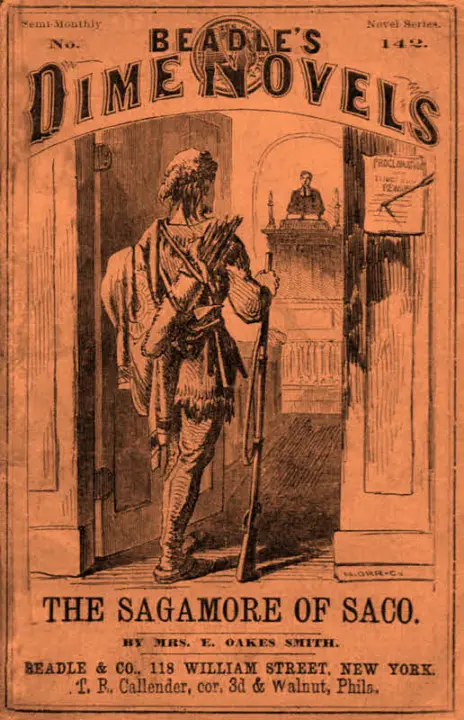
THE CLASSIC COLLECTION · 1868
"The Sagamore of Saco" by Elizabeth Oakes Smith is a historical fiction novel written in the late 19th century. The narrative unfolds during the early colonial period in New England, encompassing themes of love, conflict, and societal tensions through the experiences of young John Bonyton and his beloved, Hope Vines. The story is set against a backdrop of early colonial life, capturing the complexities of relationships between settlers and Native Americans, and the impending conflicts arising from suspicion and prejudice. The opening of the novel introduces us to the emotional turmoil surrounding John Bonyton, whose fierce love for Hope Vines stands at odds with societal expectations and familial pressures. As the narrative unfolds, it reveals the character dynamics between John, Hope, and their parents, particularly reflecting on the clashes between Puritanical beliefs and individual desires. At the same time, a dark undercurrent of jealousy from Acashee, a Native American girl enamored with John, hints at perilous circumstances that could ensnare Hope, culminating in rising tensions as the characters navigate their intertwined fates amidst cultural strife and personal aspirations.
Introduction adapted from the source catalogue; source summaries may be automatically generated.
Free to read · English · 46,077 words · No account needed
MAKE TIME FOR A GOOD BOOK
On by default. Untick to stop anonymous reading totals. Each page counts after 10 seconds in view. How this works.
Anonymous counting is on unless you have switched it off.
Mistress Bonyton at length found repose where the weary are at rest, and Nancy gave her hand, in due time, to the godly youth, Ephraim Higgins, who, stimulated by his wife, made many ambitious attempts at public prayer and exhortation, but, being deficient in that fervor or ostentation of character essential to “freedom of utterance,” our Ephraim was fain to give over these public aspirations, and content himself with the “amen,” which marked his indorsement of the sayings of others. If the truth must be told, Nancy not unfrequently nudged him to hold his peace even in this, because of the said amen having fallen in the wrong quarter, to the no little mortification of his wife.
Perseverance was a rose so guarded with thorns, that no man had the courage to pluck it, and she may have sometimes caused Nancy some discomfort by alluding to persons and events which might as well have been buried in oblivion. For instance, she was fond of marking an event thus:
“This happened when your Ephraim, the great goose, was spoonying about Hope Vines. Never shall I forget, Nancy, how he used to stand with his finger in his mouth--no, his thumb in his mouth--looking after that girl.”
“What do you think became of Hope?” asked Nancy Higgins, ignoring the spiteful remark of her sister.
“I believe Satan carried her off bodily. I no more believe that she was stolen by the Indians, than I believe that brother Ephe will set the world afire.”
“Never you mind my Ephe; it’s easy to cry sour grapes. When you get your man we shall see--we shall see!”
“There goes John, as true as I live, stalking along just as though the folks warn’t ready to eat him up,” cried Perseverance, making a rush at the door, at which she cried, loudly:
“John! John Bonyton, look here!”
The sagamore turned with a grave slowness, and confronted the speaker in silence. His sister Nancy now joined her, and beckoned him to approach. He lowered the musket which he carried carelessly in the hollow of his arm, showing it to be loaded, and casting the butt upon the ground, it gave out a sharp, significant ring.
“What is your will, wildcats?” he asked.
Unheeding this not very complimentary epithet, Mrs. Higgins entreated
him to enter her house.
“Why should I enter your house?”
“Because I am your sister, John, and it shames me to see you living
this heathenish life.”
“Then cease to regard me as a brother. Come here, Perseverance.”
Your reading position is saved on this browser. Take it to another device with a library code. Reading pages adapt to text, rather than matching a printed edition.
BEHIND THE BOOK
This eBook is for the use of anyone anywhere in the United States and most other parts of the world at no cost and with almost no restrictions whatsoever. You may copy it, give it away or re-use it under the terms of the Project Gutenberg License included with this eBook or online at www.gutenberg.org. If you are not located in the United States, you will have to check the laws of the country where you are located before using this eBook. Read the source licence.
The original source file, including credits and licence, is retained by this library. Request an original-format copy at no charge. Please include the book title and Project Gutenberg identifier #56007.
KEEP YOUR CURIOSITY GOING
Cécile Tormay

Moritz Busch
Coulson Kernahan
John L. Ransom

Maurice Baring
Frances Wright