
Love Letters of a Violinist, and Other Poems
Eric Mackay
THE CLASSIC COLLECTION · 1795
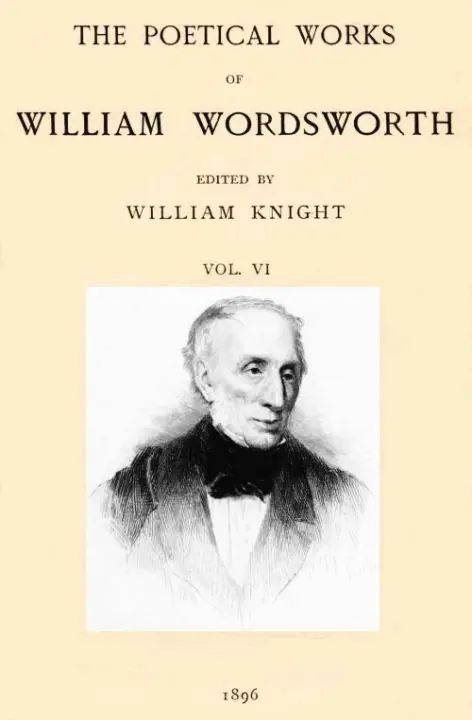
"The Poetical Works of William Wordsworth — Volume 6 (of 8)" by William Wordsworth is a collection of poetry published in the late 19th century. This volume contains a selection of Wordsworth's works from the years 1814 to 1820, showcasing his thematic focus on nature, human emotion, and the profound connection between the two. Readers can expect to find insightful reflections on personal and national identities, drawing on historical figures and settings, illustrated through the poet’s unique lens of Romanticism. The opening of this collection introduces several poems, starting with "Laodamia," which explores themes of love, loss, and the transcendent nature of human emotion through the story of a faithful wife yearning for her slain husband. Wordsworth’s mastery of language is evident as he blends mythological elements with deep emotional resonance, setting a reflective tone that permeates the selection. Additionally, the beginnings of poems such as "The Brownie's Cell" and "Yarrow Visited" highlight Wordsworth's interest in Scottish landscapes and folklore, drawing the reader into a vibrant tapestry of the natural world, as well as his reflections on heritage and history. Through these verses, Wordsworth invites readers into his intimate thoughts and contemplations, setting the foundation for a deeply enriching literary experience.
Introduction adapted from the source catalogue; source summaries may be automatically generated.
Free to read · English · 117,891 words · No account needed
MAKE TIME FOR A GOOD BOOK
On by default. Untick to stop anonymous reading totals. Each page counts after 10 seconds in view. How this works.
Anonymous counting is on unless you have switched it off.
Nor wanted lurking hamlet, dusky towns,
And scattered rural farms of aspect bright,
And, here and there, between the pastoral downs,
The azure sea upswelled upon the sight.
Fair prospect, such as Britain only shows!
But not a living creature could be seen
Through its wide circuit, hushed in deep repose,
Yea, even to sadness, quiet and serene!
Amid this solitude of earth and sky,
Through portal clear as loop-hole in a storm
Opening before the sun's triumphant eye,
Issued, to sudden view, a radiant form! 1827.
]
[Footnote 135: 1845
... may be; 1816.
]
[Footnote 136: 1827.
A thrilling voice was heard, that vivified
My patriotic heart;--aloud it cried,
"I, the Guardian of this Land, 1816.
]
[Footnote 137: 1837.
"Days are come of festive beauty; 1816.
Hence bright days of festive beauty; 1827.
]
[Footnote 138: 1820.
... will yield 1816.
]
[Footnote 139: 1827.
... of purest white,-- 1816.
]
[Footnote 140: 1827.
... burst ... 1816.
]
[Footnote 141: 1827.
... told their joys,-- 1816.
]
[Footnote 142: 1827.
Looked ... 1816.
]
[Footnote 143: 1827.
... seemed ... 1816.
]
[Footnote 144: 1837.
Anon, I saw, beneath a dome of state,
The feast dealt forth with bounty unconfined;
And while the vaulted roof did emulate
The starry heavens through splendour of the show,
It rang with music,--and methought the wind
Scattered the tuneful largess far and near,
That they who asked not might partake the cheer,
Who listened not could hear,
Where'er the wild winds were allowed to blow!
--That work reposing, on the verge
Of busiest exultation hung a dirge, 1816.
... and had power to throw 1827.
The edition of 1827 is otherwise identical with that of 1837.]
[Footnote 145: 1837.
These ... 1816.
]
[Footnote 146: 1845.
Graced with such gifts as Sculpture can bestow, When inspiration guides her patient toil; And let imperishable trophies grow 1816.
As nobly graced by Sculpture's patient toil;
And let imperishable structures grow 1827.
]
[Footnote 147: 1827.
... records ... 1816.
]
[Footnote 148: 1845.
Trophies on which the morning sun may shine, As changeful ages flow, 1816.
Records on which the morning sun may shine,
As changeful ages flow, 1827.
]
[Footnote 149: 1816.
... Ye muses long debarred C.
]
[Footnote 150: 1816.
... As mythic lore
For not unwise belief proclaimed of yore C.
]
[Footnote 151: 1827.
... consecrated stream and grove, 1816.
]
[Footnote 152: 1845.
... and move,
And exercise unblamed a generous sway,)
Now, ... 1816.
And exercise unblamed a god-like sway) 1837.
]
[Footnote 153: 1837.
... my soul's desires! 1816.
]
[Footnote BL: The title of this Ode, when first published along with the Thanksgiving Ode, was Ode, composed in January 1816. In 1845 the date 1814 was given; but there seems no reason to distrust the earlier one.--ED.]
[Footnote BM: These lines were first inserted in the edition of
1827.--ED.]
[Footnote BN: Compare Ode, Intimations of Immortality, etc., stanza
ix.--
But for those first affections,
Those shadowy recollections.
[Footnote BO: Haydon painted Wellington on the field of Waterloo. Compare the sonnet which Wordsworth wrote on that picture, in 1840, beginning--
By Art's hold privilege Warrior and War-horse stand.
Your reading position is saved on this browser. Take it to another device with a library code. Reading pages adapt to text, rather than matching a printed edition.
BEHIND THE BOOK
This eBook is for the use of anyone anywhere in the United States and most other parts of the world at no cost and with almost no restrictions whatsoever. You may copy it, give it away or re-use it under the terms of the Project Gutenberg License included with this eBook or online at www.gutenberg.org. If you are not located in the United States, you will have to check the laws of the country where you are located before using this eBook. Read the source licence.
The original source file, including credits and licence, is retained by this library. Request an original-format copy at no charge. Please include the book title and Project Gutenberg identifier #47651.
KEEP YOUR CURIOSITY GOING
Eric Mackay
Edmund Gosse
Sophia Margaretta Hensley
Gilbert Parker
George MacDonald

Elizabeth Bibesco