
Love Letters of a Violinist, and Other Poems
Eric Mackay
THE CLASSIC COLLECTION · 1795
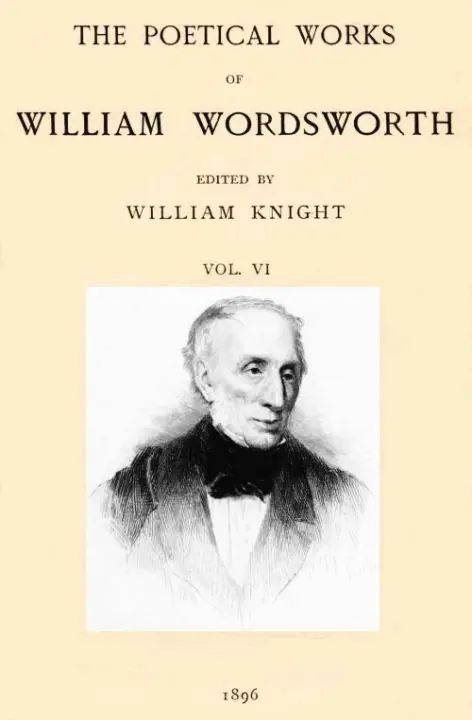
"The Poetical Works of William Wordsworth — Volume 6 (of 8)" by William Wordsworth is a collection of poetry published in the late 19th century. This volume contains a selection of Wordsworth's works from the years 1814 to 1820, showcasing his thematic focus on nature, human emotion, and the profound connection between the two. Readers can expect to find insightful reflections on personal and national identities, drawing on historical figures and settings, illustrated through the poet’s unique lens of Romanticism. The opening of this collection introduces several poems, starting with "Laodamia," which explores themes of love, loss, and the transcendent nature of human emotion through the story of a faithful wife yearning for her slain husband. Wordsworth’s mastery of language is evident as he blends mythological elements with deep emotional resonance, setting a reflective tone that permeates the selection. Additionally, the beginnings of poems such as "The Brownie's Cell" and "Yarrow Visited" highlight Wordsworth's interest in Scottish landscapes and folklore, drawing the reader into a vibrant tapestry of the natural world, as well as his reflections on heritage and history. Through these verses, Wordsworth invites readers into his intimate thoughts and contemplations, setting the foundation for a deeply enriching literary experience.
Introduction adapted from the source catalogue; source summaries may be automatically generated.
Free to read · English · 117,891 words · No account needed
MAKE TIME FOR A GOOD BOOK
On by default. Untick to stop anonymous reading totals. Each page counts after 10 seconds in view. How this works.
Anonymous counting is on unless you have switched it off.
"If Gray's plan be adopted, there is not time to become acquainted with the arrangement, and to recognise with pleasure the recurrence of the movement.
"Be so good as let me know where you found most difficulty in following me. The passage which I most suspect of being misunderstood is
And thus is missed the sole true glory;
and the passage where I doubt most about the reasonableness of expecting that the reader should follow me in the luxuriance of the imagery and the language, is the one that describes, under so many metaphors, the spreading of the news of the Waterloo victory over the globe."
The last reference in this letter is to the lines in that part of the
Ode, which follows--
Joyful annunciation!--it went forth--
It pierced the caverns of the sluggish North, etc."
[Footnote 80: 1837.
Hail, universal Source of pure delight! 1816.
]
[Footnote 81: 1837.
Whether thy orient ... 1816.
]
[Footnote 82: 1837.
... that timid pace,
Framed in subjection to the chains 1816.
... that timid pace
Submitted to the chains 1827.
]
[Footnote 83: 1850.
... yon ... 1816.
]
[Footnote 84: 1837.
... splendour, ... 1816.
]
[Footnote 85: 1837.
... but ... 1816.
]
[Footnote 86: 1837.
--Who to the murmurs of an earthly string 1816.
]
[Footnote 87: 1837.
... in the night 1816.
]
[Footnote 88: "Missed" italicised in 1837 and subsequent editions.]
[Footnote 89: "They" italicised in the editions from 1816 to 1832.]
[Footnote 90: 1837.
To Him ... 1816.
]
[Footnote 91: 1816.
... power eternal ... C.
]
[Footnote 92: 1837.
Who sees, and feels, ... 1816.
]
[Footnote 93: 1837.
While the old forest of civility Is doomed to perish, to the last fair tree. 1816.
While the whole forest of civility
Is doomed to perish, to the last fair tree! 1827.
Perish without reprieve for herb, or flower, or tree. C.
]
[Footnote 94: 1827.
And the ... 1816.
]
[Footnote 95: 1816.
From shore to shore C.
]
[Footnote 96: 1845.
Land of our fathers! precious unto me
Since the first joys of thinking infancy;
When of thy gallant chivalry I read,
And hugged the volume on my sleepless bed!
O England!--dearer far than life is dear,
If I forget thy prowess, never more
Be thy ... 1816.
Land of our fathers! loved by me
Since the first joys of thinking infancy;
Loved with a passion since I caught thy praise
A Listener, at or on some patient knee,
With an ear fastened to rude ballad lays--
Or of thy gallant chivalry I read,
And hugged the volume on a sleepless bed!
O England!--dearer far, etc. 1837.
]
[Footnote 97: 1816
... reappears ... C.
]
[Footnote 98: 1845.
... torrents roar!
But how can He be faithless to the past,
Whose soul, intolerant of base decline,
Saw in thy virtue a celestial sign,
That bade him hope, and to his hope cleave fast!
The nations strove with puissance;--at length
Wide Europe heaved, impatient to be cast,
With all her living strength,
With all her armed powers,
Upon the offensive shores. 1816.
]
Your reading position is saved on this browser. Take it to another device with a library code. Reading pages adapt to text, rather than matching a printed edition.
BEHIND THE BOOK
This eBook is for the use of anyone anywhere in the United States and most other parts of the world at no cost and with almost no restrictions whatsoever. You may copy it, give it away or re-use it under the terms of the Project Gutenberg License included with this eBook or online at www.gutenberg.org. If you are not located in the United States, you will have to check the laws of the country where you are located before using this eBook. Read the source licence.
The original source file, including credits and licence, is retained by this library. Request an original-format copy at no charge. Please include the book title and Project Gutenberg identifier #47651.
KEEP YOUR CURIOSITY GOING
Eric Mackay
Edmund Gosse
Sophia Margaretta Hensley
Gilbert Parker
George MacDonald

Elizabeth Bibesco