
Love Letters of a Violinist, and Other Poems
Eric Mackay
THE CLASSIC COLLECTION · 1795
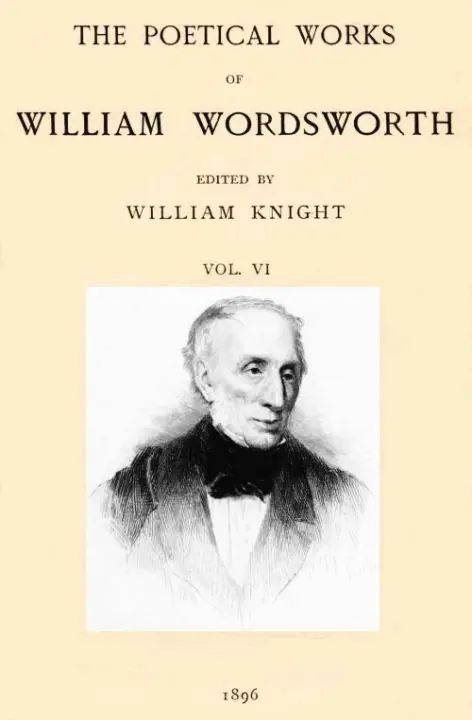
"The Poetical Works of William Wordsworth — Volume 6 (of 8)" by William Wordsworth is a collection of poetry published in the late 19th century. This volume contains a selection of Wordsworth's works from the years 1814 to 1820, showcasing his thematic focus on nature, human emotion, and the profound connection between the two. Readers can expect to find insightful reflections on personal and national identities, drawing on historical figures and settings, illustrated through the poet’s unique lens of Romanticism. The opening of this collection introduces several poems, starting with "Laodamia," which explores themes of love, loss, and the transcendent nature of human emotion through the story of a faithful wife yearning for her slain husband. Wordsworth’s mastery of language is evident as he blends mythological elements with deep emotional resonance, setting a reflective tone that permeates the selection. Additionally, the beginnings of poems such as "The Brownie's Cell" and "Yarrow Visited" highlight Wordsworth's interest in Scottish landscapes and folklore, drawing the reader into a vibrant tapestry of the natural world, as well as his reflections on heritage and history. Through these verses, Wordsworth invites readers into his intimate thoughts and contemplations, setting the foundation for a deeply enriching literary experience.
Introduction adapted from the source catalogue; source summaries may be automatically generated.
Free to read · English · 117,891 words · No account needed
MAKE TIME FOR A GOOD BOOK
On by default. Untick to stop anonymous reading totals. Each page counts after 10 seconds in view. How this works.
Anonymous counting is on unless you have switched it off.
With his attendants here at break of morn,
Wandering by stealth abroad he chanced to hear
A startling outcry made by hound and horn,
From which the tusky Boar hath fled in fear,
And, etc.
Feebly returned by {wandering} Artegal,
{trembling}
{Heir of Gorbonian! Brother gladly met, }
{Gorbonian's heir, my brother gladly met,}
And what if o'er this bright unbosoming
A cloud of time, and envious fortune past!
Have we not seen the glories of the spring
By noontide darkness veiled and overcast?
The lakes that glittered like a sunbright shield,
The sky, the gay green field,
All vanish in a moment, as if night
Were sister to the sun, and darkness born of light.
But should the sun victorious glimmer forth,
Far brighter seems the wide world than before:
Such power is latent in thy native worth,
To spread delight and joy from shore to shore:
For past misdeeds how grateful to atone,
Re-seated on thy throne,
Give proof that long adversity, and pain,
And sorrow have confirmed thy inborn right to reign.
From STANZA 28 to end
The story tells that Artegal away
Was by his brother privily conveyed
To a far distant city (at that day
Alclwyd named), whose fortress undismayed
By the hostility of mortals stood
In sight of field and flood,
Obnoxious only on the lofty Rock
To the careering storm, and perilous lightning stroke.
When this impregnable retreat was gained,
In prudent furtherance of his just intent,
King Elidure a mortal illness feigned,
And to his mightiest Lords a summons sent
Softly, and one by one into the gloom,
(As suits a sick man's room),
The attendants introduced each potent peer,
There, singly and alone, his sovereign will to hear.
Said Elidure, Behold our rightful King,
The banished Artegal, before thee stands:
Kneel, and renew to him the offering
Of thy allegiance; justice this demands,
Immortal justice, speaking through my voice,
Accept him, and rejoice.
... he will prove
Worthier than I have been of reverence and love.
If firm command and mild persuasion failed
To change the temper of an adverse mind,
With such by other engines he prevailed,
Threatening to fling their bodies to the wind
From the dread summit of the lonely block,
That castle-crested Rock,
Alclwyd then, but now Dunbarton named,
A memorable crag through spacious Albion famed.
Departing thence, to York their way they bent,
While the glad people flowers before them strewed,
And then King Elidure with full consent
Of all his peers, before the multitude
Upon his brother's head he placed the crown,
Relinquished by his own;
Triumph of justice, and affection pure,
Whence he the title gained of "pious Elidure."
Your reading position is saved on this browser. Take it to another device with a library code. Reading pages adapt to text, rather than matching a printed edition.
BEHIND THE BOOK
This eBook is for the use of anyone anywhere in the United States and most other parts of the world at no cost and with almost no restrictions whatsoever. You may copy it, give it away or re-use it under the terms of the Project Gutenberg License included with this eBook or online at www.gutenberg.org. If you are not located in the United States, you will have to check the laws of the country where you are located before using this eBook. Read the source licence.
The original source file, including credits and licence, is retained by this library. Request an original-format copy at no charge. Please include the book title and Project Gutenberg identifier #47651.
KEEP YOUR CURIOSITY GOING
Eric Mackay
Edmund Gosse
Sophia Margaretta Hensley
Gilbert Parker
George MacDonald

Elizabeth Bibesco