
Love Letters of a Violinist, and Other Poems
Eric Mackay
THE CLASSIC COLLECTION · 1795
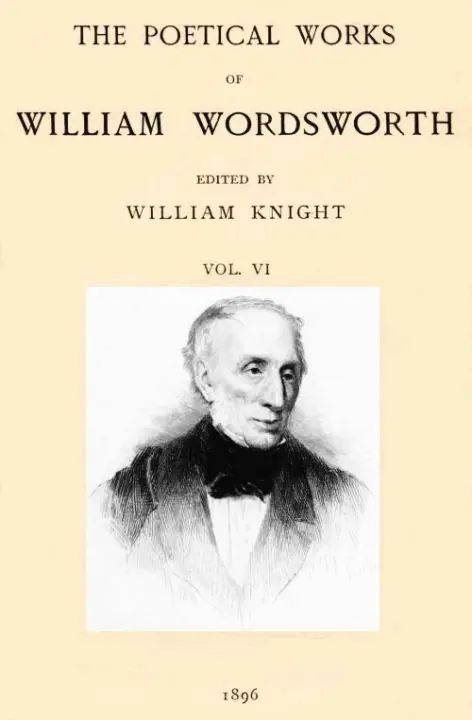
"The Poetical Works of William Wordsworth — Volume 6 (of 8)" by William Wordsworth is a collection of poetry published in the late 19th century. This volume contains a selection of Wordsworth's works from the years 1814 to 1820, showcasing his thematic focus on nature, human emotion, and the profound connection between the two. Readers can expect to find insightful reflections on personal and national identities, drawing on historical figures and settings, illustrated through the poet’s unique lens of Romanticism. The opening of this collection introduces several poems, starting with "Laodamia," which explores themes of love, loss, and the transcendent nature of human emotion through the story of a faithful wife yearning for her slain husband. Wordsworth’s mastery of language is evident as he blends mythological elements with deep emotional resonance, setting a reflective tone that permeates the selection. Additionally, the beginnings of poems such as "The Brownie's Cell" and "Yarrow Visited" highlight Wordsworth's interest in Scottish landscapes and folklore, drawing the reader into a vibrant tapestry of the natural world, as well as his reflections on heritage and history. Through these verses, Wordsworth invites readers into his intimate thoughts and contemplations, setting the foundation for a deeply enriching literary experience.
Introduction adapted from the source catalogue; source summaries may be automatically generated.
Free to read · English · 117,891 words · No account needed
MAKE TIME FOR A GOOD BOOK
On by default. Untick to stop anonymous reading totals. Each page counts after 10 seconds in view. How this works.
Anonymous counting is on unless you have switched it off.
This, and the two following sonnets, were first published in Blackwood's Magazine, vol. iv., January 1819, p. 471. They were reprinted in The Poetical Album, edited by Alaric Watts, in 1829 (Second Series, vol. i. pp. 332, 333) under the title,
"The Caves of Yorkshire." The same volume of the Album contains (p.
43) the sonnet beginning--
Not Love, not War, nor the tumultuous swell.
In the 1819 edition of Peter Bell, p. 84, a note, prefatory to the four following sonnets, occurs to this effect: "The following Sonnets having lately appeared in Periodical Publications are here reprinted."--ED.
Composed 1819.--Published 1819
One of the "Miscellaneous Sonnets."--ED.
Pure element of waters! wheresoe'er Thou dost forsake thy subterranean haunts, Green herbs, bright flowers, and berry-bearing plants, Rise[348] into life and in thy train appear: And, through the sunny portion of the year, 5 Swift insects shine, thy hovering pursuivants: And, if thy bounty fail, the forest pants; And hart and hind and hunter with his spear, Languish and droop together. Nor unfelt In man's perturbèd soul thy sway benign; 10 And, haply, far within the marble belt Of central earth, where tortured Spirits pine For grace and goodness lost, thy murmurs melt Their anguish,--and they blend sweet songs with thine.[DK]
[Footnote 347: 1820.
Sonnets, suggested ... 1819.
]
[Footnote DJ: Wordsworth visited these caves with Edward Quillinan in
1821.--ED.]
Composed 1819.--Published 1819
One of the "Miscellaneous Sonnets."--ED.
Was the aim frustrated by force or guile, When giants scooped from out the rocky ground, Tier under tier, this semicirque profound? (Giants--the same who built in Erin's isle That Causeway with incomparable toil!)-- 5 O, had this vast theatric structure wound[349][DL] With finished sweep into a perfect round, No mightier work had gained the plausive smile Of all-beholding Phoebus! But, alas, Vain earth! false world! Foundations must be laid 10 In Heaven; for, 'mid the wreck of IS and WAS, Things incomplete and purposes betrayed Make sadder transits o'er thought's optic glass[350] Than noblest objects utterly decayed.[DM]
Malham Cove is a noble amphitheatre of perpendicular limestone rock, lying in regular strata, the height being 300 feet in the centre. The Aire issues from the rock at the base of the cliff, a considerable stream. Possibly Westall's picture of Malham Cove suggested to Wordsworth the Giant's Causeway in Ireland, and its legend. They have the same columnar appearance; although the former is limestone, and the latter basalt.--ED.
[Footnote 348: 1820.
Start ...
Blackwood's Magazine, January 1819.
]
[Footnote DK: Waters (as Mr. Westall informs us in the letterpress prefixed to his admirable views) are invariably found to flow through these caverns.--W. W. 1819.]
Composed 1819.--Published 1819
One of the "Miscellaneous Sonnets."--ED.
Your reading position is saved on this browser. Take it to another device with a library code. Reading pages adapt to text, rather than matching a printed edition.
BEHIND THE BOOK
This eBook is for the use of anyone anywhere in the United States and most other parts of the world at no cost and with almost no restrictions whatsoever. You may copy it, give it away or re-use it under the terms of the Project Gutenberg License included with this eBook or online at www.gutenberg.org. If you are not located in the United States, you will have to check the laws of the country where you are located before using this eBook. Read the source licence.
The original source file, including credits and licence, is retained by this library. Request an original-format copy at no charge. Please include the book title and Project Gutenberg identifier #47651.
KEEP YOUR CURIOSITY GOING
Eric Mackay
Edmund Gosse
Sophia Margaretta Hensley
Gilbert Parker
George MacDonald

Elizabeth Bibesco