
Love Letters of a Violinist, and Other Poems
Eric Mackay
THE CLASSIC COLLECTION · 1795
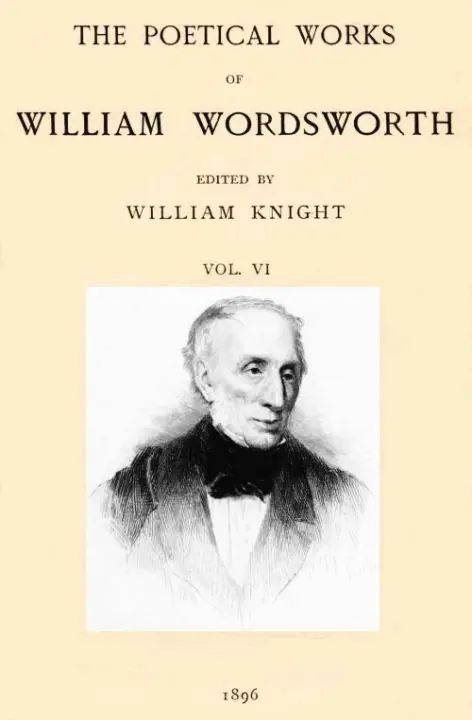
"The Poetical Works of William Wordsworth — Volume 6 (of 8)" by William Wordsworth is a collection of poetry published in the late 19th century. This volume contains a selection of Wordsworth's works from the years 1814 to 1820, showcasing his thematic focus on nature, human emotion, and the profound connection between the two. Readers can expect to find insightful reflections on personal and national identities, drawing on historical figures and settings, illustrated through the poet’s unique lens of Romanticism. The opening of this collection introduces several poems, starting with "Laodamia," which explores themes of love, loss, and the transcendent nature of human emotion through the story of a faithful wife yearning for her slain husband. Wordsworth’s mastery of language is evident as he blends mythological elements with deep emotional resonance, setting a reflective tone that permeates the selection. Additionally, the beginnings of poems such as "The Brownie's Cell" and "Yarrow Visited" highlight Wordsworth's interest in Scottish landscapes and folklore, drawing the reader into a vibrant tapestry of the natural world, as well as his reflections on heritage and history. Through these verses, Wordsworth invites readers into his intimate thoughts and contemplations, setting the foundation for a deeply enriching literary experience.
Introduction adapted from the source catalogue; source summaries may be automatically generated.
Free to read · English · 117,891 words · No account needed
MAKE TIME FOR A GOOD BOOK
On by default. Untick to stop anonymous reading totals. Each page counts after 10 seconds in view. How this works.
Anonymous counting is on unless you have switched it off.
Grasp it,--if thou shrink and tremble,
Fairest damsel of the green, 70
Thou wilt lack the only symbol
That proclaims a genuine queen;
And ensure those palms of honour
Which selected spirits wear,
Bending low before the Donor, 75
Lord of heaven's unchanging year!
[Footnote 257: 1849.
Addressed to ----, On the longest day. 1820.
]
[Footnote 258: 1845.
Sol has dropped into his harbour, MS. and 1820.
]
[Footnote 259: 1845.
Laura! ... MS. and 1820.
]
[Footnote 260: 1820.
Fix thy thoughts ... MS.
]
[Footnote 261: 1836.
Look towards Eternity! ... MS. and 1820.
]
[Footnote 262: 1820.
... her ... MS.
]
[Footnote 263: 1832.
Tow'rds ... 1820.
]
[Footnote 264: 1820.
From mysterious springs ...
And his mazes has unravelled MS.
]
[Footnote 265: This stanza is an interpolation by the poet in the MS.]
[Footnote 266: 1820.
... true ... MS.
]
Composed 1817.--Published 1820
[Bunches of fern may often be seen wheeling about in the wind as here described. The particular bunch that suggested these verses was noticed in the Pass of Dunmail Raise. The verses were composed in 1817, but the application is for all times and places.--I. F.]
Included among the "Poems of the Fancy."--ED.
"Who but hails the sight with pleasure[269]
When the wings of genius rise,
Their ability to measure
With great enterprise;
But in man was ne'er such daring 5
As yon Hawk exhibits, pairing
His brave spirit with the war in
The stormy skies!
"Mark him, how his power he uses,
Lays it by, at will resumes! 10
Mark, ere for his haunt he chooses
Clouds and utter glooms!
There, he wheels in downward mazes;
Sunward now his flight he raises,
Catches fire, as seems, and blazes 15
With uninjured plumes!"--
"Stranger,[270] 'tis no act of courage
Which aloft thou dost discern;
No bold bird gone forth to forage
'Mid the tempest stern; 20
But such mockery as the nations
See, when public perturbations[271]
Lift men from their native stations,
Like yon TUFT OF FERN;
"Such it is; the aspiring creature[272] 25
Soaring on undaunted wing,
(So you fancied) is by nature
A dull helpless thing,[273]
Dry and withered, light and yellow;--
That to be the tempest's fellow! 30
Wait--and you shall see how hollow
Its endeavouring!"
[Footnote 267: 1845.
While thy brow youth's roses crown. MS. and 1820.
]
[Footnote 268: 1827.
... political aspirants. 1820.
]
[Footnote 269: 1827.
Stranger, 'tis a sight of pleasure 1820.
]
[Footnote 270: 1827.
Traveller, ... 1820.
]
[Footnote 271: 1827.
See, when Commonwealth-vexations 1820.
]
[Footnote 272: 1827.
Such it is, and not a Haggard 1820.
]
[Footnote 273: 1827.
'Tis by nature dull and laggard,
A poor helpless Thing, 1820.
]
Composed June 27, 1817.--Published 1820
[Written at Rydal Mount. Thoughts and feelings of many walks in all weathers, by day and night, over this Pass, alone and with beloved friends.--I. F.]
Included among the "Poems of the Imagination."--ED.
Your reading position is saved on this browser. Take it to another device with a library code. Reading pages adapt to text, rather than matching a printed edition.
BEHIND THE BOOK
This eBook is for the use of anyone anywhere in the United States and most other parts of the world at no cost and with almost no restrictions whatsoever. You may copy it, give it away or re-use it under the terms of the Project Gutenberg License included with this eBook or online at www.gutenberg.org. If you are not located in the United States, you will have to check the laws of the country where you are located before using this eBook. Read the source licence.
The original source file, including credits and licence, is retained by this library. Request an original-format copy at no charge. Please include the book title and Project Gutenberg identifier #47651.
KEEP YOUR CURIOSITY GOING
Eric Mackay
Edmund Gosse
Sophia Margaretta Hensley
Gilbert Parker
George MacDonald

Elizabeth Bibesco