READ · DISCOVER · ENJOYClassic literature · Always free
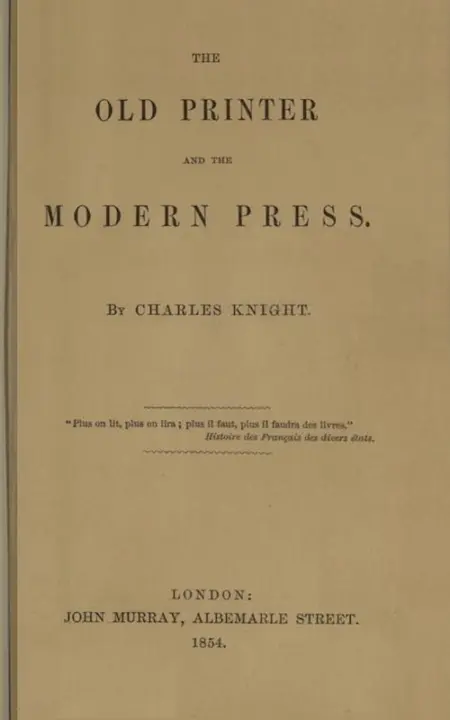
The Old Printer and the Modern Press — digital edition cover

THE CLASSIC COLLECTION · 1854

The Old Printer and the Modern Press

"The Old Printer and the Modern Press" by Charles Knight is a historical account written in the mid-19th century. The work explores the life of William Caxton, the first English printer, highlighting his contributions to the dissemination of knowledge through the printed word. The narrative reflects on various themes, including the evolution of the English language, the cultural landscape before and after the introduction of printing, and the socio-economic changes triggered by this revolutionary technology. At the start of the narrative, the context surrounding Caxton’s early life is established, particularly focusing on the Weald of Kent where he grew up. The text discusses the linguistic environment of the time, noting the transition from French to English in education, and the scarcity of books before the advent of printing. Knight paints a vivid picture of Caxton's formative years, illustrating the societal isolation and linguistic variations in his rural upbringing. The opening portion sets the stage for understanding Caxton’s later accomplishments and the profound impact of printing on English literature, culture, and society.

Introduction adapted from the source catalogue; source summaries may be automatically generated.

Start reading ↓

Free to read · English · 88,831 words · No account needed

MAKE TIME FOR A GOOD BOOK

The Old Printer and the Modern Press

On by default. Untick to stop anonymous reading totals. Each page counts after 10 seconds in view. How this works.

Anonymous counting is on unless you have switched it off.

The Old Printer and the Modern Press

It was in the autumn of 1470, when Master William Caxton would appear to have been busily labouring in some silent turret of the palace at Bruges, upon his translation of Raoul le Fevre, that an event occurred, of all others the most calculated to spread consternation in the court of Burgundy, and to make the bold duke feel that in abandoning his family alliance with the house of Lancaster he had not done the politic thing which he anticipated. Edward IV., who had sat for some years with tolerable quiet upon the English throne, to which he had fought his way in many a battlefield with prodigious bravery, suddenly arrived at Bruges, in the October of 1470, a discrowned fugitive. He made his escape from the overwhelming inroad of the power of Warwick, "attended," says Comines, "by seven or eight hundred men without any clothes but what they were to have fought in, no money in their pockets, and not one in twenty of them knew whither they were going." He, the most beautiful man of the time, as Comines describes him,—who for twelve or thirteen years of prosperity had lived a life of the most luxurious gratification,—he arrived at Bruges, after being chased by privateers, and with difficulty rescued from their hands, so poor that he "was forced to give the master of the ship for his passage a gown lined with martens." At Bruges, then, did this fugitive remain nearly five months, when he again leaped into his throne, in the following April, with a triumphant boldness which has only one parallel in modern history,—that of the march of Napoleon from Elba. In May, 1471, he addressed a letter in French to the nobles and burgomasters of Bruges, thanking them for the courtesy and hospitality he had received from them during his exile. Edward was of a sanguine temper; and, however depressed in fortune, was not likely, during those five months of humiliation, to have doubted that in good time he should regain the throne. He was of an easy and communicative disposition; and would naturally confer with his sister and her confidential servants upon his plans and prospects. Comines says, "King Edward told me that, in all the battles which he had gained, his way was, when the victory was on his side, to mount on horseback, and cry out to save the common soldiers, and put the gentry to the sword." We mention this to show that he was not indisposed to talk of himself and his doings with those whom he met during his exile. It is more than probable, then, that he had the same sort of free communication with his countryman Caxton. It was at this period that the progress of the art of printing must have been a subject of universal interest The merchants of Bruges had commercial intercourse with all the countries of Europe; and they would naturally bring to the court of Burgundy some specimens of that art which was already beginning to create a new description of commerce. From Mentz, Bamberg, Cologne, Strasburg, and Augsburg, they would bring some of the Latin and German bibles which, from 1461 to 1470, had issued from the presses of those cities. The presses of Italy, and especially of Rome, of Venice, and of Milan, had, during the same period, sent forth books, and more particularly classical works, in great abundance. The art had made such rapid progress in Italy, that in the first edition of St. Jerome's Epistles, printed in 1468, the Bishop of Aleria thus addresses Pope Paul II.: "It was reserved for the times of your holiness for the Christian world to be blessed with the immense advantages resulting from the art of printing; by means of which, and with a little money, the poorest person may collect together a few books. It is a small testimony of the glory of your holiness, that the volumes which formerly scarcely an hundred golden crowns would purchase may now be procured for twenty and less, and these well-written and authentic ones." It is pretty clear that Caxton, when he began his translation of the 'Histories of Troye,' had some larger circulation in view than could be obtained by the medium of transcription: "I thought in myself it should be a good business to translate it into our English, to the end that it might be had as well in the royaume of England as in other lands." It is also probable that he was moving about in search of the best mode of printing it; for he says, at the end of the second book of the 'Recueil,' "And for as much as I suppose the said two books be not had before this time in our English language, therefore I had the better will to accomplish the said work; which work was begun in Bruges, and continued in Gaunt [Ghent], and finished in Cologne, in time of the troublous world, and of the great divisions being and reigning as well in the royaumes of England and France as in all other places universally through the world, that is to wit, the year of our Lord one thousand, four hundred, and seventy-one." But he further says, with reference to his translation of the third book, which he doubted about doing, "because that I have now good leisure, being in Cologne, and have none other thing to do at this time in eschewing of idleness, mother of all vices, I have deliberated in myself of the contemplation of my said redoubted lady, to take this labour in hand." We shall presently see when Caxton became, or at any rate avowed himself to have become, a printer. Up to this point we see him only as a translator, a man of leisure, and not one learning a new and difficult craft. But we see him moving about from Bruges to Ghent, from Ghent to Cologne, without any distinct or specified object. There can be little doubt, we believe, that he was endeavouring to make himself acquainted with the new art, still in great measure a secret art, the masters of which required to be approached with considerable caution. That the presence of Edward IV. in Flanders, during a period when Caxton might readily have had access to his person, might have led him to believe that the time would come when, under the patronage of the restored prince, he might carry the art to London, is not an improbable conjecture. Amongst the companions of Edward's exile was his brother-in-law, the celebrated Lord Rivers. This brave and accomplished young nobleman subsequently translated a book called 'The Dictes and Sayings of Philosophers,' which Caxton printed at Westminster, in 1477. The printer has added an appendix to this translation, from which we collect that the noble author and his literary printer were upon terms of mutual confidence and regard: "At such time as he had accomplished this said work, it liked him to send it to me in certain quires to oversee.... And so afterward I came unto my said lord, and told him how I had read and seen his book, and that he had done a meritorious deed in the labour of the translation thereof.... Then my said lord desired me to oversee it, and, where as I should find fault, to correct it, wherein I answered unto his lordship that I could not amend it.... Notwithstanding he willed me to oversee it." Earl Rivers, then Lord Scales, was also at Bruges upon the occasion of the Lady Margaret's marriage. Employed, therefore, by the Duchess of Burgundy, the sister of Edward IV., and honoured with the confidence of Earl Rivers, his brother-in-law, we may reasonably believe that the presence of Edward at Bruges in 1470-71 might have had some influence upon the determination of Caxton to learn and practise the new art of printing, and to carry it into England, if the "troublous times" could afford him occasion. We have distinct evidence that Edward IV. gave a marked encouragement to the labours of Caxton as a translator, in a book printed by him without any date, 'The Life of Jason,' written, as were the 'Histories of Troy,' by Raoul le Fevre, in which Caxton says in his prologue, "For as much as late by the commandment of the right high and noble princess my Lady Margaret, &c., I translated a book out of French into English, named 'Recueil,' &c.... Therefore, under the protection and sufferance of the most high, puissant, and Christian king, my most dread natural liege, Lord Edward, &c., I intend to translate the said book of the 'Histories of Jason.'" The expression "for as much as late by the commandment, &c.," brings the date of the 'Histories of Jason' close to that of the 'Histories of Troy' and points out the probability that the protection and sufferance of Edward was afforded to Caxton when the king was a fugitive at the court of Burgundy. In the 'Issues of the Exchequer,' there is the following entry of a payment on the 15th of June, in the 19th of Edward IV., "To William Caxton, in money paid to his own hands, in discharge of twenty pounds which the lord the king commanded to be paid to the same William for certain causes and matters performed by him for the said lord the king." This is eight years after the period of Edward's exile, being in 1479. But as the productions of Caxton's press were very prolific at this time, we may believe that the payment of such a large sum for certain causes and matters performed for the king was in some degree connected with his labours in the introduction of printing into England,—a payment not improbably postponed for obligations incurred, and promises granted, at an earlier period.

Your reading position is saved on this browser. Take it to another device with a library code. Reading pages adapt to text, rather than matching a printed edition.

BEHIND THE WORDS

About Charles Knight

Charles Knight (1791–1873). Explore The Old Printer and the Modern Press in this collection. These books span history.

Explore this author’s books →

THE READERS’ VERDICT

How did this story stay with you?

Not rated yet
Your rating for The Old Printer and the Modern Press

Be the first to share your verdict.

One rating per browser, which you can change or remove. A necessary browser identifier remembers your vote. How ratings work

A GOOD STORY DESERVES COMPANY

Pass this book along.

A great read is even better when it’s shared.

SEND A LITTLE INSPIRATION

Share this book

BEHIND THE BOOK

Edition & source details.

Title
The Old Printer and the Modern Press
Author
Charles Knight
First publication (Open Library catalogue match)
1854
Digital edition publisher
Project Gutenberg
Gutenberg release date
2019-07-22
Language
English
Source edition imprint
Not stated in source catalogue
Source identifier
Project Gutenberg #59966
Contributors
No additional named contributors in source metadata

Public-domain source & licence

This eBook is for the use of anyone anywhere in the United States and most other parts of the world at no cost and with almost no restrictions whatsoever. You may copy it, give it away or re-use it under the terms of the Project Gutenberg License included with this eBook or online at www.gutenberg.org. If you are not located in the United States, you will have to check the laws of the country where you are located before using this eBook. Read the source licence.

Full source licence and obtaining an original copy

The original source file, including credits and licence, is retained by this library. Request an original-format copy at no charge. Please include the book title and Project Gutenberg identifier #59966.

the full Project Gutenberg License must appear
prominently whenever any copy of a Project Gutenberg work (any work
on which the phrase “Project Gutenberg” appears, or with which the
phrase “Project Gutenberg” is associated) is accessed, displayed,
performed, viewed, copied or distributed:

This eBook is for the use of anyone anywhere in the United States and most
other parts of the world at no cost and with almost no restrictions
whatsoever. You may copy it, give it away or re-use it under the terms
of the Project Gutenberg™ License included with this eBook or online
at www.gutenberg.org. If you
are not located in the United States, you will have to check the laws
of the country where you are located before using this eBook.

1.E.2. If an individual Project Gutenberg electronic work is
derived from texts not protected by U.S. copyright law (does not
contain a notice indicating that it is posted with permission of the
copyright holder), the work can be copied and distributed to anyone in
the United States without paying any fees or charges. If you are
redistributing or providing access to a work with the phrase “Project
Gutenberg” associated with or appearing on the work, you must comply
either with the requirements of paragraphs 1.E.1 through 1.E.7 or
obtain permission for the use of the work and the Project Gutenberg
trademark as set forth in paragraphs 1.E.8 or 1.E.9.

1.E.3. If an individual Project Gutenberg electronic work is posted
with the permission of the copyright holder, your use and distribution
must comply with both paragraphs 1.E.1 through 1.E.7 and any
additional terms imposed by the copyright holder. Additional terms
will be linked to the Project Gutenberg License for all works
posted with the permission of the copyright holder found at the
beginning of this work.

1.E.4. Do not unlink or detach or remove the full Project Gutenberg
License terms from this work, or any files containing a part of this
work or any other work associated with Project Gutenberg.

1.E.5. Do not copy, display, perform, distribute or redistribute this
electronic work, or any part of this electronic work, without
prominently displaying the sentence set forth in paragraph 1.E.1 with
active links or immediate access to the full terms of the Project
Gutenberg License.

1.E.6. You may convert to and distribute this work in any binary,
compressed, marked up, nonproprietary or proprietary form, including
any word processing or hypertext form. However, if you provide access
to or distribute copies of a Project Gutenberg work in a format
other than “Plain Vanilla ASCII” or other format used in the official
version posted on the official Project Gutenberg website
(www.gutenberg.org), you must, at no additional cost, fee or expense
to the user, provide a copy, a means of exporting a copy, or a means
of obtaining a copy upon request, of the work in its original “Plain
Vanilla ASCII” or other form. Any alternate format must include the
full Project Gutenberg License as specified in paragraph 1.E.1.

1.E.7. Do not charge a fee for access to, viewing, displaying,
performing, copying or distributing any Project Gutenberg works
unless you comply with paragraph 1.E.8 or 1.E.9.

1.E.8. You may charge a reasonable fee for copies of or providing
access to or distributing Project Gutenberg electronic works
provided that:

• You pay a royalty fee of 20% of the gross profits you derive from
the use of Project Gutenberg works calculated using the method
you already use to calculate your applicable taxes. The fee is owed
to the owner of the Project Gutenberg trademark, but he has
agreed to donate royalties under this paragraph to the Project
Gutenberg Literary Archive Foundation. Royalty payments must be paid
within 60 days following each date on which you prepare (or are
legally required to prepare) your periodic tax returns. Royalty
payments should be clearly marked as such and sent to the Project
Gutenberg Literary Archive Foundation at the address specified in
Section 4, “Information about donations to the Project Gutenberg
Literary Archive Foundation.”

• You provide a full refund of any money paid by a user who notifies
you in writing (or by e-mail) within 30 days of receipt that s/he
does not agree to the terms of the full Project Gutenberg™
License. You must require such a user to return or destroy all
copies of the works possessed in a physical medium and discontinue
all use of and all access to other copies of Project Gutenberg™
works.

• You provide, in accordance with paragraph 1.F.3, a full refund of
any money paid for a work or a replacement copy, if a defect in the
electronic work is discovered and reported to you within 90 days of
receipt of the work.

• You comply with all other terms of this agreement for free
distribution of Project Gutenberg™ works.


1.E.9. If you wish to charge a fee or distribute a Project
Gutenberg™ electronic work or group of works on different terms than
are set forth in this agreement, you must obtain permission in writing
from the Project Gutenberg Literary Archive Foundation, the manager of
the Project Gutenberg™ trademark. Contact the Foundation as set
forth in Section 3 below.

1.F.

1.F.1. Project Gutenberg volunteers and employees expend considerable
effort to identify, do copyright research on, transcribe and proofread
works not protected by U.S. copyright law in creating the Project
Gutenberg™ collection. Despite these efforts, Project Gutenberg™
electronic works, and the medium on which they may be stored, may
contain “Defects,” such as, but not limited to, incomplete, inaccurate
or corrupt data, transcription errors, a copyright or other
intellectual property infringement, a defective or damaged disk or
other medium, a computer virus, or computer codes that damage or
cannot be read by your equipment.

1.F.2. LIMITED WARRANTY, DISCLAIMER OF DAMAGES - Except for the “Right
of Replacement or Refund” described in paragraph 1.F.3, the Project
Gutenberg Literary Archive Foundation, the owner of the Project
Gutenberg™ trademark, and any other party distributing a Project
Gutenberg™ electronic work under this agreement, disclaim all
liability to you for damages, costs and expenses, including legal
fees. YOU AGREE THAT YOU HAVE NO REMEDIES FOR NEGLIGENCE, STRICT
LIABILITY, BREACH OF WARRANTY OR BREACH OF CONTRACT EXCEPT THOSE
PROVIDED IN PARAGRAPH 1.F.3. YOU AGREE THAT THE FOUNDATION, THE
TRADEMARK OWNER, AND ANY DISTRIBUTOR UNDER THIS AGREEMENT WILL NOT BE
LIABLE TO YOU FOR ACTUAL, DIRECT, INDIRECT, CONSEQUENTIAL, PUNITIVE OR
INCIDENTAL DAMAGES EVEN IF YOU GIVE NOTICE OF THE POSSIBILITY OF SUCH
DAMAGE.

1.F.3. LIMITED RIGHT OF REPLACEMENT OR REFUND - If you discover a
defect in this electronic work within 90 days of receiving it, you can
receive a refund of the money (if any) you paid for it by sending a
written explanation to the person you received the work from. If you
received the work on a physical medium, you must return the medium
with your written explanation. The person or entity that provided you
with the defective work may elect to provide a replacement copy in
lieu of a refund. If you received the work electronically, the person
or entity providing it to you may choose to give you a second
opportunity to receive the work electronically in lieu of a refund. If
the second copy is also defective, you may demand a refund in writing
without further opportunities to fix the problem.

1.F.4. Except for the limited right of replacement or refund set forth
in paragraph 1.F.3, this work is provided to you ‘AS-IS’, WITH NO
OTHER WARRANTIES OF ANY KIND, EXPRESS OR IMPLIED, INCLUDING BUT NOT
LIMITED TO WARRANTIES OF MERCHANTABILITY OR FITNESS FOR ANY PURPOSE.

1.F.5. Some states do not allow disclaimers of certain implied
warranties or the exclusion or limitation of certain types of
damages. If any disclaimer or limitation set forth in this agreement
violates the law of the state applicable to this agreement, the
agreement shall be interpreted to make the maximum disclaimer or
limitation permitted by the applicable state law. The invalidity or
unenforceability of any provision of this agreement shall not void the
remaining provisions.

1.F.6. INDEMNITY - You agree to indemnify and hold the Foundation, the
trademark owner, any agent or employee of the Foundation, anyone
providing copies of Project Gutenberg™ electronic works in
accordance with this agreement, and any volunteers associated with the
production, promotion and distribution of Project Gutenberg™
electronic works, harmless from all liability, costs and expenses,
including legal fees, that arise directly or indirectly from any of
the following which you do or cause to occur: (a) distribution of this
or any Project Gutenberg work, (b) alteration, modification, or
additions or deletions to any Project Gutenberg work, and (c) any
Defect you cause.

Section 2. Information about the Mission of Project Gutenberg

Project Gutenberg is synonymous with the free distribution of
electronic works in formats readable by the widest variety of
computers including obsolete, old, middle-aged and new computers. It
exists because of the efforts of hundreds of volunteers and donations
from people in all walks of life.

Volunteers and financial support to provide volunteers with the
assistance they need are critical to reaching Project Gutenberg’s
goals and ensuring that the Project Gutenberg collection will
remain freely available for generations to come. In 2001, the Project
Gutenberg Literary Archive Foundation was created to provide a secure
and permanent future for Project Gutenberg and future
generations. To learn more about the Project Gutenberg Literary
Archive Foundation and how your efforts and donations can help, see
Sections 3 and 4 and the Foundation information page at www.gutenberg.org.

Section 3. Information about the Project Gutenberg Literary Archive Foundation

The Project Gutenberg Literary Archive Foundation is a non-profit
501(c)(3) educational corporation organized under the laws of the
state of Mississippi and granted tax exempt status by the Internal
Revenue Service. The Foundation’s EIN or federal tax identification
number is 64-6221541. Contributions to the Project Gutenberg Literary
Archive Foundation are tax deductible to the full extent permitted by
U.S. federal laws and your state’s laws.

The Foundation’s business office is located at 41 Watchung Plaza #516,
Montclair NJ 07042, USA, +1 (862) 621-9288. Email contact links and up
to date contact information can be found at the Foundation’s website
and official page at www.gutenberg.org/contact

Section 4. Information about Donations to the Project Gutenberg
Literary Archive Foundation

Project Gutenberg™ depends upon and cannot survive without widespread
public support and donations to carry out its mission of
increasing the number of public domain and licensed works that can be
freely distributed in machine-readable form accessible by the widest
array of equipment including outdated equipment. Many small donations
($1 to $5,000) are particularly important to maintaining tax exempt
status with the IRS.

The Foundation is committed to complying with the laws regulating
charities and charitable donations in all 50 states of the United
States. Compliance requirements are not uniform and it takes a
considerable effort, much paperwork and many fees to meet and keep up
with these requirements. We do not solicit donations in locations
where we have not received written confirmation of compliance. To SEND
DONATIONS or determine the status of compliance for any particular state
visit www.gutenberg.org/donate.

While we cannot and do not solicit contributions from states where we
have not met the solicitation requirements, we know of no prohibition
against accepting unsolicited donations from donors in such states who
approach us with offers to donate.

International donations are gratefully accepted, but we cannot make
any statements concerning tax treatment of donations received from
outside the United States. U.S. laws alone swamp our small staff.

Please check the Project Gutenberg web pages for current donation
methods and addresses. Donations are accepted in a number of other
ways including checks, online payments and credit card donations. To
donate, please visit: www.gutenberg.org/donate.

Section 5. General Information About Project Gutenberg electronic works

Professor Michael S. Hart was the originator of the Project
Gutenberg concept of a library of electronic works that could be
freely shared with anyone. For forty years, he produced and
distributed Project Gutenberg eBooks with only a loose network of
volunteer support.

Project Gutenberg eBooks are often created from several printed
editions, all of which are confirmed as not protected by copyright in
the U.S. unless a copyright notice is included. Thus, we do not
necessarily keep eBooks in compliance with any particular paper
edition.

Most people start at our website which has the main PG search
facility: www.gutenberg.org.

This website includes information about Project Gutenberg,
including how to make donations to the Project Gutenberg Literary
Archive Foundation, how to help produce our new eBooks, and how to
subscribe to our email newsletter to hear about new eBooks.


KEEP YOUR CURIOSITY GOING

Your next chapter awaits.