THE CLASSIC COLLECTION✦An outlaw’s diary: the CommuneCLASSIC FREE BOOKS
An outlaw’s diary: the Commune
Cécile Tormay
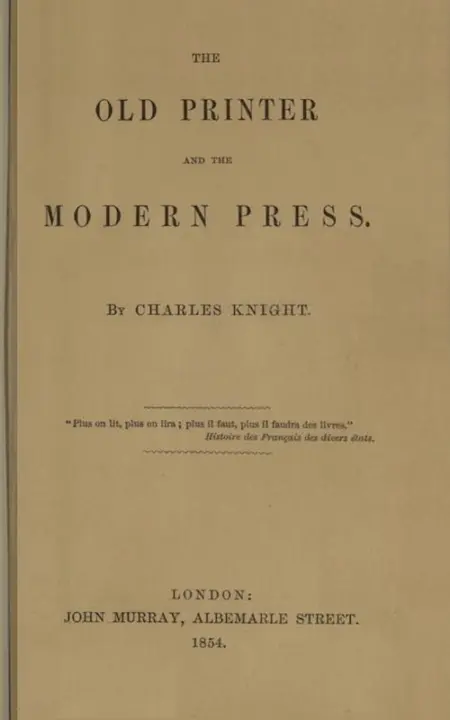
THE CLASSIC COLLECTION · 1854
"The Old Printer and the Modern Press" by Charles Knight is a historical account written in the mid-19th century. The work explores the life of William Caxton, the first English printer, highlighting his contributions to the dissemination of knowledge through the printed word. The narrative reflects on various themes, including the evolution of the English language, the cultural landscape before and after the introduction of printing, and the socio-economic changes triggered by this revolutionary technology. At the start of the narrative, the context surrounding Caxton’s early life is established, particularly focusing on the Weald of Kent where he grew up. The text discusses the linguistic environment of the time, noting the transition from French to English in education, and the scarcity of books before the advent of printing. Knight paints a vivid picture of Caxton's formative years, illustrating the societal isolation and linguistic variations in his rural upbringing. The opening portion sets the stage for understanding Caxton’s later accomplishments and the profound impact of printing on English literature, culture, and society.
Introduction adapted from the source catalogue; source summaries may be automatically generated.
Free to read · English · 88,831 words · No account needed
MAKE TIME FOR A GOOD BOOK
On by default. Untick to stop anonymous reading totals. Each page counts after 10 seconds in view. How this works.
Anonymous counting is on unless you have switched it off.
Mr. Hallam, in his 'Literature of Europe,' noticing the progress of printing, says that several books were printed in Paris in 1470 and 1471, adding, "But there seem to be unquestionable proofs that a still earlier specimen of typography is due to an English printer, the famous Caxton. His 'Recueil des Histoires de Troye' appears to have been printed during the life of Philip, Duke of Burgundy, and consequently before June 15, 1467. The place of publication, certainly within the duke's dominions, has not been conjectured. It is, therefore, by several years the earliest printed book in the French language. A Latin speech by Russell, ambassador of Edward IV. to Charles of Burgundy, in 1469, is the next publication of Caxton. This was also printed in the Low Countries." The authority upon which the learned and accomplished historian of the Middle Ages relies for this statement is that of Mr. Dibdin, in his 'Typographical Antiquities.' The French edition of the 'Recueil des Histoires de Troye' bears no printer's name, date, or place. It purports to have been composed by Raoul le Fevre, chaplain to Duke Philip de Bourgoyne, in the year 1464. The evidence that this book was printed by Caxton was summed up by Mr. Bryant, and communicated by him to Mr. Herbert, the first editor of Ames's 'Typographical Antiquities.' The Rev. Mr. Dibdin, the second editor, says that these memoranda of Mr. Bryant's "clearly prove it to have been the production of Caxton." The argument rests upon these points: that the French and English editions of Le Fevre's work have an exact conformity and likeness throughout, for not only the page itself, but the number of lines in a page, the length, breadth, and intervals of the lines, are alike in both, and the letters, great and small, are of the same magnitude. It corresponds too with 'The Game of the Chess,' printed by Caxton in England, in 1474. "These considerations," says Mr. Bryant, "settle who the printer was." We venture to doubt this. Mr. Bryant has himself shown how this resemblance might be produced between books printed by Caxton, and books supposed to be printed by him, without Caxton being the actual printer. "Mentz was taken by the Duke of Saxony in the year 1462, and most of the artificers employed by John Fust, the great inventor, were dispersed abroad. I make no doubt but Caxton, who was at no great distance from Mentz, took this opportunity of making himself a master of the mystery, which he had been at much trouble and expense to obtain. This I imagine he effected by taking into pay some of Fust's servants, and settling them for a time at Cologne. Of this number probably were Pinson and Rood, Mechlin, Lettou, and Wynkyn de Worde. With the help of some of these, he printed the book [which Wynkyn de Worde says Caxton printed] 'Bartholomeus de Prop. Rerum,' and the translation of the 'Recueil;' and probably many other books, which, being either in French or Latin, were not vendible in our country, and consequently no copies are extant here. Of all the books he printed in England, I do not remember above one in a foreign language." The calamity which drove the printers of Mentz from their homes, the storming of the city by Adolphus of Nassau, would naturally disperse their types, as well as break up their workshops. The resemblance between the doubtful books, and books undoubtedly printed by Caxton, was the resemblance of types cast in the same matrices; the spaces between the lines, as well as the form and magnitude of the letters, were produced by the letters being cast in the same mould. The resemblance would have been equally produced whether the types were used by one and the same printer, or by two printers. The typographical antiquarians say that the same types are used in the French and English works of Le Fevre and in Caxton's 'Game of Chess;' and Mr. Herbert adds, that the types are the same as those used by Fust and Schoeffer, the partners of Guttenberg. If the resemblance of types were sufficient to determine the printer of two or more books, then Fust and Schoeffer ought to be called the printers of the French 'Recueil,' as well as of the English translation which Caxton says he printed at Cologne. There can be little doubt that, when Caxton went to Cologne to be a printer in 1471, he became possessed of the types and matrices with which he printed his translation of Le Fevre, and subsequently brought to England to print his 'Game of Chess.' Another printer might have preceded him in their possession, and might have received them direct from Fust and Schoeffer. When the art ceased to be a mystery, a profit might arise from selling the types or multiplying the matrices. Upon these considerations we wholly demur to the assertion, resting solely upon this resemblance, that Caxton was a printer during the life of Philip le Bon. The belief is entirely opposed to his own statement, that shortly after the death of this prince he was completely at leisure, and set about a translation to while away his time. To be a printer in those days was a mighty undertaking. We shall subsequently see that he declares that he had practised and learnt the art at great charge and expense. It is wholly unlikely, also, that so gossiping a man, who makes a familiar friend of his readers, telling them of almost every circumstance that led to the printing of every book, that he in his translation should not have said one word of being the printer of the original work. The other book, the Latin speech by Russell, in 1469, which has been called the second publication of Caxton, is attributed to him absolutely upon no other grounds than the same resemblance of type. Assuredly we cannot receive the fact of resemblance as conclusive of Caxton being the printer either in this case or in that of the preceding. He tells us that in 1470 he was a servant receiving yearly fee from the Duchess of Burgundy, and completed an extensive work at her command, which he simply began "to eschew sloth and idleness," and to put himself "unto virtuous occupation and business." When he did fairly become a printer, he left sufficiently clear indications of his habitual industry. We have no question how he filled up his time when the press at Westminster was at work.
Your reading position is saved on this browser. Take it to another device with a library code. Reading pages adapt to text, rather than matching a printed edition.
BEHIND THE BOOK
This eBook is for the use of anyone anywhere in the United States and most other parts of the world at no cost and with almost no restrictions whatsoever. You may copy it, give it away or re-use it under the terms of the Project Gutenberg License included with this eBook or online at www.gutenberg.org. If you are not located in the United States, you will have to check the laws of the country where you are located before using this eBook. Read the source licence.
The original source file, including credits and licence, is retained by this library. Request an original-format copy at no charge. Please include the book title and Project Gutenberg identifier #59966.
KEEP YOUR CURIOSITY GOING
Cécile Tormay

Moritz Busch
John L. Ransom
Frances Wright
Cécile Tormay

Mabel Potter Daggett