
Last letters from the living dead man
David Patterson (Spirit) Hatch
THE CLASSIC COLLECTION · 1897
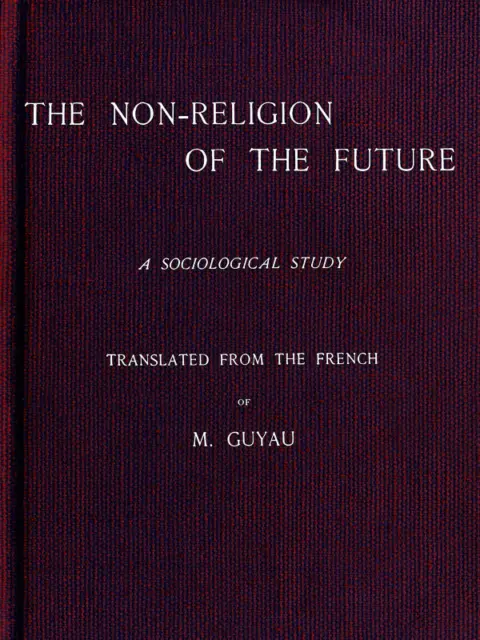
"The Non-religion of the Future: A Sociological Study" by Jean-Marie Guyau is a sociological study written in the late 19th century. The work examines the evolution of religious belief and the rise of a state of "non-religion" as a potential future for humanity, arguing against the permanence of dogmatic religions. Guyau explores the interplay between religion, aesthetics, and morals, suggesting that as society progresses, religious forms may dissolve, giving way to a more individualistic and rational approach to existence. The opening of the book introduces the central thesis that religion has originated and evolved through sociological rather than metaphysical processes. Guyau discusses various definitions of religion and emphasizes that the essence of all religious conceptions is the social bond between humanity and a cosmic society. He critiques both traditional and modern interpretations of religion, positing that all forms have evolved from primitive social understandings. The text sets the stage for a deeper exploration of how these religious roots may lead to a future where non-religious or rational frameworks fulfill humanity's social and moral needs, moving beyond mere dogma and myth.
Introduction adapted from the source catalogue; source summaries may be automatically generated.
Free to read · English · 214,102 words · No account needed
MAKE TIME FOR A GOOD BOOK
On by default. Untick to stop anonymous reading totals. Each page counts after 10 seconds in view. How this works.
Anonymous counting is on unless you have switched it off.
[Sidenote: Modern German historical criticism and liberal
Protestantism.]
Thus understood, liberal Protestantism is a doctrine that merits discussion; only it is sadly in lack of any distinguishing characteristic especially to mark it off from the numerous philosophical sects which, in the course of history, have gathered about the opinions of some man and endeavoured to identify his teachings with the truth and to lend to them an authority more than human. Pythagoras was for his disciples what Jesus is to the liberal Protestant. The traditional respect also of the Epicureans for their master is well known, the sort of worship they rendered him, the authority that they lent to his words.[60] Pythagoras brought to light a great idea, that of the harmony which governs the physical and moral universe; Epicurus, another, that of the happiness which is the true aim of rational conduct, the measure of goodness, and even of truth; and by their disciples these two great ideas came to be looked upon not as parts of the truth but as truth itself in its entirety; they saw no ground for further search. In the same way, in our own times, the Positivists see in Auguste Comte not a profound thinker simply, but one who has laid his finger, so to speak, on the definitive verity, one who has traversed at a dash the whole domain of intelligence and traced out once for all its limits. It is rigorously exact to say that Auguste Comte is a sort of Christ for bigoted Positivists—a Christ a trifle too recent, who did not have the happiness of dying on the cross. Each of these sects reposes on the following belief: Before Pythagoras, Epicurus, or Comte, nobody had seen the truth; after them nobody will ever see it more clearly. Such a creed implicitly denies: 1. Historical continuity, the inevitable result of which is that the man of genius is always more or less the expression of his century and that the honour of his discoveries is not due wholly to himself; 2. Human evolution, the inevitable result of which is that the man of genius cannot be the expression of all the centuries to come—that his point of view must necessarily be some day passed by—that the truth discovered by him is not the whole truth but simply a stage in the infinite progress of the human mind. A deus dixit is comprehensible, or if not comprehensible at least conceivable; but to resuscitate in favour of some mere human being, were it Jesus himself, the magister dixit of the Middle Ages, is a bit of an anachronism. Geometers have always held Euclid in the highest respect, but each of them has done his best to contribute some new theorem to the body of doctrine that he left behind; and is the rule for moral truth not the same as that for mathematical truth? Is it within the compass of one man’s powers to know and to utter all that there is to be known? Is an autocracy the only form of government in the sphere of mind? Liberal Protestants speak to us of the “secret of Jesus”; but there are many secrets in this world, and each of us carries his own; and who shall utter the secret of secrets, the last word, the supreme verity? Nobody in particular, probably; truth is the product of a prodigious co-operation, at which all peoples and all generations must work. The horizon of truth can neither be taken in at a single glance nor contracted; to perceive the whole of it one must move forward incessantly, and at every step a new perspective is laid bare. For humanity, to live is to learn; and before any individual human being can tell us the great secret, he must have lived the life of humanity, the lives of all existing beings and even of all existing things, which seem scarcely to deserve the name of beings; he must have concentrated in himself the universe. There can therefore properly be no religion centred about a man. A man, be he Jesus himself, cannot attach the human spirit to himself as to a fixed point. Liberal Protestants think that they have seen the last of the Strausses and Renans and their destructive criticism, because they have admitted once for all that Jesus was not a god, but criticism will object to them that the non-supernatural Messiah that they cherish is himself a pure figment of the imagination. According to the rationalistic exegesis, the doctrine of Christ, like his life, belongs more or less to the domain of legend. Jesus never so much as conceived an idea of the redemption—the very conception that is which lies at the root of Christianity; he never so much as conceived an idea of the Trinity. If one may rely upon works which stand perhaps shoulder to shoulder with that of Strauss—the works of F. A. Müller, of Professor Weiss, of M. Havet—Jesus was a Jew with the spiritual limitations of a Jew. His dominant idea was that the end of the world was at hand and that on a new-created earth would soon be realized the national kingdom looked for by the Jews in the form of an altogether terrestrial theocracy. The end of the world being near, it was naturally not worth while to set up an establishment on earth for the short time that it was still to exist; one’s entire business was properly with penitence and the amendment of one’s conduct, in order not to be devoured by fire at the day of judgment and excluded from the kingdom to be founded on the new-created earth. Moreover, Jesus preached neglect of the state, of the administration of justice, of the family, of labour and of property; in effect, of all the essential elements of social life. Evangelical morality itself presents to the critics of this school little more than a disorderly mixture of the precepts of Moses on disinterested love with the doctrine of Hillel more or less well founded on enlightened self-interest. The original element in the New Testament consisted less in the logical coherence of its teachings than in a certain unction in the language employed, in a persuasive eloquence which often took the place of reasoning. All that Christ said others had said before him, but not with the same accent. In effect, German historical criticism at once professes the greatest admiration for the numerous founders of Christianity and leads its followers a long way from the ideal man conceived by the Neo-Christians as being the man-God whom primitive Christians adored. There exists accordingly no more reason to attribute an element of revelation or of sacred authority to the New Testament than to the Vedas or to any other religious book. If Christianity is a symbolic faith, the myths of India may quite as well be adopted as a basis of symbolism as the myths of the Bible. And contemporary Brahmaists with their eclecticism, confused and mystic as it often is, must be regarded as even nearer to the truth than the liberal Protestants who still look for shelter and salvation nowhere but under the diminishing shadow of the cross.
Your reading position is saved on this browser. Take it to another device with a library code. Reading pages adapt to text, rather than matching a printed edition.
BEHIND THE BOOK
This eBook is for the use of anyone anywhere in the United States and most other parts of the world at no cost and with almost no restrictions whatsoever. You may copy it, give it away or re-use it under the terms of the Project Gutenberg License included with this eBook or online at www.gutenberg.org. If you are not located in the United States, you will have to check the laws of the country where you are located before using this eBook. Read the source licence.
The original source file, including credits and licence, is retained by this library. Request an original-format copy at no charge. Please include the book title and Project Gutenberg identifier #47421.
KEEP YOUR CURIOSITY GOING
David Patterson (Spirit) Hatch

David Patterson (Spirit) Hatch

David Patterson (Spirit) Hatch
Coulson Kernahan

Ralph Waldo Emerson
Frances Wright