
Last letters from the living dead man
David Patterson (Spirit) Hatch
THE CLASSIC COLLECTION · 1897
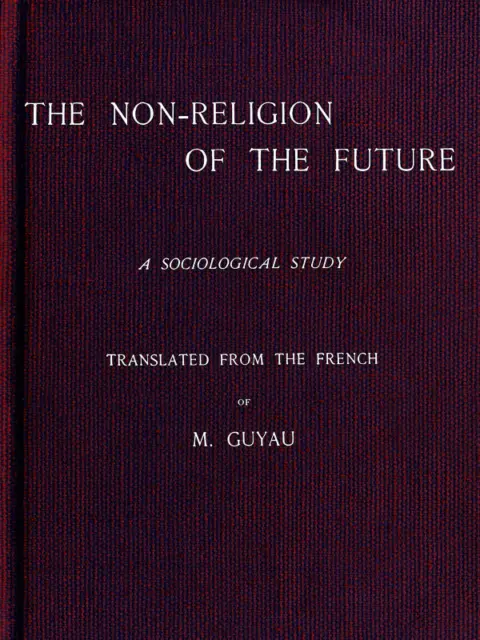
"The Non-religion of the Future: A Sociological Study" by Jean-Marie Guyau is a sociological study written in the late 19th century. The work examines the evolution of religious belief and the rise of a state of "non-religion" as a potential future for humanity, arguing against the permanence of dogmatic religions. Guyau explores the interplay between religion, aesthetics, and morals, suggesting that as society progresses, religious forms may dissolve, giving way to a more individualistic and rational approach to existence. The opening of the book introduces the central thesis that religion has originated and evolved through sociological rather than metaphysical processes. Guyau discusses various definitions of religion and emphasizes that the essence of all religious conceptions is the social bond between humanity and a cosmic society. He critiques both traditional and modern interpretations of religion, positing that all forms have evolved from primitive social understandings. The text sets the stage for a deeper exploration of how these religious roots may lead to a future where non-religious or rational frameworks fulfill humanity's social and moral needs, moving beyond mere dogma and myth.
Introduction adapted from the source catalogue; source summaries may be automatically generated.
Free to read · English · 214,102 words · No account needed
MAKE TIME FOR A GOOD BOOK
On by default. Untick to stop anonymous reading totals. Each page counts after 10 seconds in view. How this works.
Anonymous counting is on unless you have switched it off.
[59] Dr. Junqua, whose name almost became celebrated a few years ago, also tried to found a church, the Church of Liberty; those who entered were at liberty to believe almost anything they liked, not even the atheist, properly so called, being excluded. The church in question was to have been purely symbolic: baptism it was to recognize as the symbol of initiation into Christian civilization; confirmation as the symbol of an enrolment among the soldiers of Liberty; and the eucharist, that is to say a religious love feast, as the symbol of the brotherhood of man. It is to be added that these sacraments were not obligatory and that the members might abstain from them entirely if they chose. Still, they would be members of a communion. Their faith would be designated by a common name, they would be in relations with a priest who would comment in their presence on texts of the New Testament, and would talk of Christ if he and they believed in Him. The church of Dr. Junqua might easily have succeeded in England with Mr. Moncure Conway and the secularists.
[Sidenote: Neo-Christianity.]
Let us endeavour, however, to enter more intimately into the thoughts of those who may be called the Neo-Christians, and let us seek for the element of truth, if such there be, that their much-criticised doctrine contains. If Jesus is only a man, they say, he is at least the most extraordinary of men; at one bound, by an intuition at once natural and divine, he discovered the supreme truth necessary to the life of humanity; he is in advance of all times, he spoke not only for his own people, nor for his own century, nor even for a score of centuries; his voice rolled beyond the restricted circle of his auditors, and the twelve apostles, beyond the people of Judea prostrate before him, to us in whose ears it sounds the eternal truth; and it finds us even still attentive, listening, trying to understand it, incapable of finding a substitute for it. “In Jesus,” writes Pastor Bost in his work on “Le Protestantisme libéral,” “the mingling of the human and the divine was accomplished in proportions not seen elsewhere. His relation to God is the normal and typical relation of humanity to the Creator.... Jesus stands forever as the model.” Professor Herman Schultz in a conference in Göttingen, some years ago, also expressed the same idea, that Jesus is really the Messiah, properly so called, in the sense that the Jews attached to that word. He did found the kingdom of God, not it is true by marvellous exploits like those of Moses or of Elias, but by an exploit surpassing theirs, by the sacrifice of love, by the voluntary gift of himself. The apostles and Christians in general did not believe in Jesus because of the miracles he performed: they accepted his miracles owing to their previous faith in him, a faith the true foundation of which lay in Christ’s moral superiority, and that subsists still even if one deny the miracles. Professor Schultz concludes, against Strauss and M. Renan, that “a belief in Christ is wholly independent of the results of a historical criticism of his life.” Every one of the actions attributed to Jesus may be mythical, but there remain to us his words and his thoughts, which find in us an eternal echo. There are things which one discovers once for all, and whosoever has found love has made a discovery that is not illusory nor of brief duration. Is it not just that men should group themselves about him, range themselves under his name? He himself loves to call himself the Son of Man; it is under this title that humanity should revere him. It is not destruction but reconstruction that is the outcome of contemporary biblical exegesis, one of the representatives of English Unitarianism, the Rev. A. Armstrong, said in 1883. It adds to our love of Jesus to recognize in him a brother and to see in the marvellous legends associated with him no more than the symbol of a love more naïve than ours, that namely of his disciples. Proof by miracle is but the ultimate form of a temptation from which humanity should escape. In the symbolic story of the temptation in the desert, Satan says: “Command that these stones be made bread;” he urged Christ to be guilty of a miracle, of the prestidigitation which the ancient prophets had employed so frequently to strike the imagination of the people. But Jesus refused. And on another occasion he said to the people indignantly: If you did not see prodigies and miracles you do not believe, and to the Pharisees: “Ye hypocrites, ye can discern the face of the sky and of the earth, ... and why even of yourselves judge ye not what is right?” It is by the testimony of our own souls, say the Neo-Christians; it is by our own individual conscience, our own individual reason, that we shall find justice in the word of Christ, and that we shall revere it; and this word is not true because it is divine, it is divine because it is true.
Your reading position is saved on this browser. Take it to another device with a library code. Reading pages adapt to text, rather than matching a printed edition.
BEHIND THE BOOK
This eBook is for the use of anyone anywhere in the United States and most other parts of the world at no cost and with almost no restrictions whatsoever. You may copy it, give it away or re-use it under the terms of the Project Gutenberg License included with this eBook or online at www.gutenberg.org. If you are not located in the United States, you will have to check the laws of the country where you are located before using this eBook. Read the source licence.
The original source file, including credits and licence, is retained by this library. Request an original-format copy at no charge. Please include the book title and Project Gutenberg identifier #47421.
KEEP YOUR CURIOSITY GOING
David Patterson (Spirit) Hatch

David Patterson (Spirit) Hatch

David Patterson (Spirit) Hatch
Coulson Kernahan

Ralph Waldo Emerson
Frances Wright