
Last letters from the living dead man
David Patterson (Spirit) Hatch
THE CLASSIC COLLECTION · 1897
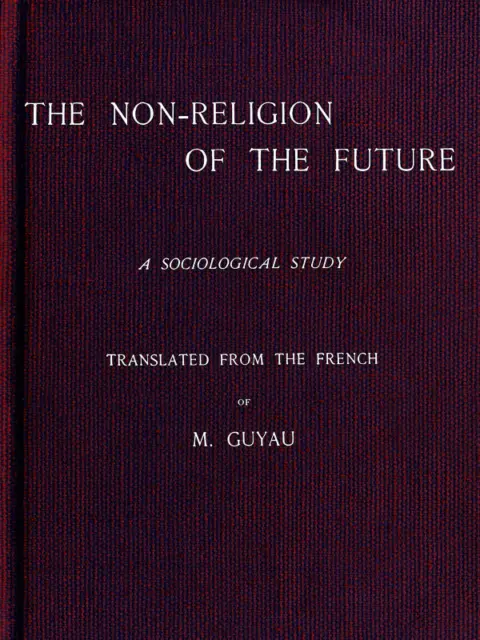
"The Non-religion of the Future: A Sociological Study" by Jean-Marie Guyau is a sociological study written in the late 19th century. The work examines the evolution of religious belief and the rise of a state of "non-religion" as a potential future for humanity, arguing against the permanence of dogmatic religions. Guyau explores the interplay between religion, aesthetics, and morals, suggesting that as society progresses, religious forms may dissolve, giving way to a more individualistic and rational approach to existence. The opening of the book introduces the central thesis that religion has originated and evolved through sociological rather than metaphysical processes. Guyau discusses various definitions of religion and emphasizes that the essence of all religious conceptions is the social bond between humanity and a cosmic society. He critiques both traditional and modern interpretations of religion, positing that all forms have evolved from primitive social understandings. The text sets the stage for a deeper exploration of how these religious roots may lead to a future where non-religious or rational frameworks fulfill humanity's social and moral needs, moving beyond mere dogma and myth.
Introduction adapted from the source catalogue; source summaries may be automatically generated.
Free to read · English · 214,102 words · No account needed
MAKE TIME FOR A GOOD BOOK
On by default. Untick to stop anonymous reading totals. Each page counts after 10 seconds in view. How this works.
Anonymous counting is on unless you have switched it off.
The task undertaken by a state that is endeavouring to substitute a lay for a clerical education is one of increasing importance. The law ought, no doubt, to recognize all religions as equal, but, as has been remarked,[82] there are two ways in which this recognition may be conducted: the one passive, the other active. The government may stand neutral simply, and abstain from either refuting or from giving comfort to the pretensions of any given system of theology; or it may be actively neuter, that is to say, it may pursue its task of scientific and philosophical achievement in complete indifference to any and every system of theology.[83] It is a neutrality of the latter sort that should be practised in primary and secondary instruction, and that should govern the conduct of the instructor.
[82] M. Goblet d’Alviella.
[83] “Lay education,” said Littré, “ought not to avoid dealing with anything which is essential; and what could be more essential in considering the moral government of society than the religions which have dominated or still dominate it?”
[Sidenote: Importance of the schoolmaster.]
The schoolmaster has always been a mark for raillery, and sometimes justly so; to-day he is slightly regarded by everyone with any pretensions to high acquirements. Renan and Taine, and partisans generally of an intellectual aristocracy, can scarcely suppress a smile at the mention of this representative of democracy, of science for small children. University professors show small tolerance for the pedantry of their humble assistant, who is sometimes ignorant of Greek. Men of culture, with any tincture of poetry or of art, regard the man as something very prosaic and utilitarian whose main ambition is to instruct some thousands of peasants in the alphabet, grammar, and the names of the principal cities of Europe, and of the geographical localities from which we obtain pepper and coffee. And yet this despised schoolmaster, whose importance is daily increasing, is the sole middle-man between the belated masses and the intellectual élite, who are moving ever more and more rapidly forward. He has the advantage of being necessary and the disadvantage of knowing it; buried in his remote village, his accomplishments impress him almost as much as they do the children and the peasantry about him; the optical illusion is a natural one. But if an exaggerated estimate of his own importance sometimes gives rise in him to an offensive pedantry, it supplies him with the sort of devotion that enables a humble functionary to rise to the height of the duties to which he has been called. And who, after all, but society, is responsible for the fashioning and instruction of the schoolmaster? And cannot society raise the level of his intelligence in proportion as it increases the magnitude of his task? A little knowledge makes a pedant, much knowledge makes a scholar. There will always be schoolmasters who will be as well educated as one could wish, provided only that their salaries are raised side by side with the list of required studies. It is strange that a society should not do its best to form those whose function it is in turn to form it. The great question of popular education becomes in certain aspects a question of shillings and pence. The practical instruction of schoolmasters has already been carried to a certain degree of perfection; he has been initiated into an apprenticeship, and introduced, as it were, into the kitchen of certain sciences; he has been supplied with notions on agriculture and chemistry which often enable him to give excellent advice to the peasantry. It would be very easy a little to perfect his theoretical knowledge, to give him a broader knowledge of the sciences which he considers too exclusively on their practical side, to give him some conception of things as a whole, to raise him above an exclusive adoration of the isolated facts of historical or grammatical minutiæ. A little philosophy would make a better historian and a less tedious geographer. He might be introduced to the great cosmological hypotheses, to some sufficient notions of psychology, and in especial of child-psychology, and finally a little history of religion would familiarize him with the principal metaphysical speculations that the human mind has put forth in its endeavour to pass beyond the bounds of science; he would become, as a result of it, more tolerant in all matters of religious belief. This more extended instruction would permit him to follow at a distance the progress of science; his intelligence would not stand still, he would not come to his complete maturity somewhere between the ABC-book and the grammar. Moreover, intellectual elevation is always accompanied by a moral elevation which manifests itself in all the conduct of life, and sometimes a word from a schoolmaster may change all the rest of a pupil’s existence. The greater one’s intellectual, and in especial, one’s moral superiority, the greater one’s influence over those about one. Even at the present time the very modest amount of knowledge at the disposal of the ordinary teacher gives him a very genuine influence; he is believed in, his words are listened to and accepted. The peasant—that doubting Thomas—who nowadays shakes his head over what the priest says, is becoming accustomed to consult the schoolmaster; the schoolmaster has shown him how to make more grain grow in the same amount of ground; the quivering of a blade of grass in the wind is for a man of the people the most categorical of affirmations; to accomplish something is to prove: action is ratiocination enough. Moreover the schoolmaster demonstrates the practical power of science by fashioning successive generations of mankind, by converting them into men. It is at the schoolmaster’s hands that everyone receives the provision of knowledge that must last him and maintain his strength throughout his whole life; he prepares one for life as the priest prepares one for death, and in the eyes of the peasant, preparation for life is much more important than preparation for death. Life has its mystery as well as death, and in the former case the fact of one’s capability is certain; the schoolmaster often determines the future of the pupil in a manner that is visible and verifiable; and nothing like so much can be said for the priest. The power of the latter also has diminished with the change that has taken place in the popular notion of punishment after death. The priest’s power lies in ceremonies, in propitiatory or expiatory sacrifices; the virtue of sacrifices of both kinds equally is to-day looked on sceptically. Knowledge is better than prayer, and the priest is gradually losing his ascendency over the people. The schoolmaster is often the butt of raillery, but the country priest, whom it was so much the fashion to idealize at the beginning of the century, is to-day a mark for open mirth. The reaction was natural and in some measure legitimate; perfection is not of this world, and dwells neither in the state nor the school, but the rôle of the schoolmaster and the priest in humanity is important, for they are the sole dispensers of science and metaphysics to the multitude. We have seen how much it is to be hoped that the priest, who is so ignorant to-day in Catholic countries, will soon receive a better education, will soon begin to create a reason for his continued existence in modern society. If he falls too far behind the intellectual movement of the times, he will drop out simply, and the schoolmaster will inherit his power. After all there are all kinds of apostles, in blouse and frock-coat as well as in priestly robes; and the proselytism of some of them is based upon a mystical disinterestedness, and of others on a certain practical aim; there are some who travel about the world, and some who sit by the fire and are none the less active for all that. What may be affirmed safely is that in all times apostles have been even more disposed to address little children than men, and it is notable that the modern Vincent de Paul was a schoolmaster-Pestalozzi.
Your reading position is saved on this browser. Take it to another device with a library code. Reading pages adapt to text, rather than matching a printed edition.
BEHIND THE BOOK
This eBook is for the use of anyone anywhere in the United States and most other parts of the world at no cost and with almost no restrictions whatsoever. You may copy it, give it away or re-use it under the terms of the Project Gutenberg License included with this eBook or online at www.gutenberg.org. If you are not located in the United States, you will have to check the laws of the country where you are located before using this eBook. Read the source licence.
The original source file, including credits and licence, is retained by this library. Request an original-format copy at no charge. Please include the book title and Project Gutenberg identifier #47421.
KEEP YOUR CURIOSITY GOING
David Patterson (Spirit) Hatch

David Patterson (Spirit) Hatch

David Patterson (Spirit) Hatch
Coulson Kernahan

Ralph Waldo Emerson
Frances Wright