
Last letters from the living dead man
David Patterson (Spirit) Hatch
THE CLASSIC COLLECTION · 1897
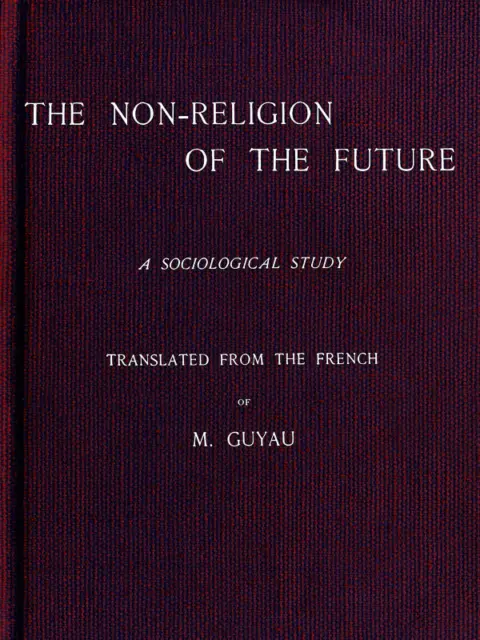
"The Non-religion of the Future: A Sociological Study" by Jean-Marie Guyau is a sociological study written in the late 19th century. The work examines the evolution of religious belief and the rise of a state of "non-religion" as a potential future for humanity, arguing against the permanence of dogmatic religions. Guyau explores the interplay between religion, aesthetics, and morals, suggesting that as society progresses, religious forms may dissolve, giving way to a more individualistic and rational approach to existence. The opening of the book introduces the central thesis that religion has originated and evolved through sociological rather than metaphysical processes. Guyau discusses various definitions of religion and emphasizes that the essence of all religious conceptions is the social bond between humanity and a cosmic society. He critiques both traditional and modern interpretations of religion, positing that all forms have evolved from primitive social understandings. The text sets the stage for a deeper exploration of how these religious roots may lead to a future where non-religious or rational frameworks fulfill humanity's social and moral needs, moving beyond mere dogma and myth.
Introduction adapted from the source catalogue; source summaries may be automatically generated.
Free to read · English · 214,102 words · No account needed
MAKE TIME FOR A GOOD BOOK
On by default. Untick to stop anonymous reading totals. Each page counts after 10 seconds in view. How this works.
Anonymous counting is on unless you have switched it off.
I. The third notion which is destined to survive historic religions, and which has been as yet imperfectly realized, is that of voluntary association for the purpose of enjoying in common some æsthetic pleasure of a high and morally refining kind; therein lies what will survive of the ceremonial of diverse religions. The artistic elements pent up in various religions will disengage themselves, will become independent of tradition, of symbolism taken seriously, and of superstition. Science, metaphysics, and morals all have their poetical side, and in so far are analogous to religion.
[Sidenote: Destined prevalence of admiration.]
The pure abstraction by which the thinker escapes beyond the limits of sentiment is an unstable and unlasting state of mind; abstraction contains something fictitious, for nothing abstract exists in nature; abstraction is of value only as an instrument; its aim is to grapple with some one side of the reality, to enable one subsequently more easily to embrace the reality as a whole. Every general result that abstraction can achieve may sooner or later become the object of a sentiment. The progress of science, as Mr. Spencer says, has always been accompanied side by side by a corresponding progress in the faculty of admiration; this faculty must inevitably develop, in the future, when man will have attained a less fragmentary and more genuinely synthetic conception of the universe. Admiration is one of the surviving elements of the religious sentiment. Man will always be subject to astonishment, and will always contemplate the universe in a spirit of wonder, although, no doubt, the time must come when he will cease to kneel. Artistic genius, even when inspired by great philosophical and cosmological ideas, remains essentially different from religious genius properly so called, the distinctive character of which is to be dogmatic. The Greeks were of all peoples the most poetical and the least religious. Poetry, like metaphysics, consists in constructions in the realm of imagination and thought, which are capable of infinite variety and tend to overrun the whole compass of the human mind. Dogmatic religion, on the contrary, tends continually to limit the fertility of the imagination and of philosophic thought; it implies a certain poverty of mind to cling always to the same conception, to feel no desire to pass beyond it, to create. Metaphysical hypothesis, unshackled by dogma, gifted with variety and liberty, must inevitably be fertile even in the domain of art; it cannot dwell forever among abstractions, it must produce a corresponding sentiment, a poetic sentiment which will not be the naïve assurance of faith but the proper emotional reaction in the presence of a transformation of the real world under the influence of thought conceiving the ideal. For the philosopher, as for the poet, every surface that science touches, every form and figure in the world that the finger of knowledge taps, gives forth a sound, not of the void, but, so to speak, of the “essential inwardness of life.” They resemble the marbles in Italy which give forth, beneath a blow, a sound as harmonious as their forms. There is an inner harmony that may well go along with harmony of surface; science shows us the laws of surfaces, philosophy and poetry put us into sympathy with what lies below the surface. If it is impossible to deny, as pure idealists attempt to deny, the objective character of the world in which we live, one can, at least, not say where objectivity begins and subjectivity ends. Between Naghiri and Yarkand there exists an almost unknown tribe called Hunza, whose language presents a peculiarity which it is impossible to separate from one’s notion of humanity; one cannot, in their speech, express the idea of a horse simply, but must say my horse or thy horse or his horse. Our language is more perfect than that of the Hunza, but we are absolutely incapable of conceiving things in abstraction from all notion of human personality; in especial, when we are dealing, not with individual, external objects, but with the cosmos as a whole. There is no such thing as a world existing in isolation; there is only your world, my world, the human world. Man is so inseparably associated with his conception of the universe that it is impossible to know what our universe would be apart from us, or what we should be apart from it. The metaphysician and the poet are at one in celebrating the projection of humanity into all things. At their highest points poetry and philosophy coincide. Metaphysics is the poetry of pure reason, poetry is the metaphysics of the senses and of the heart. The two supply us with our conception of the world, and, after all, since we are the product of the world, it must be in some sense akin to all that we contain. The fundamental secret of things lies at the bottom of human thought. Poetry is a light and winged creature, Plato says, but he was speaking of the poetry of the poet, of his sonorous and harmonious words; but the poetry of the metaphysician, the poetry of profound ideas and hidden causes, is also a winged thing, but winged not to be enabled to skim the surfaces of things as a land bird skims the surface of land and sea, but to be enabled to dive as “divers” do when they plunge into the limpid waves, and, at the risk of asphyxia, walk upon the opaque bottom of the sea and tear it up with their beaks in search of food and come up shaking their feathers from none knows where. Sometimes their search has been in vain, sometimes they bring up buried treasure; and they alone of all beings employ their wings not to skim and to touch the surface of things, but to penetrate to the depths of them. The last word of poetry, as of thought, will be to dive beneath the moving flood and sweep of things, and seize the secret of the material universe which is also the secret of the spiritual universe.
Your reading position is saved on this browser. Take it to another device with a library code. Reading pages adapt to text, rather than matching a printed edition.
BEHIND THE BOOK
This eBook is for the use of anyone anywhere in the United States and most other parts of the world at no cost and with almost no restrictions whatsoever. You may copy it, give it away or re-use it under the terms of the Project Gutenberg License included with this eBook or online at www.gutenberg.org. If you are not located in the United States, you will have to check the laws of the country where you are located before using this eBook. Read the source licence.
The original source file, including credits and licence, is retained by this library. Request an original-format copy at no charge. Please include the book title and Project Gutenberg identifier #47421.
KEEP YOUR CURIOSITY GOING
David Patterson (Spirit) Hatch

David Patterson (Spirit) Hatch

David Patterson (Spirit) Hatch
Coulson Kernahan

Ralph Waldo Emerson
Frances Wright