
Last letters from the living dead man
David Patterson (Spirit) Hatch
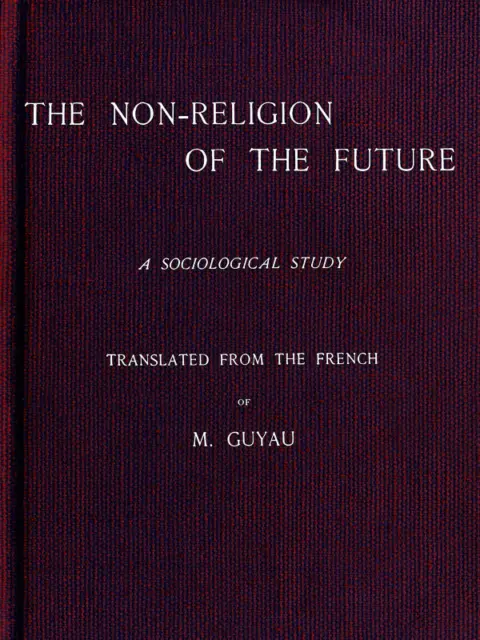
THE CLASSIC COLLECTION · 1897
"The Non-religion of the Future: A Sociological Study" by Jean-Marie Guyau is a sociological study written in the late 19th century. The work examines the evolution of religious belief and the rise of a state of "non-religion" as a potential future for humanity, arguing against the permanence of dogmatic religions. Guyau explores the interplay between religion, aesthetics, and morals, suggesting that as society progresses, religious forms may dissolve, giving way to a more individualistic and rational approach to existence. The opening of the book introduces the central thesis that religion has originated and evolved through sociological rather than metaphysical processes. Guyau discusses various definitions of religion and emphasizes that the essence of all religious conceptions is the social bond between humanity and a cosmic society. He critiques both traditional and modern interpretations of religion, positing that all forms have evolved from primitive social understandings. The text sets the stage for a deeper exploration of how these religious roots may lead to a future where non-religious or rational frameworks fulfill humanity's social and moral needs, moving beyond mere dogma and myth.
Introduction adapted from the source catalogue; source summaries may be automatically generated.
Free to read · English · 214,102 words · No account needed
MAKE TIME FOR A GOOD BOOK
On by default. Untick to stop anonymous reading totals. Each page counts after 10 seconds in view. How this works.
Anonymous counting is on unless you have switched it off.
If faith has not varied especially in and of itself as a mode of feeling, the objects with which it is concerned have differed from generation to generation. Hence the various forms of doctrine which we shall pass in review as showing the evolution and dissolution of faith.
[Sidenote: Primitive faith more properly a credulity.]
In primitive religions, faith was altogether experimental and physical; it was not opposed to scientific belief, which, to say the truth, did not exist. It was a credulity rather than a faith; and religious faith, in our day, is still a credulity, an obligatory credulity, primarily in the authority of superior men, secondarily in that of God himself.
[Sidenote: Subordination of the marvellous in primitive faith.]
The origin of religious faith has been attributed solely to an appetite for the marvellous and the extraordinary; but we have already shown that religions do everything in their power to regulate the imagination even in the very act of stimulating it, and to bring the unknown to the touchstone of the known. The marvellous must aid in making something at least apparently comprehensible; with marvel for marvel’s sake religion holds no commerce. So much so, that primitive people have sought in religion, less to multiply the marvellous, in the modern sense of the word, than partially to suppress it; they have been in search of an explanation of some sort. An explanation by superior powers, by spirits, by occult virtues, seemed clearer to them than an explanation by scientific law.
[Sidenote: Rationale of primitive man’s faith in the marvellous.]
For the rest, any explanation once given, primitive man never dreamed of disputing it, he was essentially a “man of faith.” The delicate shades of thought we designate as verisimilitude, probability, possibility, were as little known to primitive man as to children. The voluntary suspension of judgment that we call doubt indicates an extremely advanced state of mind. With children and savages, to conceive and to believe are one; they know nothing about reserving their approbation, or mistrusting their own intelligence or that of others. A certain humility, which young minds do not possess, is necessary before one can say: That may be true but also it may not, or in other words, I don’t know. And also one must have patience to verify with care what one believes, and patience is courage of the most difficult kind. Finally, man always feels the need to declare that what is attractive, what satisfies his mind, is real: when one tells an interesting story to a child, he says, “It is true, is it not?” If, on the contrary, it is a sad story he will cry out: “That is not true!” A man of the people to whom one should demonstrate, with the evidence in one’s hand, that a thing he thought true was false, would reply with a shake of the head, “If it is not true, it ought to be.” All primitive people were like that. In a memorandum on The Development of Language and Intelligence among Children, E. Egger characterized this state of mind as “rebellion against the notion of doubt and even that of simple probability.” Felix, a child of five and one-half years, took a lively interest in sacred history, but he could not understand why all the lacunæ had not been filled in, or why doubtful points should be marked as such. “The actual state of his mind,” adds E. Egger, “corresponds in a manner to that of the Greek mind during the period when the effort was made painfully to set in order the chaos of ancient legend.” Two years later the same child received a present of a collection of stories. He found in the preface that the author gave the stories out as true; he asked nothing further, and was promptly astonished to find anybody else in doubt. “His trustfulness displayed no disposition to go behind the letter of his text, in especial as the stories sounded to him sufficiently probable.” In my own experience with children, I have noticed that nothing irritates them like uncertainty; a thing must be true or false, and generally they prefer that it should be true. For the rest, a child does not know the limits of his own power, and still less that of others; and too, he has no clear sense of the marvellous and the improbable. A child saw a horse galloping by one day, and said to me seriously, “I could run as fast as that.” Thus again the little peasant girl, of whom we spoke above, asked her mistress why she might not have made the flowers in the garden. A sense of the possible is lacking in primitive intelligences: because you seem to a child or a savage to be able to do more things than he, he readily comes to believe that you can do everything; so that what we call miracles seem to primitive people simply the visible and necessary sign of superior power; so much so, indeed, that to them a man of mark ought to be able to perform miracles; they expect them from him as their due, and become indignant if they are not forthcoming, as a child is indignant when one does not help him carry a burden that is too heavy for his strength. The Hebrews precisely expected Moses to perform miracles and, so to speak, obliged him to do them. The people believe in their great men, and the belief in miracles is but a corollary from their general confidence.
Your reading position is saved on this browser. Take it to another device with a library code. Reading pages adapt to text, rather than matching a printed edition.
BEHIND THE BOOK
This eBook is for the use of anyone anywhere in the United States and most other parts of the world at no cost and with almost no restrictions whatsoever. You may copy it, give it away or re-use it under the terms of the Project Gutenberg License included with this eBook or online at www.gutenberg.org. If you are not located in the United States, you will have to check the laws of the country where you are located before using this eBook. Read the source licence.
The original source file, including credits and licence, is retained by this library. Request an original-format copy at no charge. Please include the book title and Project Gutenberg identifier #47421.
KEEP YOUR CURIOSITY GOING
David Patterson (Spirit) Hatch

David Patterson (Spirit) Hatch

David Patterson (Spirit) Hatch
Coulson Kernahan

Ralph Waldo Emerson
Frances Wright