
Under Sail
Felix Riesenberg
THE CLASSIC COLLECTION · 1918
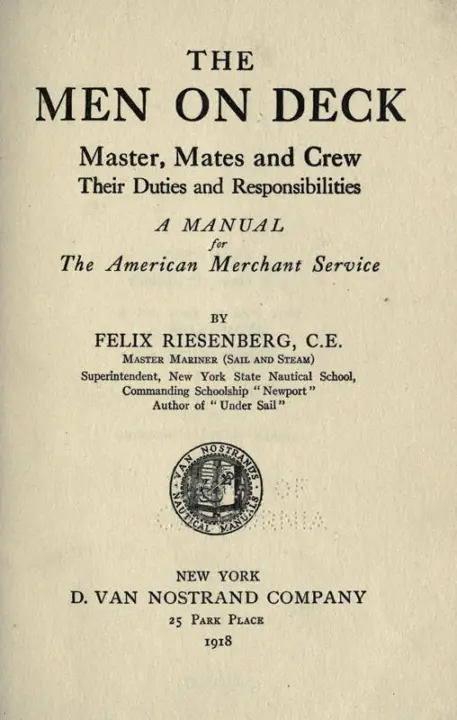
"The Men on Deck: Master, Mates and Crew, Their Duties and Responsibilities" by Felix Riesenberg is a manual for the American Merchant Service, likely written in the early 20th century. This informative work aims to clarify the roles and responsibilities of the various members of a ship's deck department, transitioning from the age of sail to the era of steam and steel. The book outlines the expectations and duties of seafarers, particularly focusing on the captain and his crew, thereby addressing the complexities of modern maritime operations. The opening of the book provides a comprehensive overview of the significant transitions within maritime practices, emphasizing the shift from traditional sailing vessels to steam-powered ships. It discusses the intricacies and responsibilities of the Master Mariner, who bears ultimate accountability for navigation, cargo safety, crew management, and adherence to maritime law. Riesenberg underscores the importance of proper training and knowledge within both the captain and crew, stressing that clarity in responsibilities is essential to maintaining order and discipline at sea in an increasingly complex environment. This introduction sets the stage for a detailed exploration of the maritime duties expected of various crew members, which continues throughout the manual.
Introduction adapted from the source catalogue; source summaries may be automatically generated.
Free to read · English · 104,758 words · No account needed
MAKE TIME FOR A GOOD BOOK
On by default. Untick to stop anonymous reading totals. Each page counts after 10 seconds in view. How this works.
Anonymous counting is on unless you have switched it off.
E. Paints—oils—turpentine—white lead—red lead—bitumastic—bottom composition—putty, brushes, graining tools, etc., etc.
F. Cargo gear—in use, condition, location, etc. Spare gear—condition
and where stowed.
G. Ship's navigating gear (under care of Second Mate).
H. Coaling gear, condition, where stowed.
I. Life-saving equipment—boats, rafts and their complete equipment. When bread boxes were last filled—inspected, when breakers were last filled, etc. Life preservers—number—location—last inspected. Fire hose, when supplied length, and location of reels, nozzles, couplings, reducers, valves, etc. Fire extinguishers, kind—number—location—when charged last. Axes, number—location. Buckets—number—location. Smoke helmets, condition and where stowed. Extra tarpaulins.
Also ring buoys, rockets, line-throwing gun, spare lines, projectiles, powder charges—sewed in bunting bags, and stowed in proper canister. Coston lights, number—kind. Wave oil, tanks and fittings.
J. Ship's signal gear—flags—rockets—etc. (under charge of Third Mate).
Having familiarized himself with his vessel, her complement, equipment, and stores, the Chief Mate is ready to take up his duties with full knowledge of the situation.
The inspection of the vessel, from stem to stern, is a matter of some time and, in a large steamer, calls for repeated investigation. Every hole and tank and corner should be known to the Chief Mate, its condition, its contents, and its use.
+Deck Crew.+ He must organize and supervise the routine work of the deck department of the vessel.
Third Mate—forward holds, under immediate eye of Chief Mate.
Second Mate—after holds.
Boatswain, in active charge of crew at work on deck, over the side, and
in holds.
Carpenter, at work about ship, under orders from the Chief Mate.
Quartermasters—gangway, bridge, and hold watches, under junior officers.
In large steamers where extra watch officers, junior officers and cadets, or sub-junior officers are carried, the Chief Mate usually has a clerk, and his work is largely that of a general manager. In such vessels the cargo, mail, baggage, specie, etc., is handled through the purser, or other officer, and the Chief Mate devotes himself strictly to the management of the seamanship end of his department.
+Holds.+ He must supervise the preparation of holds to receive cargo.
Sweep clean.
Dunnage on stringers.
Limbers cleared—limber boards lifted.
Bilges cleaned.
Rose boxes cleared (strainers—strum boxes).
Ceiling in good condition.
Cargo battens in good condition.
Smothering lines in good condition, ends clear.
Sounding pipes not dented or bent out of shape, ends free.—Brass screw
plugs in place.
'Tween deck hatch covers, strong backs, etc., in good order.
'Tween deck and hold electrical connections—in good order.
Lift tank covers.
Take-up tank manholes (engineers).
Examine cement in tanks.
Your reading position is saved on this browser. Take it to another device with a library code. Reading pages adapt to text, rather than matching a printed edition.
Felix Riesenberg
BEHIND THE BOOK
This eBook is for the use of anyone anywhere in the United States and most other parts of the world at no cost and with almost no restrictions whatsoever. You may copy it, give it away or re-use it under the terms of the Project Gutenberg License included with this eBook or online at www.gutenberg.org. If you are not located in the United States, you will have to check the laws of the country where you are located before using this eBook. Read the source licence.
The original source file, including credits and licence, is retained by this library. Request an original-format copy at no charge. Please include the book title and Project Gutenberg identifier #57820.
KEEP YOUR CURIOSITY GOING
Cécile Tormay

Moritz Busch
John L. Ransom
Frances Wright
Cécile Tormay

Mabel Potter Daggett