
Under Sail
Felix Riesenberg
THE CLASSIC COLLECTION · 1918
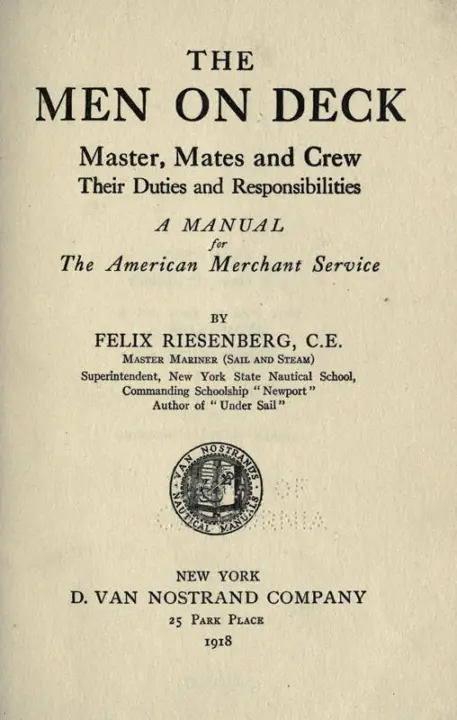
"The Men on Deck: Master, Mates and Crew, Their Duties and Responsibilities" by Felix Riesenberg is a manual for the American Merchant Service, likely written in the early 20th century. This informative work aims to clarify the roles and responsibilities of the various members of a ship's deck department, transitioning from the age of sail to the era of steam and steel. The book outlines the expectations and duties of seafarers, particularly focusing on the captain and his crew, thereby addressing the complexities of modern maritime operations. The opening of the book provides a comprehensive overview of the significant transitions within maritime practices, emphasizing the shift from traditional sailing vessels to steam-powered ships. It discusses the intricacies and responsibilities of the Master Mariner, who bears ultimate accountability for navigation, cargo safety, crew management, and adherence to maritime law. Riesenberg underscores the importance of proper training and knowledge within both the captain and crew, stressing that clarity in responsibilities is essential to maintaining order and discipline at sea in an increasingly complex environment. This introduction sets the stage for a detailed exploration of the maritime duties expected of various crew members, which continues throughout the manual.
Introduction adapted from the source catalogue; source summaries may be automatically generated.
Free to read · English · 104,758 words · No account needed
MAKE TIME FOR A GOOD BOOK
On by default. Untick to stop anonymous reading totals. Each page counts after 10 seconds in view. How this works.
Anonymous counting is on unless you have switched it off.
Inward manifests.
No merchandise shall be brought into the United States, from any foreign port, in any vessel unless the master has on board manifests in writing of the cargo, signed by such master. (R. S., 2806.)
Every manifest required by the preceding section shall contain:
First. The name of the ports where the merchandise in such manifest mentioned were taken on board, and the ports within the United States for which the same are destined; particularly noting the merchandise destined for each port respectively. (R. S., 2807.)
Provided, however, That the master of a vessel laden exclusively either with sugar, coal, salt, hides, dyewoods, wool, or jute butts, consigned to one consignee, arriving at a port for orders, may be permitted to destine such cargo or determine its disposition "for orders," upon entering the vessel at the custom-house, and, within fifteen days afterward and before the unloading of any part of the cargo, to amend the manifest by designating the actual port of discharge of such cargo:
Provided further, That in the event of failure to designate the port of discharge within fifteen days such cargo must be discharged at the port where the vessel entered. (June 3, 1892.)
Second. The name, description, and build of the vessel; the true admeasurement or tonnage thereof; the port to which such vessel belongs; the name of each owner, according to the register of the same; and the name of the master of such vessel.
Third. A just and particular account of all the merchandise, so laden on board, whether in packages or stowed loose, of any kind or nature whatever, together with the marks and numbers as marked on each package, and the number or quantity and description of the packages in words at length, whether leaguer, pipe, butt, puncheon, hogshead, barrel, keg, case, bale, pack, truss, chest, box, band-box, bundle, parcel, cask, or package, of any kind or sort, describing the same by its usual name or denomination.
Fourth. The names of the persons to whom such packages are respectively consigned, agreeably to the bills of lading signed for the same, unless when the goods are consigned to order, when it shall be so expressed in the manifest.
Fifth. The names of the several passengers on board the vessel, distinguishing whether cabin or steerage passengers, or both, with their baggage, specifying the number and description of packages belonging to each respectively. (R. S., 2807.)
Sixth. An account of the sea-stores remaining, if any.
Your reading position is saved on this browser. Take it to another device with a library code. Reading pages adapt to text, rather than matching a printed edition.
Felix Riesenberg
BEHIND THE BOOK
This eBook is for the use of anyone anywhere in the United States and most other parts of the world at no cost and with almost no restrictions whatsoever. You may copy it, give it away or re-use it under the terms of the Project Gutenberg License included with this eBook or online at www.gutenberg.org. If you are not located in the United States, you will have to check the laws of the country where you are located before using this eBook. Read the source licence.
The original source file, including credits and licence, is retained by this library. Request an original-format copy at no charge. Please include the book title and Project Gutenberg identifier #57820.
KEEP YOUR CURIOSITY GOING
Cécile Tormay

Moritz Busch
John L. Ransom
Frances Wright
Cécile Tormay

Mabel Potter Daggett