
Under Sail
Felix Riesenberg
THE CLASSIC COLLECTION · 1918
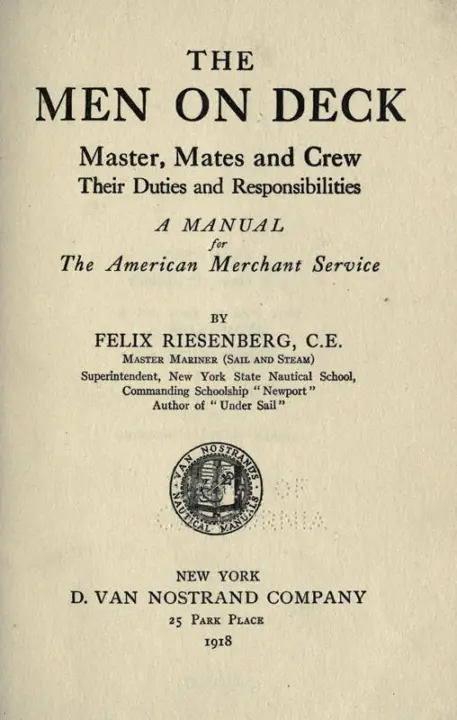
"The Men on Deck: Master, Mates and Crew, Their Duties and Responsibilities" by Felix Riesenberg is a manual for the American Merchant Service, likely written in the early 20th century. This informative work aims to clarify the roles and responsibilities of the various members of a ship's deck department, transitioning from the age of sail to the era of steam and steel. The book outlines the expectations and duties of seafarers, particularly focusing on the captain and his crew, thereby addressing the complexities of modern maritime operations. The opening of the book provides a comprehensive overview of the significant transitions within maritime practices, emphasizing the shift from traditional sailing vessels to steam-powered ships. It discusses the intricacies and responsibilities of the Master Mariner, who bears ultimate accountability for navigation, cargo safety, crew management, and adherence to maritime law. Riesenberg underscores the importance of proper training and knowledge within both the captain and crew, stressing that clarity in responsibilities is essential to maintaining order and discipline at sea in an increasingly complex environment. This introduction sets the stage for a detailed exploration of the maritime duties expected of various crew members, which continues throughout the manual.
Introduction adapted from the source catalogue; source summaries may be automatically generated.
Free to read · English · 104,758 words · No account needed
MAKE TIME FOR A GOOD BOOK
On by default. Untick to stop anonymous reading totals. Each page counts after 10 seconds in view. How this works.
Anonymous counting is on unless you have switched it off.
See that stanchion brackets and shifting boards are ready for bulk
cargoes, such as grain.
See that sufficient dunnage is in each hold; spruce planking, and chocking pieces. Find out what kind of cargo is to be stowed.
See all hold ladders in good order—rungs all secure.
Look for runs of rust, under frames and stringers, in wake of mast doublings, under winch beds, under deck in wake of shrouds.
Examine all ports and dead lights in 'tween decks.
Examine all side ports—cargo—coal.
All rust should be cleaned off and painted—red lead and pigment in
linseed oil.
See all bulkhead doors tight and in working order.
Spare propeller blades, booms, anchors, hubs, etc., stowed below, should be examined as to lashings and rust. Spare shafting usually carried in shaft tunnel, under charge of Chief Engineer, if in hold, Chief Mates responsible for safety.
Look to all wire lashings in the nips.
Look for leaks in joints of shell plating abreast of hatches where drafts of cargo swing in against the side.
Examine masts, at doublings, at the steps.
Examine all fire lines and connections in holds and 'tween decks.
Examine rivets under bed plates of winches.
Examine framing under hatch coamings.
Examine state of pillars and stanchions.
+Cargo Gear.+ The Chief Mate is charged with the proper use and upkeep of the cargo handling gear. This includes everything except the steam winches, and steam lines which are under the charge of the engineer department.
The Chief Mate should supervise and attend to the following—note condition and provide for proper maintenance:
+Masts—and all fittings, viz.—collars—trucks—sheaves—links—shrouds— stays—and all equipment on masts, whether cargo, radio, lights, or lookout cages.+
+King posts—same as masts—re-cargo handling.+
+Booms—goosenecks—bands—links—shackles—sheaves—gins—guys—and cradles.+
+Examine all shrouds and stays under the nips and thimbles.+
+Examine all links—turnbuckles—bales—eye bolts—pins—cleats—etc., for excessive wear, or fracture.+
+If wind platforms are fitted see to all stanchions, struts and
brasses.+
+When heavy purchases are to be rove, the Chief Mate should carefully supervise the preparation of the gear—preventers—lashings—etc.+
+See that winches are powerful enough to take the load safely.+
+See that booms are strong enough or are fished and reinforced where
needed.+
+Shore up weak goosenecks.+
+Rig preventer guys—stays—etc.+
Leave nothing to chance—use new gear—know the weight to be lifted—be sure it will clear the hatch coamings—the bulwarks—take your time. It takes ten times as long to clear away a wreck as to make the most careful preparation for lifting a heavy weight.
Your reading position is saved on this browser. Take it to another device with a library code. Reading pages adapt to text, rather than matching a printed edition.
Felix Riesenberg
BEHIND THE BOOK
This eBook is for the use of anyone anywhere in the United States and most other parts of the world at no cost and with almost no restrictions whatsoever. You may copy it, give it away or re-use it under the terms of the Project Gutenberg License included with this eBook or online at www.gutenberg.org. If you are not located in the United States, you will have to check the laws of the country where you are located before using this eBook. Read the source licence.
The original source file, including credits and licence, is retained by this library. Request an original-format copy at no charge. Please include the book title and Project Gutenberg identifier #57820.
KEEP YOUR CURIOSITY GOING
Cécile Tormay

Moritz Busch
John L. Ransom
Frances Wright
Cécile Tormay

Mabel Potter Daggett