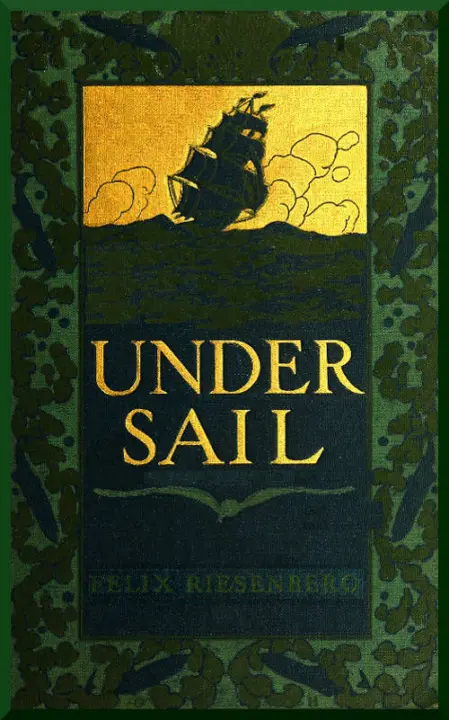
Under Sail
Felix Riesenberg
THE CLASSIC COLLECTION · 1918
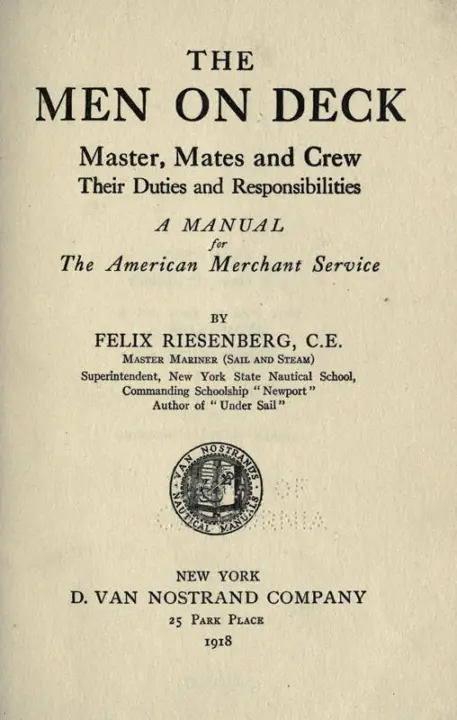
"The Men on Deck: Master, Mates and Crew, Their Duties and Responsibilities" by Felix Riesenberg is a manual for the American Merchant Service, likely written in the early 20th century. This informative work aims to clarify the roles and responsibilities of the various members of a ship's deck department, transitioning from the age of sail to the era of steam and steel. The book outlines the expectations and duties of seafarers, particularly focusing on the captain and his crew, thereby addressing the complexities of modern maritime operations. The opening of the book provides a comprehensive overview of the significant transitions within maritime practices, emphasizing the shift from traditional sailing vessels to steam-powered ships. It discusses the intricacies and responsibilities of the Master Mariner, who bears ultimate accountability for navigation, cargo safety, crew management, and adherence to maritime law. Riesenberg underscores the importance of proper training and knowledge within both the captain and crew, stressing that clarity in responsibilities is essential to maintaining order and discipline at sea in an increasingly complex environment. This introduction sets the stage for a detailed exploration of the maritime duties expected of various crew members, which continues throughout the manual.
Introduction adapted from the source catalogue; source summaries may be automatically generated.
Free to read · English · 104,758 words · No account needed
MAKE TIME FOR A GOOD BOOK
On by default. Untick to stop anonymous reading totals. Each page counts after 10 seconds in view. How this works.
Anonymous counting is on unless you have switched it off.
A steam vessel shall be provided with an efficient whistle or siren, sounded by steam or by some substitute for steam, so placed that the sound may not be intercepted by any obstruction, and with an efficient fog horn; also with an efficient bell. A sailing vessel of twenty tons gross tonnage or upward shall be provided with a similar fog horn and bell.
In fog, mist, falling snow, or heavy rain storms, whether by day or night, the signals described in this article shall be used as follows, namely:
Steam vessel under way.
(a) A steam vessel under way shall sound, at intervals of not more than one minute, a prolonged blast.
Sail vessel under way.
(c) A sailing vessel under way shall sound, at intervals of not more than one minute, when on the starboard tack, one blast; when on the port tack, two blasts in succession, and when with the wind abaft the beam, three blasts in succession.
Vessels at anchor or not under way.
(d) A vessel when at anchor shall, at intervals of not more than one minute, ring the bell rapidly for about five seconds.
Vessels towing or towed.
(e) A steam vessel when towing, shall, instead of the signals prescribed in subdivision (a) of this article, at intervals of not more than one minute, sound three blasts in succession, namely, one prolonged blast followed by two short blasts. A vessel towed may give this signal and she shall not give any other.
Rafts, or other craft not provided for.
(f) All rafts or other water craft, not herein provided for, navigating by hand power, horse power, or by the current of the river, shall sound a blast of the fog horn, or equivalent signal, at intervals of not more than one minute.
Speed in fog.
ART. 16. Every vessel shall, in a fog, mist, falling snow, or heavy rain storms, go at a moderate speed, having careful regard to the existing circumstances and conditions.
A steam vessel hearing, apparently forward of her beam, the fog signal of a vessel the position of which is not ascertained shall, so far as the circumstances of the case admit, stop her engines, and then navigate with caution until danger of collision is over.
Preliminary.
Risk of collision can, when circumstances permit, be ascertained by carefully watching the compass bearing of an approaching vessel. If the bearing does not appreciably change, such risk should be deemed to exist.
Sailing vessels.
ART. 17. When two sailing vessels are approaching one another, so as to involve risk of collision, one of them shall keep out of the way of the other as follows, namely:
Your reading position is saved on this browser. Take it to another device with a library code. Reading pages adapt to text, rather than matching a printed edition.
Felix Riesenberg
BEHIND THE BOOK
This eBook is for the use of anyone anywhere in the United States and most other parts of the world at no cost and with almost no restrictions whatsoever. You may copy it, give it away or re-use it under the terms of the Project Gutenberg License included with this eBook or online at www.gutenberg.org. If you are not located in the United States, you will have to check the laws of the country where you are located before using this eBook. Read the source licence.
The original source file, including credits and licence, is retained by this library. Request an original-format copy at no charge. Please include the book title and Project Gutenberg identifier #57820.
KEEP YOUR CURIOSITY GOING
Cécile Tormay

Moritz Busch
John L. Ransom
Frances Wright
Cécile Tormay

Mabel Potter Daggett