
Under Sail
Felix Riesenberg
THE CLASSIC COLLECTION · 1918
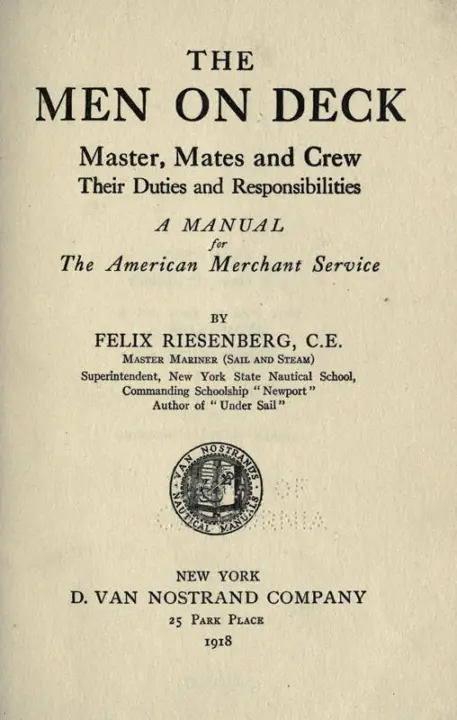
"The Men on Deck: Master, Mates and Crew, Their Duties and Responsibilities" by Felix Riesenberg is a manual for the American Merchant Service, likely written in the early 20th century. This informative work aims to clarify the roles and responsibilities of the various members of a ship's deck department, transitioning from the age of sail to the era of steam and steel. The book outlines the expectations and duties of seafarers, particularly focusing on the captain and his crew, thereby addressing the complexities of modern maritime operations. The opening of the book provides a comprehensive overview of the significant transitions within maritime practices, emphasizing the shift from traditional sailing vessels to steam-powered ships. It discusses the intricacies and responsibilities of the Master Mariner, who bears ultimate accountability for navigation, cargo safety, crew management, and adherence to maritime law. Riesenberg underscores the importance of proper training and knowledge within both the captain and crew, stressing that clarity in responsibilities is essential to maintaining order and discipline at sea in an increasingly complex environment. This introduction sets the stage for a detailed exploration of the maritime duties expected of various crew members, which continues throughout the manual.
Introduction adapted from the source catalogue; source summaries may be automatically generated.
Free to read · English · 104,758 words · No account needed
MAKE TIME FOR A GOOD BOOK
On by default. Untick to stop anonymous reading totals. Each page counts after 10 seconds in view. How this works.
Anonymous counting is on unless you have switched it off.
+83. Where are the following lockers, and what do they contain?+
+Boatswain's.+
+Paint.+
+Lamp.+
+Sail.+
+84. Is there a steam line running into the paint and lamp lockers for
smothering fire?+
+85. What kind of windlass is fitted? How does it work by hand? How many men needed to weight anchor by hand?+
+86. Do the gangways abreast of cargo hatches turn in, lift out, or are the rails and bulwarks stationary? Are the freeing ports well oiled and loose?+
+87. Where is the ice plant? What hatch?+
+88. Where is the washdeck gear kept? Are reducers fitted on salt water line for inch and a half wash deck hose?+
+89. Where is the sand locker?+
+90. Has the vessel range lights?+
+91. Learn the names and condition of the stays and shrouds. What strain do they bear—ordinarily—when lifting heavy weights?+
+92. What kind of coaling gear is used?+
+93. Has the vessel a sea anchor? Was it over used?+
+94. Examine the turnbuckle screws in the rigging. Are they covered with canvas? How old? Are they whiteleaded and tallowed?+
+95. Where are the slings, chain and rope kept? In what condition? How
many?+
+96. How many net slings on board? What condition?+
+97. What happens when metal becomes fatigued? Where is this liable to happen? What is a crystalline fracture?+
+98. What kind of wood in the decks? In the margin or waterway planks? Know Oregon pine—pitch pine—yellow pine—teak, when you see it.+
+99. How are decks caulked? What kind of filler is used—pitch—marine
glue?+
+100. What do you know about the following parts of a steamer? Of her
fittings, etc.?+
+Anchor davits?+
+Anchors?+
+Awning deck?+
+Ballast—water—dry?+
+Beams—camber of—duty of—theory of—spacing—strength—types?+
+Bilges—bilge keels?+
+Boat chocks. Davits—cranes?+
+Bollards? How many, etc?+
+Bow—different kinds—framing?+
+Breast hooks?+
+Bridge—locations—names, etc.?+
+Buckled—plates—spars?+
+Bulkheads? How many—what kind—where?+
+Bull rope?+
+Bulwarks?+
+Bunkers—how many—what capacity—where?+
+Buoyancy? What is it? Reserve buoyancy?+
+Bureau veritas? What is it? What does it do?+
+Buttock lines?+
+Buttstraps?+
+Cables—size—weight—strength—studs—marking—shackles—
forelocks—swivels?+
+Cant frames (old dagger knees)?+
+Cantilever principle—where used?+
+Capstans—where—how many—what uses?+
+Cargo—a big subject—takes a year or two to master it.+
+Catheads?+
+Cattle steamers—guards—footlocks, etc?+
+Caulking—tools—materials? Steel plates—wood decks? Ceiling?+
+Cement—hydraulic—asphaltic?+
+Chain—slings—for clearing limbers, etc.?+
+Chart house?+
+Cheek plates?+
+Circulating pumps?+
+Coaling hatches—ports—chutes?+
+Coamings?+
+Coefficient of fineness?+
+Commercial efficiency of a vessel?+
+Composite construction?+
+Corrosion—where most prevalent—how to keep down?+
+Dead weight cargo? also measurement cargo?+
+Decks—how many—where—what purpose?+
+Derricks? How many?+
+Docking—stresses—all—data?+
+Dolly—what is it?+
+Donkey boiler—where—why?+
+Doors—water-tight—where—how closed—how controlled?+
+Double bottom? See plans—study.+
+Doubling plates? Where?+
+Drain holes—in bottom?+
+Elastic limit—of materials used in construction of vessel?+
+Electric welding—how—how strong?+
+Engine—learn all you can about it.+
+Escape holes—for trimmers?+
+Expansion joints—bends—trunks?+
+Fair leads?+
+Fans?+
+Fiddley?+
+Floors—rise of?+
+Flush deck?+
+Fore foot?+
+Forgings?+
+Frames?—look them over when in the hold.+
+What are+
+Z bars?+
+Bulb angles?+
+Channel bars?+
+Web frames?+
+Reverse frames?+
+Transome frames?+
+Freeboard? How determined?+
+Freeing ports—percentage of in bulwarks?+
+Frictional, or skin resistance?+
+Galley? Where—how many?+
+Garboard strake?+
+Girders?+
+Grain bulkheads?+
+Gudgeons?+
+Gunwale?+
+Gutters?+
+Half beams?+
+Hatches—how many—where—names? Booby hatch?+
+Hawse pipes? Clearing hawse?+
+Heeling?+
+Hogging?+
+Hydraulic derricks—principle?+
+Insulation of holds?+
+Isherwood system of framing?+
+Jogged framing?+
+Jib-booms?+
+Keel—kind, plate, bilge?+
+Keelson? Where—why?+
+Knighthead frame?+
+Lapped joints?+
+Launching—how done?+
+Limbers—limber boards?+
+Lloyd's—register—rules?+
+Load line?+
+Longitudinal bulkheads—framing?+
+Manholes—where—why?+
+Margin plates?+
+Masts—caps—coats—holes—partners—steps—stiffeners—telescopic—
wedges? Bending forces—Buckling—failure—material—painting
interior—rake—strength of?+
+Natural draft?+
+Neutral axis of a beam?+
+Oil fuel—flash point?+
+Oxy-acetylene blow pipe—how used?+
+Paints—what kind used aboard ship—how mixed? Where stowed—
How much used? What surface will gallon cover? How long
in applying?+
+Panting—what is it—have you noticed it at sea, etc.?+
+Peak tanks—fore peak—what stowed there?+
+Pillars—stations, etc? Their function?+
+Pintles?+
+Plating—how thick—how joined?+
+Portland cement—same as hydraulic—what uses?+
+Pratigue—what is it?+
+Propellers—how many—what kind—pitch—motion?+
+Pressure—steam—in deck lines—main boilers—donkey boilers—water
pressure—under bottom?+
+Pumps—where are hand pumps—what will they throw—do they work?+
+Quadrant tiller—how connected to steering engine?+
+Red lead—use of?+
+Relieving tackles for steering gear—how rove?+
+Rigging—chain plates—screws—spread of—strength of?+
+Rivets—in what kind of shear? Pitch—strength?+
+Rolling chocks (bilge keels)?+
+Rudder—angle of—balanced, or not—cross head—how supported?+
+Sanitary tanks—where located—how filled?+
+Scuppers where located? Are those on deck house tops clear?+
+Scantlings—what do they include?+
+Shaft—bearings—stools—tube—tunnel?+
+Sheathing—wood—copper?+
+Sheer?+
+Shell plating?+
+Skylights?+
+Sounding pipes—rods—how marked—how used?+
+Spar deck?+
+Sponsons?+
+Steel strength of—tensile—shearing—compressive?+
+Stem?+
+Steering gear—learn all about it.+
+Stem—ordinary—cruiser?+
+Stoke holds (fire rooms)?+
+Stress?+
+Strain?+
+Stringers? Duty of?+
+Surveys—purpose—by whom?+
+Sweating—cork paint?+
+Tail shaft—where—after gland—what?+
+Tanks—how lined—where?+
+Thrust block?+
+Ventilation—how accomplished—natural or blower?+
+Vibration?—note it at sea.+
+Water ballast—part of tank data?+
+Water line?+
+Water-tight doors—where—how managed?+
+Well decks?+
+Winches?+
+Yards—if any?+
+Zincs—what used for—why?+
Your reading position is saved on this browser. Take it to another device with a library code. Reading pages adapt to text, rather than matching a printed edition.
Felix Riesenberg
BEHIND THE BOOK
This eBook is for the use of anyone anywhere in the United States and most other parts of the world at no cost and with almost no restrictions whatsoever. You may copy it, give it away or re-use it under the terms of the Project Gutenberg License included with this eBook or online at www.gutenberg.org. If you are not located in the United States, you will have to check the laws of the country where you are located before using this eBook. Read the source licence.
The original source file, including credits and licence, is retained by this library. Request an original-format copy at no charge. Please include the book title and Project Gutenberg identifier #57820.
KEEP YOUR CURIOSITY GOING
Cécile Tormay

Moritz Busch
John L. Ransom
Frances Wright
Cécile Tormay

Mabel Potter Daggett