
Under Sail
Felix Riesenberg
THE CLASSIC COLLECTION · 1918
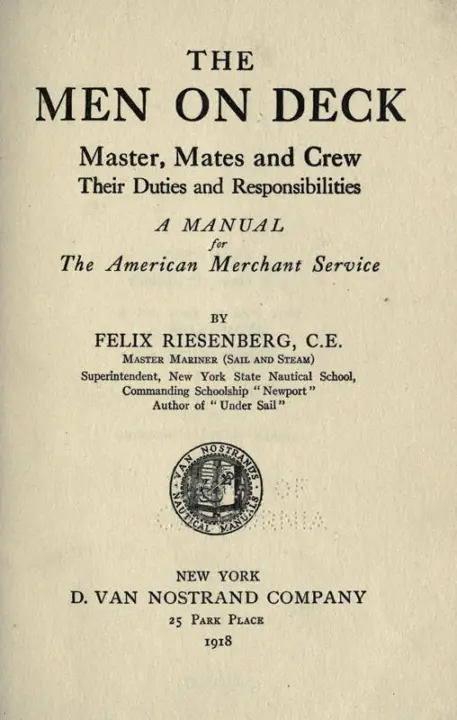
"The Men on Deck: Master, Mates and Crew, Their Duties and Responsibilities" by Felix Riesenberg is a manual for the American Merchant Service, likely written in the early 20th century. This informative work aims to clarify the roles and responsibilities of the various members of a ship's deck department, transitioning from the age of sail to the era of steam and steel. The book outlines the expectations and duties of seafarers, particularly focusing on the captain and his crew, thereby addressing the complexities of modern maritime operations. The opening of the book provides a comprehensive overview of the significant transitions within maritime practices, emphasizing the shift from traditional sailing vessels to steam-powered ships. It discusses the intricacies and responsibilities of the Master Mariner, who bears ultimate accountability for navigation, cargo safety, crew management, and adherence to maritime law. Riesenberg underscores the importance of proper training and knowledge within both the captain and crew, stressing that clarity in responsibilities is essential to maintaining order and discipline at sea in an increasingly complex environment. This introduction sets the stage for a detailed exploration of the maritime duties expected of various crew members, which continues throughout the manual.
Introduction adapted from the source catalogue; source summaries may be automatically generated.
Free to read · English · 104,758 words · No account needed
MAKE TIME FOR A GOOD BOOK
On by default. Untick to stop anonymous reading totals. Each page counts after 10 seconds in view. How this works.
Anonymous counting is on unless you have switched it off.
+53. Has she bilge keels?+
+54. What kind of propellers, or propeller? Material? Pitch? Right handed or left? How will it send the vessel's head—going ahead—backing?+
+55. Learn everything you can about her construction, and equipment.+
+56. What is her draft when light—holds empty? What is her stability when in this condition? Is her propeller out of water in that condition? How much? What is her light displacement? How can you determine her stability—by means of shifting weights on deck?+
+57. How many cubic feet to a ton of bunker coal?+
+58. How many pounds to a cubic foot of sea water? Fresh water?+
+59. How do you figure the cubic capacity of a lifeboat? How many cubic feet allowed per person?+
+60. What is the strength of a new six-inch manila line? Of a five-inch
wire hawser?+
+61. What is the tensile strength of mild steel? Of cast iron? The
compressive strength?+
+62. Can you figure out the safe load for a steel boom under given conditions? Shell and stiffening given, supports and angle given? Safety factor 5.+
+63. Become familiar with the fittings of the holds. Go in, look around and study out the plan of construction and use.+
+64. Find out the location and use of the following parts—+
+Limbers.+
+Limber boards.+
+Ceiling.+
+Cargo battens.+
+Rose boxes (strums, also strainers).+
+Intercostal plates.+
+Keelson.+
+Stringers.+
+Framing.+
+Beams.+
+Shell plating.+
+Pillars.+
+Bulkheads.+
+Tanks.+
+Bilges.+
+Smothering lines.+
+Sounding pipes.+
+Fire lines.+
+Light connections.+
+Mast partners.+
+Mast wedges.+
+Shaft trunk.+
+Hatch coamings.+
+Hatch strong backs.+
+Hatch fore and afters.+
+Hatch battens.+
+Hatch covers.+
+Wedges.+
+65. Where do the steam pipes lead into the holds?+
+66. Where are the valves located? Which is which?+
+67. Where are the plugs for cargo clusters?+
+68. Where are the cargo clusters kept? How many are there?+
+69. Are they all in good condition?+
+70. How much dunnage wood in the holds?+
+71. What cargo was carried last?+
+72. What cargo loading or coming in?+
+73. How much and what kind of dunnage will be needed?+
+74. Who is the boss stevedore? Watch him.+
+75. Note where each ventilator leads to.+
+76. Get acquainted with the deck engineers.+
+77. What kind of winches are used?+
+78. Get familiar with all details of the cargo handling gear. How many booms, capacity? Is gear rove off on steel boom? Where is it stowed? In what condition? How is it rigged?+
+79. How many hawsers in the vessel? Where stowed? In what condition?+
+80. How many wires in the vessel? What size? Where and how stowed?+
+81. How does hand steering gear work? What type of steering engine? How is it locked when shifting from steam to hand?+
+82. Are there wave oil tanks? Where? How is flow of oil controlled? What kind of oil is used? How much on board? How much required by law?+
Your reading position is saved on this browser. Take it to another device with a library code. Reading pages adapt to text, rather than matching a printed edition.
Felix Riesenberg
BEHIND THE BOOK
This eBook is for the use of anyone anywhere in the United States and most other parts of the world at no cost and with almost no restrictions whatsoever. You may copy it, give it away or re-use it under the terms of the Project Gutenberg License included with this eBook or online at www.gutenberg.org. If you are not located in the United States, you will have to check the laws of the country where you are located before using this eBook. Read the source licence.
The original source file, including credits and licence, is retained by this library. Request an original-format copy at no charge. Please include the book title and Project Gutenberg identifier #57820.
KEEP YOUR CURIOSITY GOING
Cécile Tormay

Moritz Busch
John L. Ransom
Frances Wright
Cécile Tormay

Mabel Potter Daggett