
Last letters from the living dead man
David Patterson (Spirit) Hatch
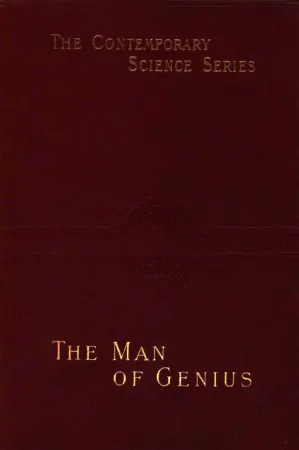
THE CLASSIC COLLECTION · 1891
"The Man of Genius" by Cesare Lombroso is a scientific publication written in the late 19th century. The book delves into the complex relationship between genius and madness, exploring the characteristics of individuals considered genius and how these traits intersect with patterns of mental illness. Lombroso examines historical figures and provides a foundational analysis of genius through a lens of physiological and psychological phenomena. The opening of the work sets the stage for an exploration of genius by referencing significant historical thoughts on the topic, from Aristotle to more contemporary thinkers. Lombroso reflects on his evolving views about genius relating to degradation and neurosis, suggesting that exceptional intellectual capabilities often stem from psychological anomalies. He lays out an argument that associates genius with various signs of degeneration, prompting readers to reconsider what defines genius and how societal perceptions may have historically conflated brilliance with madness. This thought-provoking introduction invites further examination of the intertwining nature of genius, mental health, and societal recognition.
Introduction adapted from the source catalogue; source summaries may be automatically generated.
Free to read · English · 130,716 words · No account needed
MAKE TIME FOR A GOOD BOOK
On by default. Untick to stop anonymous reading totals. Each page counts after 10 seconds in view. How this works.
Anonymous counting is on unless you have switched it off.
[454] T. Gautier, according to the Goncourts, often declared that he could not--on account of his youth--convince himself that he was really the father of his daughter (Journal des Goncourt, 1888). “La Fontaine was not far removed from a bad man,” says Bourget. “What are we to think of a husband who deserts his young wife and his child, without any motive whatever?” Stendhal (Beyle) hated his father and was hated by him; he always declared his invincible repugnance towards compulsory family affection (Bourget, Essais de Psychologie, p. 310). “I consecrated myself to grief for her,” wrote Chateaubriand of Pauline de Baumont. “ ... She had not been dead six months, when her place was filled in my heart” (Ibid.).
[455] Revue Littéraire, Aug. 15, 1887, No. 3.
[456] Lombroso, Delitti politici, 1890.
[457] Correspondance, 1889, p. 538.
[458] Feeri, Nuova Antologia, 1889.
[459] See Archivio di Psichiatria, vol. ii.; L’Uomo Delinquente,
part iii.
[460] Encéphale, No. 5, 1887.
[461] See the table in Déjerine, op. cit.
[462] Mahomet had a strange fondness for his monkey; Richelieu for his squirrel; Crébillon, Helvetius, Bentham, Erskine, for cats--the latter also for a leech. Schopenhauer was very fond of dogs, and named them his heirs; and Byron had a regular menagerie of ten horses, eight dogs, three monkeys, five cats, five peacocks, an eagle, and a bear. Alfieri had a passion for horses. (Smiles, op. cit.)
[463] Le Epilessie, p. 19, Turin, 1880.
[464] Shenstone, Darwin, Swift, and Walter Scott were subject to
giddiness (Smiles).
[465] See L’Uomo Delinquente, part iii. p. 623.
[466] “There is a fatality,” says Goncourt, “in the first chance which suggests your idea. Then there is an unknown force, a superior will, a sort of necessity of writing which command your work and guide your pen; so much so, that sometimes the book which leaves your hands does not seem to have come out of yourself; it astonishes you, like something which was in you, and of which you were unconscious. That is the impression which Sœur Philomène gives me” (Journal des Goncourt, Paris, 1888). Even Buffon, who had said that invention depends on patience, adds, “One must look at one’s subject for a long time; then it gradually unfolds and develops itself; you feel a slight electric shock strike your head and at the same time seize you at the heart; that is the moment of genius.”
[467] Evidently the author himself.
[468] Dostoïeffsky, Besi, Paris.
[469] Archivio di Psichiatria, ix. 1., p. 89.
[470] Taine, Revue des Deux Mondes--Dec. 1886, and Jan. 1887.
[471] Renan, in Les Apôtres.
[472] Renan.
[473] Tonnini, Epilessie, 1886; Archivio di Psichiatria, 1886.
[474] Les Hystériques, Paris, 1883.
[475] Vinson, Les religions actuelles, 1884; Luke ii. 49; Matt. xii.
48; Mark iii. 33.
[476] Anfosso, La Légende religieuse au moyen-âge, 1887.
Your reading position is saved on this browser. Take it to another device with a library code. Reading pages adapt to text, rather than matching a printed edition.
BEHIND THE BOOK
This eBook is for the use of anyone anywhere in the United States and most other parts of the world at no cost and with almost no restrictions whatsoever. You may copy it, give it away or re-use it under the terms of the Project Gutenberg License included with this eBook or online at www.gutenberg.org. If you are not located in the United States, you will have to check the laws of the country where you are located before using this eBook. Read the source licence.
The original source file, including credits and licence, is retained by this library. Request an original-format copy at no charge. Please include the book title and Project Gutenberg identifier #50539.
KEEP YOUR CURIOSITY GOING
David Patterson (Spirit) Hatch
Coulson Kernahan

Ralph Waldo Emerson
Frances Wright

Edwin Abbott Abbott

Joseph Droz