
Last letters from the living dead man
David Patterson (Spirit) Hatch
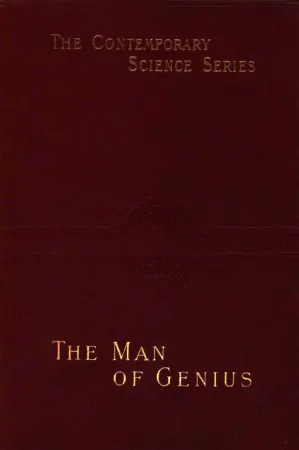
THE CLASSIC COLLECTION · 1891
"The Man of Genius" by Cesare Lombroso is a scientific publication written in the late 19th century. The book delves into the complex relationship between genius and madness, exploring the characteristics of individuals considered genius and how these traits intersect with patterns of mental illness. Lombroso examines historical figures and provides a foundational analysis of genius through a lens of physiological and psychological phenomena. The opening of the work sets the stage for an exploration of genius by referencing significant historical thoughts on the topic, from Aristotle to more contemporary thinkers. Lombroso reflects on his evolving views about genius relating to degradation and neurosis, suggesting that exceptional intellectual capabilities often stem from psychological anomalies. He lays out an argument that associates genius with various signs of degeneration, prompting readers to reconsider what defines genius and how societal perceptions may have historically conflated brilliance with madness. This thought-provoking introduction invites further examination of the intertwining nature of genius, mental health, and societal recognition.
Introduction adapted from the source catalogue; source summaries may be automatically generated.
Free to read · English · 130,716 words · No account needed
MAKE TIME FOR A GOOD BOOK
On by default. Untick to stop anonymous reading totals. Each page counts after 10 seconds in view. How this works.
Anonymous counting is on unless you have switched it off.
[431] In spite of all this, six Italian mental specialists have declared Passanante free from all suspicion of insanity; and he is still confined in a convict prison.
[432] See, for further details, Archivio di Psichiatria, vol. iv.
[433] Las Neurosis de los Hombres celebres en la Historia Argentina, by José Maria Ramon Mejia, Buenos Ayres, 1878.
[434] De Vita Propria.
[435] Schurz, ii.
[436] Ibid., p. 283.
[437] January, 1765.
[438] Of 45 insane writers referred to by Philomneste (op. cit.) there were--15 who devoted themselves to poetry, 12 to theology, 5 to prophecy, 3 to autobiography, 2 to mathematics, 2 to mental pathology, 2 to politics. Poetry predominates for the reason above given, while, on the other hand, theology, philosophy, and the like are more prominent in the mattoids.
[439] Page 200.
[440] He declares that musk reminds him of scarlet and gold, and describes “perfumes which have the smell of infants’ flesh, or of the dawn,” &c., &c.
[441] Manso, Vita, p. 249.
[442] Du Vin, i. 1880.
[443] Schurz, i. 328.
[444] Kreisler is, like himself, full of strange ideals, always at war with reality, and ends by becoming insane.
“Francesco, inferma, entro le membra inferme
Ho l’anima.”
[446] Epistolario, iii. 1.
[447] “Mad Nat Lee,” who was for a long time an inmate of Bedlam, minutely describes the insanity of genius in his poems; e.g., in Cæsar Borgia:--
“Like a poor lunatic that makes his moan, And, for a while, beguiles his lookers-on, He reasons well. His eyes their wildness lose, He vows his keepers his wronged sense abuse, But if you hit the cause that hurts his brain, Then his teeth gnash, he foams, he shakes his chain.”
See Winslow, Obscure Diseases of the Brain, p. 210, London, 1863. See also the chapter “On the Art of Insanity,” for proofs of a like tendency on the part of insane painters.
“Vi son dei giorni che il mio cor vien meno
E il fango mi conquista.”
“Venga l’obbrobrio--dell’uomo sobrio;
Venga il disprezzo del genere umano;
Venga l’inferno--del Padre Eterno;
Vi scenderò col mio bicchiere in mano.”
[450] See Dilthey, Dichterische Einbildungskraft und Wahnsinn,
Leipzig, 1886.
[451] Letter from Edmond de Goncourt to Emile Zola (Lettres de Jules de Goncourt, Paris, 1885).
[452] Déjerine, De l’Hérédité dans les Maladies, 1886; Ribot, De l’Hérédité, 1878; Ireland, The Blot upon the Brain, 1885.
[453] See Part II., pp. 126-132. I must rectify a mistake I have made in not assigning sufficient importance to the influence of race in France. In fact, in revising my studies on a large scale, I find that the departments peopled by the Belgio-Germanic race yield the maximum proportion of geniuses as 40 per cent., while the Celtic departments yielded only 13·5 per cent., and the Iberian 20 per cent.
Your reading position is saved on this browser. Take it to another device with a library code. Reading pages adapt to text, rather than matching a printed edition.
BEHIND THE BOOK
This eBook is for the use of anyone anywhere in the United States and most other parts of the world at no cost and with almost no restrictions whatsoever. You may copy it, give it away or re-use it under the terms of the Project Gutenberg License included with this eBook or online at www.gutenberg.org. If you are not located in the United States, you will have to check the laws of the country where you are located before using this eBook. Read the source licence.
The original source file, including credits and licence, is retained by this library. Request an original-format copy at no charge. Please include the book title and Project Gutenberg identifier #50539.
KEEP YOUR CURIOSITY GOING
David Patterson (Spirit) Hatch
Coulson Kernahan

Ralph Waldo Emerson
Frances Wright

Edwin Abbott Abbott

Joseph Droz