
Last letters from the living dead man
David Patterson (Spirit) Hatch
THE CLASSIC COLLECTION · 1891
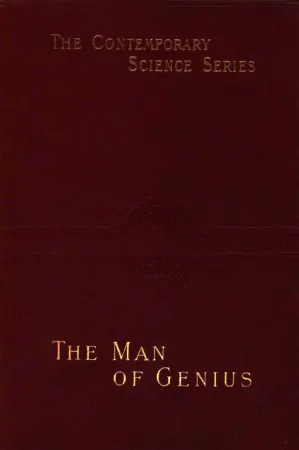
"The Man of Genius" by Cesare Lombroso is a scientific publication written in the late 19th century. The book delves into the complex relationship between genius and madness, exploring the characteristics of individuals considered genius and how these traits intersect with patterns of mental illness. Lombroso examines historical figures and provides a foundational analysis of genius through a lens of physiological and psychological phenomena. The opening of the work sets the stage for an exploration of genius by referencing significant historical thoughts on the topic, from Aristotle to more contemporary thinkers. Lombroso reflects on his evolving views about genius relating to degradation and neurosis, suggesting that exceptional intellectual capabilities often stem from psychological anomalies. He lays out an argument that associates genius with various signs of degeneration, prompting readers to reconsider what defines genius and how societal perceptions may have historically conflated brilliance with madness. This thought-provoking introduction invites further examination of the intertwining nature of genius, mental health, and societal recognition.
Introduction adapted from the source catalogue; source summaries may be automatically generated.
Free to read · English · 130,716 words · No account needed
MAKE TIME FOR A GOOD BOOK
On by default. Untick to stop anonymous reading totals. Each page counts after 10 seconds in view. How this works.
Anonymous counting is on unless you have switched it off.
[1] Magnan, Annales Médico-Psychologiques, 1887; Lombroso, Tre Tribuni, pp. 3-9, 16-23, 148-150; Saury, Études Cliniques sur la Folie Héréditaire, 1886.
[2] Psychologie du Génie, 1883.
[3] De Renzis, L’opera d’un Pazzo, 1887.
[4] Revue des Deux Mondes, 1886.
[5] De Pronost., i. p. 7.
[6] Problemata, sect. xxx.
[7] Horace, Ars Poet., 296-297.
[8] Observationes in Hom. Affect., 1641, lib. 10, p. 305. More singular examples in Italy were collected by F. Gazoni, in the Hospitale dei folli incurabili, 1620.
[9] Diderot, Dictionnaire Encyclopédique.
[10] I Mattoidi e il Monumente a Vittorio Emanuele, 1885.
[11] Magnan, Annales Médico-psych., 1887; Déjerine, L’Hérédité dans les Maladies Mentales, 1886; Ireland, The Blot upon the Brain, 1885.
[12] I Caratteri dei Delinquenti, 1886, Turin.
[13] Méd. de l’Esprit, ii.
[14] Lamartine, Cours de Littérature, ii.
[15] Revue Britannique, 1884.
[16] Canesterini, Il Cranio di Fusinieri, 1875.
[17] Plutarch, Life of Pericles, iii.
[18] Kupfer, “Der Schädel Kants,” in Arch. für Anth., 1881.
[19] Welcker, Schiller’s Schädel, 1883.
[20] Mantegazza, Sul Cranio di Foscolo, Florence, 1880.
[21] Turner, Quarterly Journal of Science, 1864.
[22] De Quatrefages, Crania Ethnica, Part i. p. 30.
[23] Zoja, La Testa di Scarpa, 1880.
[24] Sul Cranio di Volta, 1879, Turin.
[25] Welcker, Schiller’s Schädel, 1883.
[26] Revue Scientifique, 1882.
[27] Wagner (Das Hirngewicht, 1877) gives these measurements of scientific men of Gottingen:--
Dirichlet Mathematician Age 54 1520 g. Fuchs Physician “ 52 1499 g. Gauss Mathematician “ 78 1492 g. Hermann Philologist “ 51 1358 g. Hausmann Mineralogist “ 77 1226 g.
Bischoff (Hirngewichte bei Münchener Gelehrten) gives the following
measurements:--
Hermann Geometrician Age 60 1590 g. Pfeufer Physician “ 60 1488 g. Bischoff Physician “ 79 1452 g. Melchior Meyer Poet “ 61 1415 g. Arnoldi Orientalist “ 85 1730 g. Thackeray Novelist “ 52 1660 g. Abercrombie Physician “ 64 1780 g. Cuvier Naturalist “ 63 1829 g. Doell Archæologist “ 85 1650 g. Schiller Poet “ 46 1580 g. Huber Philosopher “ 47 1499 g. Fallmerayer Historian “ 74 1349 g. Liebig Chemist “ 70 1352 g. Tiedemann Physiologist “ 79 1254 g. Harless Chemist “ 40 1238 g. Döllinger Physiologist “ 71 1207 g.
The measurement of the cerebral area often gives superiority even to those men of genius who present a feeble weight. Fuchs had a cerebral surface of 22,1005 square c. and Gauss of 21,9588; while with the same weight the same surface in an unknown woman was 20,4115 and in a workman 18,7672.
[28] Bulletin de la Société d’Anthropologie, 1861.
[29] Die tiefen Windungen des Menschenhirnes, 1877.
[30] Mendel, Centralblatt, No. 4, 1884.
[31] Ein Beitrag zur Anatomie der Affenspalte und der Interparietal Furche beim Menschen nach Rasse, Geschlecht, und Individualität, 1886.
[32] Bulletin de la Société d’Anthropologie, 1886, p. 135.
[33] La Circonvolution de Broca, Paris, 1888.
[34] Vorstudien, &c., 1st Memoir, 1860.
[35] Le Cerveau et la Pensée, t. ii. p. 46.
[36] Gallichon in Gazette des Beaux Arts, 1867.
[37] Lombroso, Sul Mancinismo motorio e sensorio nei sani e negli
alienati, 1885, Turin.
[38] Essay VII., Of Parents and Children.
[39] Lettres à Georges Sand, Paris, 1885.
[40] Destouches, Philos. Mariés.
[41] Beard, American Nervousness, 1887; Cancellieri, Intorno Uomini dotati di gran memoria, 1715; Klefeker, Biblioth. eruditorum procacium, Hamburg, 1717; Baillet, De præcocibus eruditis, 1715.
[42] Savage, Moral Insanity, 1886.
[43] Guy de Maupassant, Étude sur Gustave Flaubert, Paris, 1885.
[44] Revue des Deux Mondes, 1883, p. 92.
[45] Revue Bleue, 1887, p. 17.
Your reading position is saved on this browser. Take it to another device with a library code. Reading pages adapt to text, rather than matching a printed edition.
BEHIND THE BOOK
This eBook is for the use of anyone anywhere in the United States and most other parts of the world at no cost and with almost no restrictions whatsoever. You may copy it, give it away or re-use it under the terms of the Project Gutenberg License included with this eBook or online at www.gutenberg.org. If you are not located in the United States, you will have to check the laws of the country where you are located before using this eBook. Read the source licence.
The original source file, including credits and licence, is retained by this library. Request an original-format copy at no charge. Please include the book title and Project Gutenberg identifier #50539.
KEEP YOUR CURIOSITY GOING
David Patterson (Spirit) Hatch
Coulson Kernahan

Ralph Waldo Emerson
Frances Wright

Edwin Abbott Abbott

Joseph Droz