
Last letters from the living dead man
David Patterson (Spirit) Hatch
THE CLASSIC COLLECTION · 1891
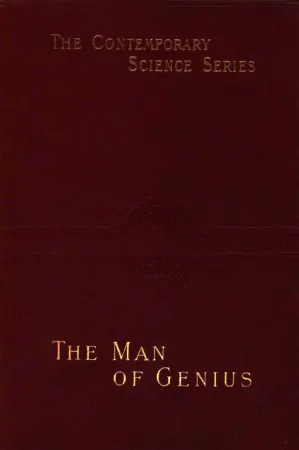
"The Man of Genius" by Cesare Lombroso is a scientific publication written in the late 19th century. The book delves into the complex relationship between genius and madness, exploring the characteristics of individuals considered genius and how these traits intersect with patterns of mental illness. Lombroso examines historical figures and provides a foundational analysis of genius through a lens of physiological and psychological phenomena. The opening of the work sets the stage for an exploration of genius by referencing significant historical thoughts on the topic, from Aristotle to more contemporary thinkers. Lombroso reflects on his evolving views about genius relating to degradation and neurosis, suggesting that exceptional intellectual capabilities often stem from psychological anomalies. He lays out an argument that associates genius with various signs of degeneration, prompting readers to reconsider what defines genius and how societal perceptions may have historically conflated brilliance with madness. This thought-provoking introduction invites further examination of the intertwining nature of genius, mental health, and societal recognition.
Introduction adapted from the source catalogue; source summaries may be automatically generated.
Free to read · English · 130,716 words · No account needed
MAKE TIME FOR A GOOD BOOK
On by default. Untick to stop anonymous reading totals. Each page counts after 10 seconds in view. How this works.
Anonymous counting is on unless you have switched it off.
In the United States, Beard remarks,[237] the influence of a dry and changeable climate favours in the North a remarkable spirit of progress, the love of knowledge, the agitation of public life and a great desire for novelty; while in the South, the moist and but slightly varying climate develops eminently conservative tendencies, so that manufacturers in Georgia have great difficulty in finding a market there for new stuffs or machines; these are refused, not because they are not good or useful, but because they are new.
In Germany it has been observed that regions enjoying a mild and healthy climate, by reason of protecting mountains, have produced the greatest poets and in greatest number. The regions of the Main and the Neckar are renowned for their mild climate, luxuriant vegetation, and fertility, and the greatest German poets come from these regions. The Main gave us the greatest of German poets, Goethe, and many other dii minorum gentium, genial and noteworthy poets, although beneath that giant, men such as Klinger, Börne, Rückert, Bettina von Arnim (née Brentano), &c. In the favoured region of the Neckar were born Schiller and Victor von Scheffel, and throughout the Swabian land, we meet with many other great poets and thinkers, such as Wieland, Uhland, Justinus Kerner, Hauff, Schubart, Mörike, G. Schwab,
Schelling, Müller, Hölderlin, and others. That hilly regions are richer than others in poets is shown in Germany by Hanover (Klopstock, Stolberg, Iffland, Bürger, Leisewitz, Bodenstedt, Hoffmann von Fallersleben, the two Schlegels, &c.); by the Rhine province (Heine, Jacobi, J. Müller, Brentano); Saxony, one of the districts possessing a mild climate, which has yielded the largest number of poets (Körner, Gellert, Kästner, Rabener, and, above all, Lessing); and Thuringia (Kotzebue, Rückert, G. Freytag, Heinse, Musäus, Gotter). On the other hand, the flat regions of Germany or those with a severe climate, have produced few poets.[238] As exceptions must be mentioned, Herder (Mohrungen in East Prussia), M. von Schenkendorf (Tilsit), E. M. Arndt (Rügen), Luther (Eisleben), Paul Gerhardt (Gräfenhainichen), the two Humboldts, Paul Heyse, Tieck, Gutzkow (Berlin), Immermann (Magdeburg), Wilhelm Müller, Max Müller, Moses Mendelssohn (Dessau). Westphalia, again, is mountainous, but poor in poets.
Your reading position is saved on this browser. Take it to another device with a library code. Reading pages adapt to text, rather than matching a printed edition.
BEHIND THE BOOK
This eBook is for the use of anyone anywhere in the United States and most other parts of the world at no cost and with almost no restrictions whatsoever. You may copy it, give it away or re-use it under the terms of the Project Gutenberg License included with this eBook or online at www.gutenberg.org. If you are not located in the United States, you will have to check the laws of the country where you are located before using this eBook. Read the source licence.
The original source file, including credits and licence, is retained by this library. Request an original-format copy at no charge. Please include the book title and Project Gutenberg identifier #50539.
KEEP YOUR CURIOSITY GOING
David Patterson (Spirit) Hatch
Coulson Kernahan

Ralph Waldo Emerson
Frances Wright

Edwin Abbott Abbott

Joseph Droz