
Last letters from the living dead man
David Patterson (Spirit) Hatch
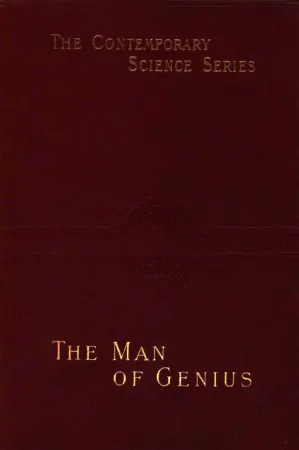
THE CLASSIC COLLECTION · 1891
"The Man of Genius" by Cesare Lombroso is a scientific publication written in the late 19th century. The book delves into the complex relationship between genius and madness, exploring the characteristics of individuals considered genius and how these traits intersect with patterns of mental illness. Lombroso examines historical figures and provides a foundational analysis of genius through a lens of physiological and psychological phenomena. The opening of the work sets the stage for an exploration of genius by referencing significant historical thoughts on the topic, from Aristotle to more contemporary thinkers. Lombroso reflects on his evolving views about genius relating to degradation and neurosis, suggesting that exceptional intellectual capabilities often stem from psychological anomalies. He lays out an argument that associates genius with various signs of degeneration, prompting readers to reconsider what defines genius and how societal perceptions may have historically conflated brilliance with madness. This thought-provoking introduction invites further examination of the intertwining nature of genius, mental health, and societal recognition.
Introduction adapted from the source catalogue; source summaries may be automatically generated.
Free to read · English · 130,716 words · No account needed
MAKE TIME FOR A GOOD BOOK
On by default. Untick to stop anonymous reading totals. Each page counts after 10 seconds in view. How this works.
Anonymous counting is on unless you have switched it off.
But, to come to more definite examples, we find that Florence, enjoying a mild temperature and in special degree a city of the hills, has furnished Italy with her most splendid cohort of great men: Dante, Giotto, Machiavelli, Lulli, Leonardo, Brunellesco, Guicciardini, Cellini, Fra Angelico, Andrea del Sarto, Nicolini, Capponi, Vespucci, Viviani, Lippi, Boccaccio, Alberti, Dati, Alamanni, Rucellai, Ghirlandajo, Donati; Pisa, on the other hand, with scientific conditions at least as favourable as Florence, being the seat of a flourishing university, only offers us--if we except a few soldiers and statesmen of no great number and worth who were unable, even with powerful allies, to prevent her fall--Pisa only offers us Nicola Pisano, Giunta, and Galileo who, although born there, was of Florentine parentage. Now Pisa only differs from Florence by being situated on a plain.
In Lombardy, the regions of mountain and lake, like Bergamo, Brescia, and Como, have produced more great men than the flat regions. I will mention Bernardo Tasso, Mascheroni, Donizetti, Tartaglia, Ugoni, Volta, Parini, Appiani, Mai, Cagnola; while Lower Lombardy can only bring forward Alciato, Beccaria, Oriani, Cavalleri, Aselli, and Bocaccini. Verona, a town of the hills, has produced Maffei, Paolo Veronese, Catullus, Pliny, Fracastoro, Bianchini, Sammicheli, Cagnola, Tiraboschi, Brusasorsi, Lorgna, Pindemonte; and not to speak of artists, economists, and thinkers of the first order (it is enough to name Trezza), I note that, in a very accurate document,[236] it appears that in 1881, there were 160 poets at Verona, many rising considerably above mediocrity. On the other hand, the wealthy and learned Padua has only given to Italy Livy, Cesarotti, Pietro d’Abano, and a few others.
Genoa and Naples, which unite the advantages of a climate at once warm, maritime, and hilly, have produced men of genius at least as remarkable as those yielded by Florence, if not in such great number; such are Columbus, Doria, Mazzini, Paganini, Vico, Caracciolo, Pergolese, Genovesi, Cirillo, Filangeri.
In Spain, the influence of a warm climate is evident. The whole of Catalonia, including Barcelona, though inhabited by a serious race, has not produced artists, having yielded only a single poet, an imitator of Petrarch. Seville, on the contrary, has produced Cervantes, Velasquez and Murillo; Cordova has yielded many men of genius, such as Seneca, Lucan, Morales, Mina, Gongora and Céspedes, at once painter, sculptor, and poet.
Your reading position is saved on this browser. Take it to another device with a library code. Reading pages adapt to text, rather than matching a printed edition.
BEHIND THE BOOK
This eBook is for the use of anyone anywhere in the United States and most other parts of the world at no cost and with almost no restrictions whatsoever. You may copy it, give it away or re-use it under the terms of the Project Gutenberg License included with this eBook or online at www.gutenberg.org. If you are not located in the United States, you will have to check the laws of the country where you are located before using this eBook. Read the source licence.
The original source file, including credits and licence, is retained by this library. Request an original-format copy at no charge. Please include the book title and Project Gutenberg identifier #50539.
KEEP YOUR CURIOSITY GOING
David Patterson (Spirit) Hatch
Coulson Kernahan

Ralph Waldo Emerson
Frances Wright

Edwin Abbott Abbott

Joseph Droz