THE CLASSIC COLLECTION✦A dead man’s diaryCLASSIC FREE BOOKS
A dead man’s diary
Coulson Kernahan
THE CLASSIC COLLECTION · 1910
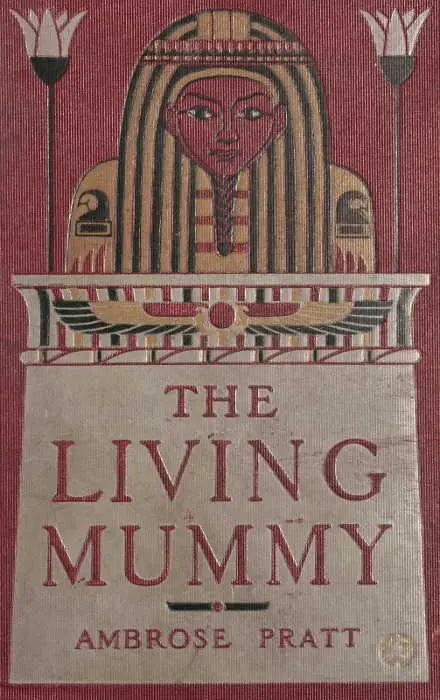
"The Living Mummy" by Ambrose Pratt is a fiction novel written in the early 20th century. The story is set in the Libyan desert, where the main character, Dr. Pinsent, is an Egyptologist who becomes embroiled in a mysterious and thrilling adventure involving the famous explorer Sir Robert Ottley and his daughter, Miss Ottley. The narrative introduces a fascinating premise centered around ancient Egyptian history, particularly revolving around the discovery of a tomb belonging to a powerful priest named Ptahmes, and explores themes of curiosity, ambition, and the supernatural. The opening of the narrative sets the stage with Dr. Pinsent intensely focused on his academic work when he is unexpectedly interrupted by the arrival of Sir Robert Ottley and his daughter. The excitement builds as they embark on a journey to explore a tomb that Ottley has searched for years. However, mysterious and ominous elements start to surface, including the enigmatic allure of the sarcophagus and the supernatural presence that seems to haunt the characters. Through tense interactions and the introduction of a shadowy figure that appears to threaten their safety, the opening hints at a deeper connection between the ancient past and the unfolding drama, enticing the reader to delve further into the book's mysteries and character dynamics.
Introduction adapted from the source catalogue; source summaries may be automatically generated.
Free to read · English · 72,228 words · No account needed
MAKE TIME FOR A GOOD BOOK
On by default. Untick to stop anonymous reading totals. Each page counts after 10 seconds in view. How this works.
Anonymous counting is on unless you have switched it off.
I awoke in the grey light of dawn, stiff with cold and aching in every limb. Arising, I left my hiding-place and went into the vestibule. The night porter sat on a stool in his little office toasting his toes before the stove and reading one of the morning papers. I stepped up to the door at once. Hearing my footsteps, he looked around. "Good-morning, Michael," I said, as well as my chattering teeth would let me. "Do you want all that fire?" I had forgotten that I was completely invisible. The fellow sprang to his feet with a start and stared at me aghast. "What's the matter with you?" I demanded, testily.
"'Ere--you keep off. I've done nothing to 'arm you!" he whined, and he backed before my advance against the wall of the office, the very picture of abject terror. His appearance recalled me to my senses. But it was too late to cry over spilt milk. I thought it better to make a confidant of the man if he would let me.
"Don't be frightened, Michael; there is no need. I'm not a ghost, feel
my hands!" I said.
But panic seized the fellow. He uttered a wild shriek and fled for his life into the passage. I could hardly help laughing, but I saw a chance in the contretemps to end my immediate difficulty--so I went straight to the desk, and fortunately found it open. In Hubbard's pigeon-hole was the key I wanted. I took it out, caught up a Times and hurried up the stairs. In another moment I was safe in Hubbard's room with the door locked against intrusion. My first care was to set the asbestos ablaze and warm myself. Then I opened the paper and found at once the news I sought under great cross headlines in the main sheet. Miss Ottley's house had been completely gutted by fire. Some of the walls still stood, but with the exception of a few pictures, the whole of the valuable art furniture and the late Sir Robert Ottley's splendid collection of Egyptian coins, manuscripts and curios had been destroyed. It was supposed that Dr. Belleville had perished in the flames, but no sign of his remains had been discovered. The fire, as far as it was possible to ascertain, had arisen from an accident due to the unsuccessful conduct of a chemical experiment. It was well known in scientific circles, said the journal, that the Doctor had been engaged in a series of experiments, the object of which had been kept a close secret, but a city firm of manufacturing chemists had recently supplied him with large quantities of a certain highly inflammable liquid compound possessing radio activities which had been prepared at enormous cost, under his directions. The manager of the firm, on being interviewed, stated that in his opinion, this compound was principally responsible for the tragic disaster. There was always a danger in handling it of spontaneous combustion, it appeared, and if it once took fire, by no means could it be extinguished except by the shutting off of all supplies of oxygen. Failing this, it would burn to the last with the most explosive energy. According to Miss Ottley's statement, when first interrogated by an officer from Scotland Yard, she had been in the laboratory with Dr. Belleville at the time of the catastrophe. She had lately been very ill and it seems she had fainted. It was extremely probable that the Doctor, in his anxiety to revive her, had neglected his usual caution and had done some careless thing which had led to his destruction. Probably he had been killed outright by the first explosion. It was, however, a matter of general relief that Miss Ottley had managed to escape, and that there had been no further sacrifice of life. Everyone would sympathise with the unfortunate young lady in her sad position. Only a few weeks ago the gallant young officer to whom she had been engaged to be married, had come to an untimely end in a railway accident on the very eve of his wedding day. Then, a little later, the dark angel had deprived her of a loving and beloved father, the great millionaire archæologist, whose recent operations on 'Change had startled the world, and made of him the richest man in the United Kingdom. And now, she had lost by death the kind and learned guardian to whom her late father had entrusted her future and the management of her enormous fortune. Nobody would be surprised to learn that this great accumulation of calamities had reduced the fate-stricken young lady to a state of utter physical prostration. She had been taken yesterday evening, after her rescue from the burning mansion, to the Albert Hospital, but she had subsequently been removed to the Walsingham Hotel, where the management had placed a suite of rooms at her disposal. She was there being treated under the care of Drs. Fiaschi and Mason, the well-known heart and nerve specialists. These gentlemen express themselves hopeful of her ultimate recovery, but they do not conceal the fact that she is at present in a very low condition, and it is significant that the road in front of the hotel was, in the small hours of the morning, thickly overspread with tan.
Your reading position is saved on this browser. Take it to another device with a library code. Reading pages adapt to text, rather than matching a printed edition.
BEHIND THE BOOK
This eBook is for the use of anyone anywhere in the United States and most other parts of the world at no cost and with almost no restrictions whatsoever. You may copy it, give it away or re-use it under the terms of the Project Gutenberg License included with this eBook or online at www.gutenberg.org. If you are not located in the United States, you will have to check the laws of the country where you are located before using this eBook. Read the source licence.
The original source file, including credits and licence, is retained by this library. Request an original-format copy at no charge. Please include the book title and Project Gutenberg identifier #58944.
KEEP YOUR CURIOSITY GOING
Coulson Kernahan

Maurice Baring
Frances Wright
Cécile Tormay
Francis Greenleaf Allinson & Anne C. E. (Anne Crosby Emery) Allinson

Frederic Jesup Stimson