THE CLASSIC COLLECTION✦A dead man’s diaryCLASSIC FREE BOOKS
A dead man’s diary
Coulson Kernahan
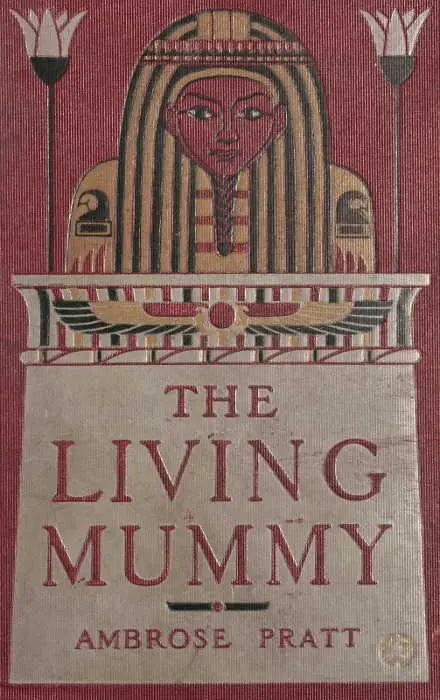
THE CLASSIC COLLECTION · 1910
"The Living Mummy" by Ambrose Pratt is a fiction novel written in the early 20th century. The story is set in the Libyan desert, where the main character, Dr. Pinsent, is an Egyptologist who becomes embroiled in a mysterious and thrilling adventure involving the famous explorer Sir Robert Ottley and his daughter, Miss Ottley. The narrative introduces a fascinating premise centered around ancient Egyptian history, particularly revolving around the discovery of a tomb belonging to a powerful priest named Ptahmes, and explores themes of curiosity, ambition, and the supernatural. The opening of the narrative sets the stage with Dr. Pinsent intensely focused on his academic work when he is unexpectedly interrupted by the arrival of Sir Robert Ottley and his daughter. The excitement builds as they embark on a journey to explore a tomb that Ottley has searched for years. However, mysterious and ominous elements start to surface, including the enigmatic allure of the sarcophagus and the supernatural presence that seems to haunt the characters. Through tense interactions and the introduction of a shadowy figure that appears to threaten their safety, the opening hints at a deeper connection between the ancient past and the unfolding drama, enticing the reader to delve further into the book's mysteries and character dynamics.
Introduction adapted from the source catalogue; source summaries may be automatically generated.
Free to read · English · 72,228 words · No account needed
MAKE TIME FOR A GOOD BOOK
On by default. Untick to stop anonymous reading totals. Each page counts after 10 seconds in view. How this works.
Anonymous counting is on unless you have switched it off.
This last paragraph, as may easily be conceived, filled me with anxiety. I resolved to go at once to the Walsingham Hotel and find out exactly how she was for myself. But, fortunately, in moving towards the door to put my purpose into execution, I had to pass the mirror-backed door of a clothes press. I did not pass it then. I stopped, spellbound. I was no longer invisible. That is to say, my face and hands were not--although my body was. The mirror showed me a head floating apparently in mid-air and a pair of hands hanging mysteriously from nothing. My eyes were curiously goggled with a thin, gelatinous-like film, with a glassy surface that was bound about my head. This I tore off forthwith and curiously examined. It was actually composed of gelatine. Tossing it aside, I ran my fingers over my clothing and discovered, from the sense of touch, that I was clad to the neck in one unbroken combination suit of rubber overalls, which included footgear. I soon made out the secret of its fastening, and tearing it open, I stepped forth into the light of day and perfect visibility, to find that I still had on all the clothes I had worn when Dr. Belleville trapped me, except my boots. The overalls, however, remained visible, or rather partially so, for their inner surface viewed from the opening was discernible. I put them carefully aside for future investigation and proceeded to make a toilet. My first care was a hot bath. The hall porter, whom I had frightened so desperately a little while before, answered my ring. He was astounded to see me, but I did not choose to make him any explanations, and he was too overcome to ask me for any. A little later I was luxuriating in a steaming bath, which removed the last vestige of my Parisian disguise. Most of the paint, however, had worn off before, so it was the easier to become myself again. But not quite my old, familiar self. My experiences had permanently aged me. There were lines upon my face that I was stranger to, and with which I made reluctant acquaintance. And my hair was liberally streaked with grey. I had put on ten years, at least. I felt old, too, that was the worst of it--old, ill and thick-blooded and infinitely world-weary. I felt a hunger for the desert and big open spaces; a need to hasten from the grinding, selfish life of cities, with their secret crimes and gilded vices and dull-herded groping after sordid happiness. But I did not wish to go alone. At a little after eight o'clock I entered the Walsingham and demanded to see Miss Ottley's head nurse. She was at breakfast, but the waiter told me that Miss Ottley had spent a good night and was still asleep, so I was content to wait. Afterwards, I had to lie to the nurse in order to be permitted to see the invalid. I told her that I was Miss Ottley's nearest living relative, and I suppressed the fact of my medical qualifications. The woman, otherwise, would have referred me to the physicians, who had employed her, and I should have been put off for hours. As it was, it required all my powers of persuasion to induce her to admit me to the sick room. But I prevailed on her at last, with a show of stern authority, and a curt intimation that her position depended on my complaisance. The falsehood is not one that I feel any shame at, for I knew what an effect my appearance would make in the patient, and I was determined, at all costs, to be with her at the moment of her waking. I shall pass over the preliminary period that I spent beside her bed. It is too full of sorrow to recall with anything but misery. The poor girl was as frail and wan as any spirit. They had cut off all her glorious hair, and the hand I kissed, which lay so weakly on the coverlid, was whiter than a snowflake, and almost as destitute of vigour. She slept as gently as a weary babe, and it was hard at first to believe thoroughly she lived. But at length she sighed and her great eyes slowly opened and looked up questioningly into mine. She thought that she was dead and that my ghost had sought her out. "Hugh!" she whispered, and a soft smile lighted her face and made it infinitely lovely, though so wan. "I knew that I should find you, dear," she sighed. "And so I could not help but pray to die. Will God punish us for that?"
Your reading position is saved on this browser. Take it to another device with a library code. Reading pages adapt to text, rather than matching a printed edition.
BEHIND THE BOOK
This eBook is for the use of anyone anywhere in the United States and most other parts of the world at no cost and with almost no restrictions whatsoever. You may copy it, give it away or re-use it under the terms of the Project Gutenberg License included with this eBook or online at www.gutenberg.org. If you are not located in the United States, you will have to check the laws of the country where you are located before using this eBook. Read the source licence.
The original source file, including credits and licence, is retained by this library. Request an original-format copy at no charge. Please include the book title and Project Gutenberg identifier #58944.
KEEP YOUR CURIOSITY GOING
Coulson Kernahan

Maurice Baring
Frances Wright
Cécile Tormay
Francis Greenleaf Allinson & Anne C. E. (Anne Crosby Emery) Allinson

Frederic Jesup Stimson