THE CLASSIC COLLECTION✦Peeps at HeraldryCLASSIC FREE BOOKS
Peeps at Heraldry
Phoebe Allen
THE CLASSIC COLLECTION · 1901
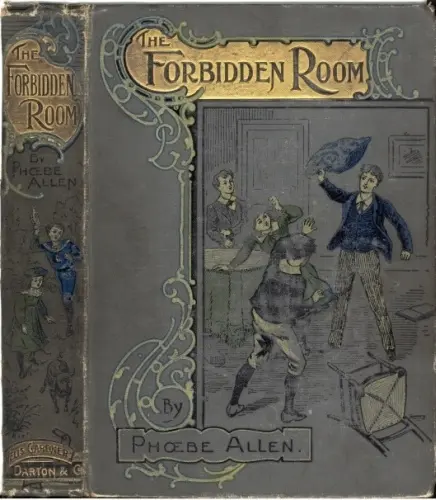
"The Forbidden Room; Or, 'Mine Answer was My Deed'" by Phoebe Allen is a novel written in the early 20th century. The story unfolds in a rural setting centered around Gaybrook Farm, where a group of children, including the timid Gaston Delzant and the lively cousins, come together for a summer visit. Through their adventures and interactions, themes of childhood innocence, friendship, and the quest for acceptance come to the forefront. The opening of the novel introduces the lively preparations at Gaybrook Farm for the arrival of guests, particularly focusing on the excitement and nerves of the children, especially Gaston, who fears being teased. As the guests arrive, a diverse cast of characters is established, each with their distinctive personalities and quirks. The children's initial interactions set the stage for playful dynamics and conflicts, particularly highlighting Andrew's bravado and the gentle, more timid nature of Gaston. This portion of the book effectively sets the tone for a light-hearted yet poignant exploration of childhood experiences in a close-knit farm community.
Introduction adapted from the source catalogue; source summaries may be automatically generated.
Free to read · English · 50,678 words · No account needed
MAKE TIME FOR A GOOD BOOK
On by default. Untick to stop anonymous reading totals. Each page counts after 10 seconds in view. How this works.
Anonymous counting is on unless you have switched it off.
There was something in its irregular rambling style of architecture that gave to Gaybrook Farm, as Di expressed it, a particularly “holiday-house” look.
Nobody quite knew how old it was, but the various additions to the original building, which had been evidently made at different intervals, suggested the handiwork of several generations, and seeing that, as Mrs. Busson was fond of saying, “Busson’s great grandfather had been born there, and that Busson himself was no chicken, the farm must have been standing, well over a hundred years at any rate.”
But though so strangely irregular, it was a very substantial pile of
buildings.
The red, pan-tiled roof of the main portion seemed, as it were, to run up-hill, and from under this the first floor projected, supported by heavy black beams.
It was in this part of the house, in low ceilinged rooms, with little old casement windows, and long window panes, that Mrs. Busson had arranged to bestow her visitors.
For this end of the house, “the up-hill part,” as Hubert called it, comprised all the living rooms of the family. There was the large house place below, with the roomy parlours on either side, the best bedrooms above, and the attics another storey higher.
Beneath the lower roof of the building, which was thatched and much weather-worn, were all the various farmhouse offices.
Foremost amongst these was the kitchen. Oh! such a kitchen it was. Flanked by the store-room and larders, and a dairy a little further on, which opened out into a spacious back yard, and with the baking and brewing-houses, and the wood and the wash sheds, it formed a regular little quadrangle.
Over the kitchen was a long, low room, filled with linen-presses, and fragrant with lavender and dried rose-leaves, for Mrs. Busson held fast to old traditions in these matters of household economy; whilst almost adjoining was a huge apple-room, and overhead the vast cheese-loft.
Between the linen room and the apple store was another chamber door (if that door had never been there, this story would never have been written). To judge, however, from the cobwebs which hung like a thick grey mist about its cracks and hinges, that door must have been long, very long unopened.
“Now mind, you girls,” Mrs. Busson had cautioned her hand-maidens, before the children’s arrival, “whatever happens, you never let the little gentlemen and ladies go trying to get in there.”
Unanimously, the girls promised obedience.
But that same evening, directly after tea, their mistress reiterated her
commands.
Your reading position is saved on this browser. Take it to another device with a library code. Reading pages adapt to text, rather than matching a printed edition.
BEHIND THE BOOK
This eBook is for the use of anyone anywhere in the United States and most other parts of the world at no cost and with almost no restrictions whatsoever. You may copy it, give it away or re-use it under the terms of the Project Gutenberg License included with this eBook or online at www.gutenberg.org. If you are not located in the United States, you will have to check the laws of the country where you are located before using this eBook. Read the source licence.
The original source file, including credits and licence, is retained by this library. Request an original-format copy at no charge. Please include the book title and Project Gutenberg identifier #49389.
KEEP YOUR CURIOSITY GOING
Coulson Kernahan

Maurice Baring
Frances Wright
Cécile Tormay

Frederic Jesup Stimson

W. H. P. (William Henry Pope) Jarvis