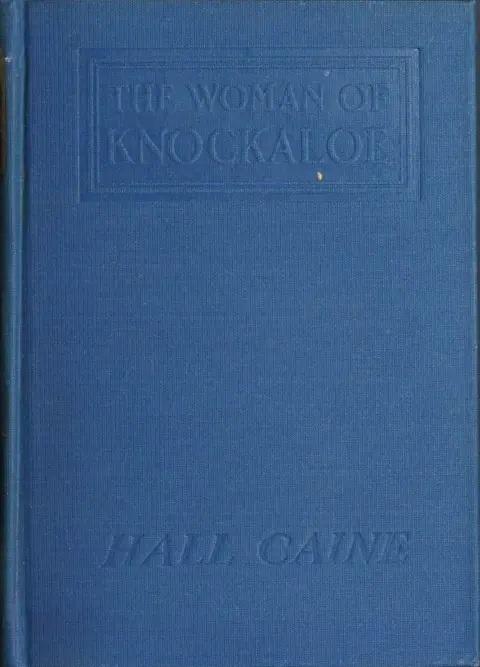
The Woman of Knockaloe: A Parable
Hall, Sir Caine
THE CLASSIC COLLECTION · 1901
"The Eternal City" by Hall Caine is a novel written in the early 20th century. The story delves into the lives of various characters against the backdrop of societal and political turmoil in Rome, particularly focusing on themes of love, sacrifice, and social justice. The characters include a young boy named David Leone, whose poignant backstory intertwines with the central narrative that revolves around the influential figure of David Rossi, an anarchist politician seeking reform. The opening of the book introduces the struggles of a poor, vulnerable boy, David Leone, who finds himself lost in the cold streets of London, reflecting on the despair faced by those in his situation. After being rescued by a kind doctor, the story quickly shifts to a narrative set twenty years later, on the last day of the century, as the Pope's Jubilee attracts a crowd in Rome. As the festivities unfold, we meet various prominent figures, including David Rossi, who plans a significant protest against the injustices faced by the people. The setting and character dynamics are rich with political and emotional complexities, indicating that the novel will address the struggles of the working class and the individual's place within the larger societal framework.
Introduction adapted from the source catalogue; source summaries may be automatically generated.
Free to read · English · 172,155 words · No account needed
MAKE TIME FOR A GOOD BOOK
On by default. Untick to stop anonymous reading totals. Each page counts after 10 seconds in view. How this works.
Anonymous counting is on unless you have switched it off.
Roma was lying on a bed-chair in the frescoed room which had once been the Pope's salon. She was wearing a white dress, and it made her unruffled brow look like alabaster. Her large eyes, which were closed, had blue rings on the lids, and her mouth, once so rosy and so gay with laughter and light words, was colourless as marble.
A lay Sister, in a black and white habit, moved softly about the room. It was Bruno's widow, Elena. She was the Sister Angelica who had entered the convent of the Sacred Heart. It was there she had buried her own trouble until, hearing of Roma's, she had begged to be allowed to nurse her.
A door opened and an officer, in a mixed light and dark blue uniform, entered. It was the doctor of the regiment.
"Sleeping, Sister?"
"Yes, sir."
"Poor soul! Let her sleep as long as she can."
But at that moment Roma opened her eyes, and held out her white hand. "Is it you, doctor?" she said with a smile.
"And how is my patient this morning? Better, I think."
"Much better. In fact, I feel no pain at all to-day."
"She never does. She never feels anything if you believe her," said
Elena.
"Tired, Sister?"
"Why should I be tired, I wonder?"
"Sitting up all night with me. Your big burden is very troublesome,
doctor."
"Tut! You mustn't talk like that."
"If all jailors were as good to their prisoners as mine are to me!"
"And if all prisoners were as good to their jailors.... But I forbid that subject. I absolutely forbid it.... Ah, here comes your breakfast."
A soldier in uniform trousers and a linen jacket and cap had come in with a tray on which there was a smoking basin.
"You are from Sicily, aren't you, cook?"
"Yes, from Sicily, Signora."
Roma leaned back to Elena and said in an undertone, "That's where he
has gone to, isn't it?"
"Some people say so, but nobody knows where he is."
"No news yet?"
"None whatever."
"Sicily must be a lovely place, cook?"
"It is, Signora. It's the loveliest place in the world."
"Last night I had such a beautiful dream, doctor. Somebody who had been away came back, and all the church bells rang for him. I thought it was noon, I remember, for the big gun of the Castle had just been fired. But when I awoke it was quite dark, yet there was really something going on, for I could hear people singing in the city and bands of music playing."
Your reading position is saved on this browser. Take it to another device with a library code. Reading pages adapt to text, rather than matching a printed edition.
Hall, Sir Caine
Hall, Sir Caine
Hall, Sir Caine
Hall, Sir Caine
BEHIND THE BOOK
This eBook is for the use of anyone anywhere in the United States and most other parts of the world at no cost and with almost no restrictions whatsoever. You may copy it, give it away or re-use it under the terms of the Project Gutenberg License included with this eBook or online at www.gutenberg.org. If you are not located in the United States, you will have to check the laws of the country where you are located before using this eBook. Read the source licence.
The original source file, including credits and licence, is retained by this library. Request an original-format copy at no charge. Please include the book title and Project Gutenberg identifier #19732.
KEEP YOUR CURIOSITY GOING
Coulson Kernahan

Maurice Baring
Frances Wright
Cécile Tormay

Frederic Jesup Stimson

W. H. P. (William Henry Pope) Jarvis