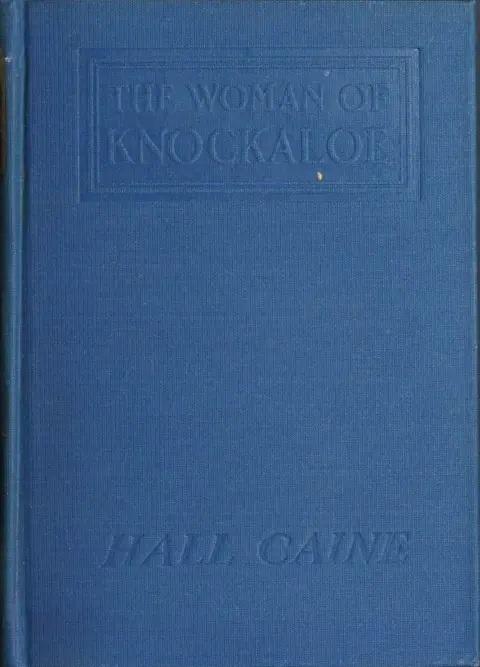
The Woman of Knockaloe: A Parable
Hall, Sir Caine
THE CLASSIC COLLECTION · 1901
"The Eternal City" by Hall Caine is a novel written in the early 20th century. The story delves into the lives of various characters against the backdrop of societal and political turmoil in Rome, particularly focusing on themes of love, sacrifice, and social justice. The characters include a young boy named David Leone, whose poignant backstory intertwines with the central narrative that revolves around the influential figure of David Rossi, an anarchist politician seeking reform. The opening of the book introduces the struggles of a poor, vulnerable boy, David Leone, who finds himself lost in the cold streets of London, reflecting on the despair faced by those in his situation. After being rescued by a kind doctor, the story quickly shifts to a narrative set twenty years later, on the last day of the century, as the Pope's Jubilee attracts a crowd in Rome. As the festivities unfold, we meet various prominent figures, including David Rossi, who plans a significant protest against the injustices faced by the people. The setting and character dynamics are rich with political and emotional complexities, indicating that the novel will address the struggles of the working class and the individual's place within the larger societal framework.
Introduction adapted from the source catalogue; source summaries may be automatically generated.
Free to read · English · 172,155 words · No account needed
MAKE TIME FOR A GOOD BOOK
On by default. Untick to stop anonymous reading totals. Each page counts after 10 seconds in view. How this works.
Anonymous counting is on unless you have switched it off.
After recitation of the Rosary, the Pope, who had kept his religious retreat throughout the day, announced, to the astonishment of his chamberlains, his desire to walk in the garden at night. With Father Pifferi carrying a long Etruscan lamp he walked down the dark corridors with their surprised palfrenieri, and across the open courtyards with their startled sentinels, to where the arches of the Vatican opened upon the soft spring sky.
The night was warm and quiet, and the moon, which had just risen and was near the full, shone with steady brilliance.
The venerable old men walked without speaking, and only the beating of their sticks on the gravel seemed to break the empty air. At length the Pope stopped and said:
"How strange it all was, Father Pifferi!"
"Very strange, your Holiness," said the Capuchin.
"Rossi is not his name, it seems."
"'Not really his name' was what she said."
"His mother was deceived by every one, and she drowned herself in the
Tiber."
"That was so, your Holiness."
"He was nursed in the Foundling, brought up in the Campagna, and then sold as a boy into England."
"It is really extraordinary," said Father Pifferi.
"Most extraordinary," repeated the Pope.
They looked steadily at each other for a moment, and then walked on in silence. Little sparks of blue light pulsed and throbbed and floated before their faces, and the moon itself, like a greater firefly, came and went in the interstices of the thin-leaved trees. The Pope, who shuffled in his walking, stopped again.
"Your Holiness?"
"Who can he be, I wonder?"
The Capuchin drew a deep breath. "We shall know everything to-morrow
morning."
"Yes," said the Pope, "we shall know everything to-morrow morning."
Some dark phantom of the past was hovering about them, and they were
afraid to challenge it.
At that moment the silence of the listening air was broken by a long clear call, which rang out through the night without any warning, and then stopped as suddenly.
"The nightingale," said the Pope.
A mighty flood of melody floated down from some unseen place, in varying strains of divine music broken by many pauses, and running through every phase of jubilation, sorrow, and pain. It ended in a low wail of unutterable sadness, a pleading, yearning cry of anguish, which seemed to call on God Himself to hear. When it was over, and all was hushed around, the world seemed to have become void.
The Pope's feet shuffled on the gravel. "I shall never forget it," he
said.
"It was wonderful," said the Capuchin.
Your reading position is saved on this browser. Take it to another device with a library code. Reading pages adapt to text, rather than matching a printed edition.
Hall, Sir Caine
Hall, Sir Caine
Hall, Sir Caine
Hall, Sir Caine
BEHIND THE BOOK
This eBook is for the use of anyone anywhere in the United States and most other parts of the world at no cost and with almost no restrictions whatsoever. You may copy it, give it away or re-use it under the terms of the Project Gutenberg License included with this eBook or online at www.gutenberg.org. If you are not located in the United States, you will have to check the laws of the country where you are located before using this eBook. Read the source licence.
The original source file, including credits and licence, is retained by this library. Request an original-format copy at no charge. Please include the book title and Project Gutenberg identifier #19732.
KEEP YOUR CURIOSITY GOING
Coulson Kernahan

Maurice Baring
Frances Wright
Cécile Tormay

Frederic Jesup Stimson

W. H. P. (William Henry Pope) Jarvis