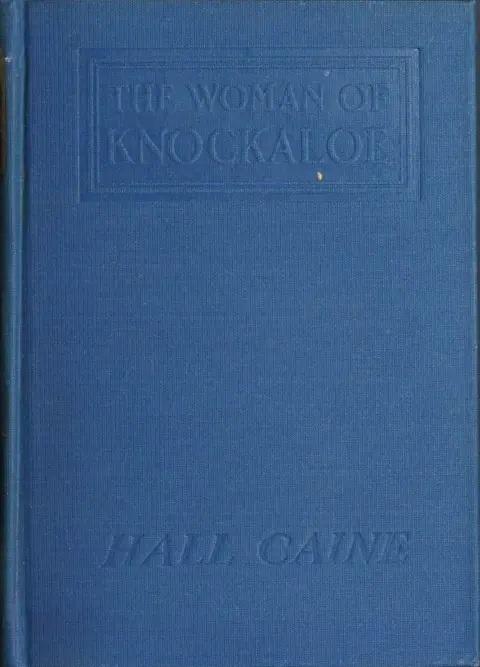
The Woman of Knockaloe: A Parable
Hall, Sir Caine
THE CLASSIC COLLECTION · 1901
"The Eternal City" by Hall Caine is a novel written in the early 20th century. The story delves into the lives of various characters against the backdrop of societal and political turmoil in Rome, particularly focusing on themes of love, sacrifice, and social justice. The characters include a young boy named David Leone, whose poignant backstory intertwines with the central narrative that revolves around the influential figure of David Rossi, an anarchist politician seeking reform. The opening of the book introduces the struggles of a poor, vulnerable boy, David Leone, who finds himself lost in the cold streets of London, reflecting on the despair faced by those in his situation. After being rescued by a kind doctor, the story quickly shifts to a narrative set twenty years later, on the last day of the century, as the Pope's Jubilee attracts a crowd in Rome. As the festivities unfold, we meet various prominent figures, including David Rossi, who plans a significant protest against the injustices faced by the people. The setting and character dynamics are rich with political and emotional complexities, indicating that the novel will address the struggles of the working class and the individual's place within the larger societal framework.
Introduction adapted from the source catalogue; source summaries may be automatically generated.
Free to read · English · 172,155 words · No account needed
MAKE TIME FOR A GOOD BOOK
On by default. Untick to stop anonymous reading totals. Each page counts after 10 seconds in view. How this works.
Anonymous counting is on unless you have switched it off.
The Baron Bonelli had invited certain of his friends to witness the Pope's procession from the windows and balconies of his palace overlooking the piazza, and they had begun to arrive as early as half-past nine.
In the green courtyard they were received by the porter in the cocked hat, on the dark stone staircase by lackeys in knee-breeches and yellow stockings, in the outer hall, intended for coats and hats, by more lackeys in powdered wigs, and in the first reception-room, gorgeously decorated in the yellow and gold of the middle ages, by Felice, in a dress coat, the Baron's solemn personal servant, who said, in sepulchral tones:
"The Baron's excuses, Excellency! Engaged in the Council-room with some of the Ministers, but expects to be out presently. Sit in the Loggia, Excellency?"
"So our host is holding a Cabinet Council, General?" said the English
Ambassador.
"A sort of scratch council, seemingly. Something that concerns the day's doings, I guess, and is urgent and important."
"A great man, General, if half one hears about him is true."
"Great?" said the American. "Yes, and no, Sir Evelyn, according as you regard him. In the opinion of some of his followers the Baron Bonelli is the greatest man in the country--greater than the King himself--and a statesman too big for Italy. One of those commanding personages who carry everything before them, so that when they speak even monarchs are bound to obey. That's one view of his picture, Sir Evelyn."
"And the other view?"
General Potter glanced in the direction of a door hung with curtains, from which there came at intervals the deadened drumming of voices, and then he said:
"A man of implacable temper and imperious soul, an infidel of hard and cynical spirit, a sceptic and a tyrant."
"Which view do the people take?"
"Can you ask? The people hate him for the heavy burden of taxation with which he is destroying the nation in his attempt to build it up."
"And the clergy, and the Court, and the aristocracy?"
"The clergy fear him, the Court detests him, and the Roman aristocracy
are rancorously hostile."
"Yet he rules them all, nevertheless?"
"Yes, sir, with a rod of iron--people, Court, princes, Parliament, King as well--and seems to have only one unsatisfied desire, to break up the last remaining rights of the Vatican and rule the old Pope himself."
"And yet he invites us to sit in his Loggia and look at the Pope's
procession."
"Perhaps because he intends it shall be the last we may ever see of it."
"The Princess Bellini and Don Camillo Murelli," said Felice's sepulchral
voice from the door.
Your reading position is saved on this browser. Take it to another device with a library code. Reading pages adapt to text, rather than matching a printed edition.
Hall, Sir Caine
Hall, Sir Caine
Hall, Sir Caine
Hall, Sir Caine
BEHIND THE BOOK
This eBook is for the use of anyone anywhere in the United States and most other parts of the world at no cost and with almost no restrictions whatsoever. You may copy it, give it away or re-use it under the terms of the Project Gutenberg License included with this eBook or online at www.gutenberg.org. If you are not located in the United States, you will have to check the laws of the country where you are located before using this eBook. Read the source licence.
The original source file, including credits and licence, is retained by this library. Request an original-format copy at no charge. Please include the book title and Project Gutenberg identifier #19732.
KEEP YOUR CURIOSITY GOING
Coulson Kernahan

Maurice Baring
Frances Wright
Cécile Tormay

Frederic Jesup Stimson

W. H. P. (William Henry Pope) Jarvis