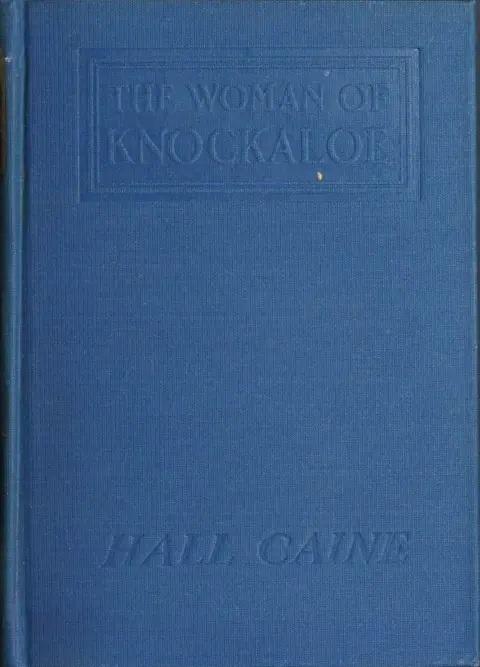
The Woman of Knockaloe: A Parable
Hall, Sir Caine
THE CLASSIC COLLECTION · 1901
"The Eternal City" by Hall Caine is a novel written in the early 20th century. The story delves into the lives of various characters against the backdrop of societal and political turmoil in Rome, particularly focusing on themes of love, sacrifice, and social justice. The characters include a young boy named David Leone, whose poignant backstory intertwines with the central narrative that revolves around the influential figure of David Rossi, an anarchist politician seeking reform. The opening of the book introduces the struggles of a poor, vulnerable boy, David Leone, who finds himself lost in the cold streets of London, reflecting on the despair faced by those in his situation. After being rescued by a kind doctor, the story quickly shifts to a narrative set twenty years later, on the last day of the century, as the Pope's Jubilee attracts a crowd in Rome. As the festivities unfold, we meet various prominent figures, including David Rossi, who plans a significant protest against the injustices faced by the people. The setting and character dynamics are rich with political and emotional complexities, indicating that the novel will address the struggles of the working class and the individual's place within the larger societal framework.
Introduction adapted from the source catalogue; source summaries may be automatically generated.
Free to read · English · 172,155 words · No account needed
MAKE TIME FOR A GOOD BOOK
On by default. Untick to stop anonymous reading totals. Each page counts after 10 seconds in view. How this works.
Anonymous counting is on unless you have switched it off.
The young King, who wore the uniform of a cavalry officer, with sword and long blue cloak, knelt to the Pope and kissed his ring, while the Prime Minister, who was in ordinary civilian costume, bowed deeply, but remained standing.
"Pray sit," said the Pope, seating himself in the gilded arm-chair, with the Capuchin on his left.
The King sat on one of the wooden stools in front of the Pope, but the Baron continued to stand by his side. Between the Pope and the King was a wooden table on which two large candles were burning. The young King was pale, and the expression of his twitching face was one of pain.
"It was good of your Holiness to see us," he said, "and perhaps the gravity of our errand may excuse the informality of our visit."
The Pope, who was leaning forward on the arms of his chair, only bent
his head.
"His Excellency," said the King, indicating the Baron, "tells me he has gained proof of an organised conspiracy against my life, and he says that your Holiness holds the secret of the conspirators."
The Pope, without responding, looked steadily into the face of the young King, who became nervous and embarrassed.
"Not that I'm afraid," he said, "personally afraid. But naturally I must think of others--my family--my people--even of Italy--and if your Holiness...if your...your Holiness..."
The Baron, who had been standing with one arm across his breast, and the other supporting his chin, intervened at this moment.
"Your Majesty," he said, "with your Majesty's permission, and that of his Holiness," he bowed to both sovereigns, "it may be convenient if I state shortly the object of our visit."
The young King drew a breath of relief, and the Pope, who was still
silent, bent his head again.
"Some days ago your Holiness was good enough to warn his Majesty's Government that from private sources of information you had reason to fear that an assault against the public peace was to be attempted."
The Pope once more assented.
"Since then the Government has received corroboration of the gracious message of your Holiness, coupled with very definite predictions of the nature of the revolt intended. In short, we have been told by our correspondents abroad that a conspiracy of European proportions, involving the subversive elements of England, France, and Germany, is to be directed against Rome as a centre of revolution, and that an attempt is to be made to assail constituted society by striking at our King."
"Well, sir?"
Your reading position is saved on this browser. Take it to another device with a library code. Reading pages adapt to text, rather than matching a printed edition.
Hall, Sir Caine
Hall, Sir Caine
Hall, Sir Caine
Hall, Sir Caine
BEHIND THE BOOK
This eBook is for the use of anyone anywhere in the United States and most other parts of the world at no cost and with almost no restrictions whatsoever. You may copy it, give it away or re-use it under the terms of the Project Gutenberg License included with this eBook or online at www.gutenberg.org. If you are not located in the United States, you will have to check the laws of the country where you are located before using this eBook. Read the source licence.
The original source file, including credits and licence, is retained by this library. Request an original-format copy at no charge. Please include the book title and Project Gutenberg identifier #19732.
KEEP YOUR CURIOSITY GOING
Coulson Kernahan

Maurice Baring
Frances Wright
Cécile Tormay

Frederic Jesup Stimson

W. H. P. (William Henry Pope) Jarvis