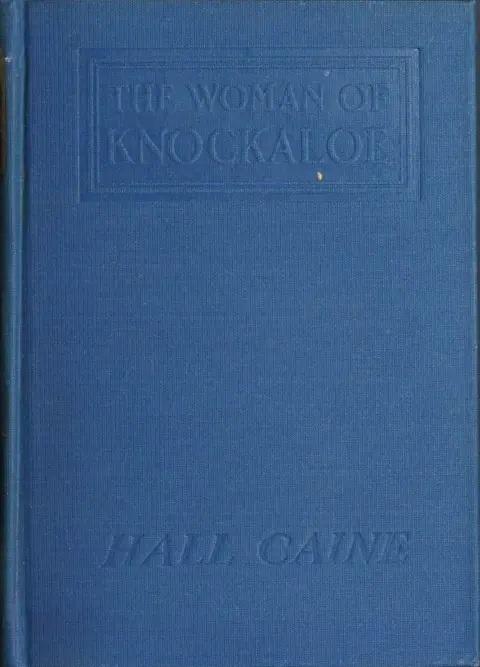
The Woman of Knockaloe: A Parable
Hall, Sir Caine
THE CLASSIC COLLECTION · 1901
"The Eternal City" by Hall Caine is a novel written in the early 20th century. The story delves into the lives of various characters against the backdrop of societal and political turmoil in Rome, particularly focusing on themes of love, sacrifice, and social justice. The characters include a young boy named David Leone, whose poignant backstory intertwines with the central narrative that revolves around the influential figure of David Rossi, an anarchist politician seeking reform. The opening of the book introduces the struggles of a poor, vulnerable boy, David Leone, who finds himself lost in the cold streets of London, reflecting on the despair faced by those in his situation. After being rescued by a kind doctor, the story quickly shifts to a narrative set twenty years later, on the last day of the century, as the Pope's Jubilee attracts a crowd in Rome. As the festivities unfold, we meet various prominent figures, including David Rossi, who plans a significant protest against the injustices faced by the people. The setting and character dynamics are rich with political and emotional complexities, indicating that the novel will address the struggles of the working class and the individual's place within the larger societal framework.
Introduction adapted from the source catalogue; source summaries may be automatically generated.
Free to read · English · 172,155 words · No account needed
MAKE TIME FOR A GOOD BOOK
On by default. Untick to stop anonymous reading totals. Each page counts after 10 seconds in view. How this works.
Anonymous counting is on unless you have switched it off.
"Because here is the hall, and here is the table, and there's not even a curtain between, and the moment the door is opened he is exposed to everybody. People know it, too, and they take advantage. He would give the chicken off his plate if he hadn't anything else. I have to scold him a little sometimes--I can't help it. And as for father, he says he has doubled his days in purgatory by the lies he tells, turning people away."
"That will be his bedroom, I suppose," said the stranger, indicating a door which the boy had passed through.
"No, sir, his sitting-room. That is where he receives his colleagues in Parliament, and his fellow-journalists, and his electors and printers and so forth. Come in, sir."
The walls were covered with portraits of Mazzini, Garibaldi, Kossuth, Lincoln, Washington, and Cromwell, and the room, which had been furnished originally with chairs covered in chintz, was loaded with incongruous furniture.
"Joseph, you've been naughty again! My little boy is all for being a porter, sir. He has got the butt-end of his father's fishing-rod, you see, and torn his handkerchief into shreds to make a tassel for his mace." Then with a sweep of the arm, "All presents, sir. He gets presents from all parts of the world. The piano is from England, but nobody plays, so it is never opened; the books are from Germany, and the bronze is from France, but the strangest thing of all, sir, is this."
"A phonograph?"
"It was most extraordinary. A week ago a cylinder came from the island
of Elba."
"Elba? From some prisoner, perhaps?"
"'A dying man's message,' Mr. Rossi called it. 'We must save up for an instrument to reproduce it, Sister,' he said. But, look you, the very next day the carriers brought the phonograph."
"And then he reproduced the message?"
"I don't know--I never asked. He often turns on a cylinder to amuse the boy, but I never knew him try that one. This is the bedroom, sir; you may come in."
It was a narrow room, very bright and lightsome, with its white counterpane, white bed curtains, and white veil over the looking-glass to keep it from the flies.
"How sweet!" said the stranger.
"It would be but for these," said the woman, and she pointed to the other end of the room, where a desk stood between two windows, amid heaps of unopened newspapers, which lay like fishes as they fall from the herring net.
Your reading position is saved on this browser. Take it to another device with a library code. Reading pages adapt to text, rather than matching a printed edition.
Hall, Sir Caine
Hall, Sir Caine
Hall, Sir Caine
Hall, Sir Caine
BEHIND THE BOOK
This eBook is for the use of anyone anywhere in the United States and most other parts of the world at no cost and with almost no restrictions whatsoever. You may copy it, give it away or re-use it under the terms of the Project Gutenberg License included with this eBook or online at www.gutenberg.org. If you are not located in the United States, you will have to check the laws of the country where you are located before using this eBook. Read the source licence.
The original source file, including credits and licence, is retained by this library. Request an original-format copy at no charge. Please include the book title and Project Gutenberg identifier #19732.
KEEP YOUR CURIOSITY GOING
Coulson Kernahan

Maurice Baring
Frances Wright
Cécile Tormay

Frederic Jesup Stimson

W. H. P. (William Henry Pope) Jarvis