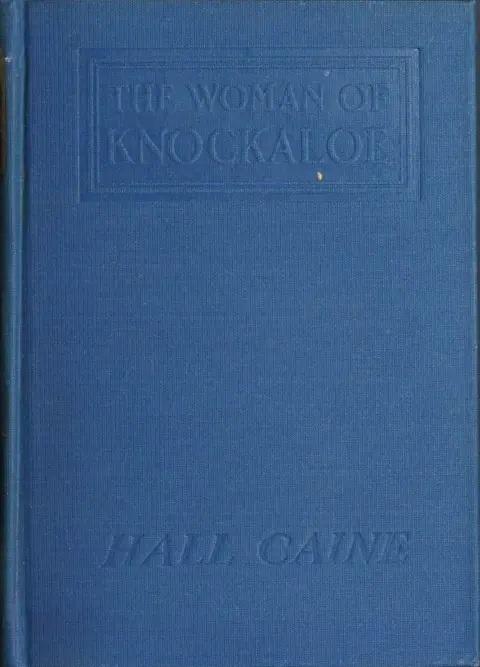
The Woman of Knockaloe: A Parable
Hall, Sir Caine
THE CLASSIC COLLECTION · 1901
"The Eternal City" by Hall Caine is a novel written in the early 20th century. The story delves into the lives of various characters against the backdrop of societal and political turmoil in Rome, particularly focusing on themes of love, sacrifice, and social justice. The characters include a young boy named David Leone, whose poignant backstory intertwines with the central narrative that revolves around the influential figure of David Rossi, an anarchist politician seeking reform. The opening of the book introduces the struggles of a poor, vulnerable boy, David Leone, who finds himself lost in the cold streets of London, reflecting on the despair faced by those in his situation. After being rescued by a kind doctor, the story quickly shifts to a narrative set twenty years later, on the last day of the century, as the Pope's Jubilee attracts a crowd in Rome. As the festivities unfold, we meet various prominent figures, including David Rossi, who plans a significant protest against the injustices faced by the people. The setting and character dynamics are rich with political and emotional complexities, indicating that the novel will address the struggles of the working class and the individual's place within the larger societal framework.
Introduction adapted from the source catalogue; source summaries may be automatically generated.
Free to read · English · 172,155 words · No account needed
MAKE TIME FOR A GOOD BOOK
On by default. Untick to stop anonymous reading totals. Each page counts after 10 seconds in view. How this works.
Anonymous counting is on unless you have switched it off.
"Well, to prevent a recurrence of the disgraceful scene of yesterday, the King has promulgated the Public Security Act by royal decree, and the wonderful crisis is at an end."
"And now?"
"Now the Prime Minister is master of the situation, and has begun by
proclaiming the mass meeting which was to have been held in the
Coliseum."
"Good thing too," said Count Mario. "We've heard enough of liberal
institutions lately."
"And of the scandalous speeches of professional agitators," said Madame
Sella.
"And of the liberty of the press," said Senator Palomba. And then the effeminate old dandy, the fashionable dressmaker, and the oily little Mayor exchanged significant nods.
"Wait! Only wait!" said Roma, in a low voice, to Rossi, who was standing
in silence by her side.
"Unhappy Italy!" said the American Ambassador. "With the largest array of titled nobility and the largest army of beggars. The one class sipping iced drinks in the piazzas during the playing of music, and the other class marching through the streets and conspiring against society."
"You judge us from a foreign standpoint, dear friend," said Don Camillo, "and forget our love of a pageant. The Princess says our poor are always demonstrating. We are all always demonstrating. Our favourite demonstration is a funeral, with drums beating and banners waving. If we cannot have a funeral we have a wedding, with flowers and favours and floods of tears. And when we cannot have either, we put up with a revolution, and let our Radical orators tell us of the wickedness of taxing the people's bread."
"Always their bread," said the Princess, with a laugh.
"In America, dear General, you are so tragically sincere, but in Italy we are a race of actors. The King, the Parliament, the Pope himself...."
"Shocking!" said the little Princess. "But if you had said as much of our professional agitators...."
"Oh, they are the most accomplished and successful actors, Princess. But we are all actors in Italy, from the greatest to the least, and the 'curtain' is to him who can score off everybody else."
"So," began the American, "to be Prime Minister in Rome...."
"Is to be the chief actor in Europe, and his leading part is that in which he puts an end to his adversary amidst a burst of inextinguishable laughter."
"What is he driving at?" said the English to the American Ambassador.
"Don't you know? Haven't you heard what is coming?" And then some
further whispering.
"Wait, only wait!" said Roma.
Your reading position is saved on this browser. Take it to another device with a library code. Reading pages adapt to text, rather than matching a printed edition.
Hall, Sir Caine
Hall, Sir Caine
Hall, Sir Caine
Hall, Sir Caine
BEHIND THE BOOK
This eBook is for the use of anyone anywhere in the United States and most other parts of the world at no cost and with almost no restrictions whatsoever. You may copy it, give it away or re-use it under the terms of the Project Gutenberg License included with this eBook or online at www.gutenberg.org. If you are not located in the United States, you will have to check the laws of the country where you are located before using this eBook. Read the source licence.
The original source file, including credits and licence, is retained by this library. Request an original-format copy at no charge. Please include the book title and Project Gutenberg identifier #19732.
KEEP YOUR CURIOSITY GOING
Coulson Kernahan

Maurice Baring
Frances Wright
Cécile Tormay

Frederic Jesup Stimson

W. H. P. (William Henry Pope) Jarvis