
Switch off
Oliver Optic
THE CLASSIC COLLECTION · 1896
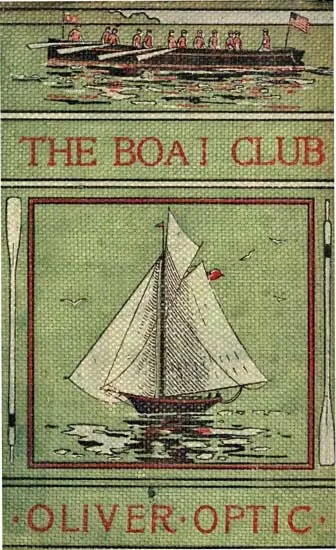
"The Boat Club; or, The Bunkers of Rippleton" by Oliver Optic is a novel written in the late 19th century. Targeted primarily at young readers, the narrative centers around themes of friendship, moral decisions, and the joys of outdoor adventures. The story particularly follows Frank Sedley and his friends as they navigate their relationships while engaging in club activities centered around boating on Wood Lake. The beginning of the book introduces us to Frank Sedley and his friend Charles Hardy during the lead-up to the Fourth of July. As they discuss their plans for the celebration, Frank contemplates using their saved money to help a local widow and her children instead of spending it on fireworks and treats. Their decision to support the widow highlights their growing sense of responsibility and compassion. The initial chapters establish the boys' characters, their strong friendship, and their diverse backgrounds, ultimately paving the way for their involvement with the titular boat club and the adventures that await them on the lake.
Introduction adapted from the source catalogue; source summaries may be automatically generated.
Free to read · English · 46,119 words · No account needed
MAKE TIME FOR A GOOD BOOK
On by default. Untick to stop anonymous reading totals. Each page counts after 10 seconds in view. How this works.
Anonymous counting is on unless you have switched it off.
"Can't we have a race with him?" asked Charles Hardy.
"Sartin, if you like. There is a fresh breeze springing up."
The boys waited patiently until Captain Sedley reached the spot.
"How do you like your craft, boys?" asked he, as he threw his boat up into the wind, alongside the Zephyr.
"First-rate!" they exclaimed with one voice.
"Three cheers for Captain Sedley," cried Tony Weston, taking off his cap and swinging it round above his head. "One!"
"Hurrah!"
"Two!"
"Hurrah!"
"Three!"
"Hurrah!" and the boys all clapped their hands for several moments.
Captain Sedley took off his hat, and politely returned his acknowledgments. When boys get to cheering, they hardly know where to stop; and when Fred Harper proposed three for Uncle Ben, there was a prompt and hearty response to the call.
"I'm much obleeged to you, boys, for the compliment," said the veteran, pulling off his tarpaulin.
"Now for the race," cried Charles.
Uncle Ben explained the wishes of the boys to Captain Sedley; and he readily agreed to a trial of speed, with the remark that he should expect to be beaten.
"Let me get my boat under good headway before you start," continued he, as he hauled aft his jib-sheet, and brought the boat before the wind.
The boat's crew waited till he had got nearly the eighth of a mile from them, and then, with all the forms, the Zephyr got under way. Uncle Ben had taught them to keep time in rowing by the swaying back and forth of the coxswain's body.
"Don't get excited, boys; the wind is freshening," said Uncle Ben.
"Steady, now."
The Zephyr darted like an arrow through the water under the impetus of the twelve oars. Frank, in his anxiety to win the race, began to sway to and fro so rapidly that Uncle Ben was obliged to caution him several times to keep cool.
"We are overhauling him very rapidly," said he; "if you pull regular, and save your strength, you will pass him before you get half way to the beach. Steady, Frank; don't hurry them."
The boys pulled steadily; and, as the old sailor had predicted, they passed Captain Sedley's boat long before they came to the beach. As the Zephyr shot past him, a long, loud cheer burst from her crew.
"Isn't this fun!" exclaimed Charles Hardy.
"Glorious!" replied Phil Barker, who was at the next oar before him.
"What do you think the Bunkers would say if they should see us about
this time?"
"Wouldn't they stare!"
"Way enough!" said Frank; and the boys ceased rowing, while the boat continued to shoot through the water with scarcely diminished velocity.
Your reading position is saved on this browser. Take it to another device with a library code. Reading pages adapt to text, rather than matching a printed edition.
BEHIND THE BOOK
This eBook is for the use of anyone anywhere in the United States and most other parts of the world at no cost and with almost no restrictions whatsoever. You may copy it, give it away or re-use it under the terms of the Project Gutenberg License included with this eBook or online at www.gutenberg.org. If you are not located in the United States, you will have to check the laws of the country where you are located before using this eBook. Read the source licence.
The original source file, including credits and licence, is retained by this library. Request an original-format copy at no charge. Please include the book title and Project Gutenberg identifier #24557.
KEEP YOUR CURIOSITY GOING
Coulson Kernahan

Maurice Baring
Frances Wright
Cécile Tormay

Frederic Jesup Stimson

W. H. P. (William Henry Pope) Jarvis
