
Switch off
Oliver Optic
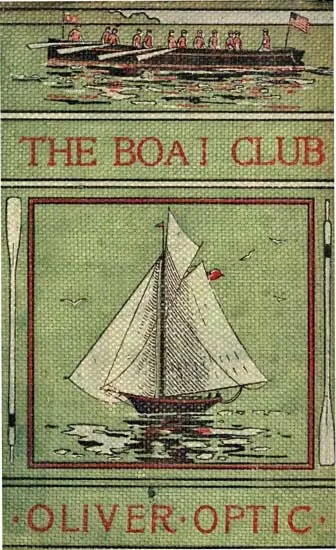
THE CLASSIC COLLECTION · 1896
"The Boat Club; or, The Bunkers of Rippleton" by Oliver Optic is a novel written in the late 19th century. Targeted primarily at young readers, the narrative centers around themes of friendship, moral decisions, and the joys of outdoor adventures. The story particularly follows Frank Sedley and his friends as they navigate their relationships while engaging in club activities centered around boating on Wood Lake. The beginning of the book introduces us to Frank Sedley and his friend Charles Hardy during the lead-up to the Fourth of July. As they discuss their plans for the celebration, Frank contemplates using their saved money to help a local widow and her children instead of spending it on fireworks and treats. Their decision to support the widow highlights their growing sense of responsibility and compassion. The initial chapters establish the boys' characters, their strong friendship, and their diverse backgrounds, ultimately paving the way for their involvement with the titular boat club and the adventures that await them on the lake.
Introduction adapted from the source catalogue; source summaries may be automatically generated.
Free to read · English · 46,119 words · No account needed
MAKE TIME FOR A GOOD BOOK
On by default. Untick to stop anonymous reading totals. Each page counts after 10 seconds in view. How this works.
Anonymous counting is on unless you have switched it off.
Captain Sedley reached the depot just in time to take the two-o'clock train; and the club returned to Centre Island, where another hour was spent very pleasantly in listening to the music of the band, and in such amusements as the ingenuity of boys can devise.
But at last they grew tired of the land. The beautiful Zephyr, resting so lightly and gracefully on the water, seemed to invite them to more congenial sports.
"Mother, won't you let us row you round the lake?" asked Frank. "We want to go on an exploring voyage."
"With pleasure; but the band is engaged for all the afternoon."
"Can't we take them in the boat?"
"I'm afraid it is not large enough; there are thirteen musicians."
"That would be first-rate--music on the water!" exclaimed Charles
Hardy.
"What do you think, Uncle Ben?" asked Mrs. Sedley.
"I don't think it would be safe, marm."
"I am afraid not."
"Oh, yes, it would!" cried Charles, disappointed at the thought of
resigning the plan.
"There is not room enough in the Zephyr for them. But there's a little breeze springing up, and I'll take them in the sailboat."
"That will do just as well," replied Mrs. Sedley.
"But you can't keep up with us, Uncle Ben," said Charles.
"Then you must go slower."
"Zephyrs, ahoy!" cried Frank.
The club hastened to the boat, and seated themselves. The musicians found ample room in the large sailboat.
"Stop a minute, mother, till we go about and bring the stern in shore," said Frank, as he gave the word to elevate the oars.
Uncle Ben and his party had already got under way, and the band commenced playing "Wood Up," as the sailboat slowly gathered headway.
The Zephyr backed in, and Mrs. Sedley and Mary Weston were assisted to their seats by the gallant young coxswain.
"Give way!" said Frank; and the club boat shot out from the land.
"How fine the music sounds on the water!" said Mary.
"Beautiful," replied Mrs. Sedley. "I am sorry your mother is not with
us, Mary."
"She could not come before dinner."
"Would she join us now, do you think?"
"I guess she would."
"We can go and see, at any rate," said Frank. "Uncle Ben is steering
that way."
"Do, Frank; I have something I wish to say to her."
"Bunkers!" exclaimed Fred Harper.
"Where?"
"Coming up from Rippleton."
"I hope they will keep away from us," added Frank, whose forenoon experience was still remembered.
"They will want to hear the music."
"You must keep near Uncle Ben, Frank."
The Zephyr was rapidly approaching the Sylph, as the sailboat was
called.
Your reading position is saved on this browser. Take it to another device with a library code. Reading pages adapt to text, rather than matching a printed edition.
BEHIND THE BOOK
This eBook is for the use of anyone anywhere in the United States and most other parts of the world at no cost and with almost no restrictions whatsoever. You may copy it, give it away or re-use it under the terms of the Project Gutenberg License included with this eBook or online at www.gutenberg.org. If you are not located in the United States, you will have to check the laws of the country where you are located before using this eBook. Read the source licence.
The original source file, including credits and licence, is retained by this library. Request an original-format copy at no charge. Please include the book title and Project Gutenberg identifier #24557.
KEEP YOUR CURIOSITY GOING
Coulson Kernahan

Maurice Baring
Frances Wright
Cécile Tormay

Frederic Jesup Stimson

W. H. P. (William Henry Pope) Jarvis
